Environment Magazine has published new research today that finds that the greenhouse gas emissions derived from military use of oil is worse than previously thought. University of Nebraska professors, Adam Liska and Richard Perrin write in the article, Securing Foreign Oil: A Case for Including Military Operations in the Climate Change Impact of Fuels, “we assert that military activity to protect international oil trade is a direct production component for importing foreign oil—as necessary for imports as are pipelines and supertankers—and therefore the greenhouse gas (GHG) emissions from that military activity are relevant to U.S. fuel policies related to climate change.”
Other areas that may be considered tied to military production of GHG emissions are the global protection of oil reserves and Middle Eastern wars.

The authors note that as part of the Energy Independence and Security Act of 2007, specific GHG emission reductions must be met by biofuels including direct life cycle emissions as well as indirect emissions; however, in current legislation, only the direct GHG emissions are accounted for when calculating life cycle emissions of gasoline production. Therefore, the authors wanted to understand how military emissions affect the total amount of GHG emissions of gasoline. What they discovered is that direct spending on military activity and military acquisition of oil results in the release of nearly 289,000 tons of carbon dioxide per billion dollars spent.
To get a handle on the billions of dollars spent just on the Iraq War, the U.S. Congressional Research Service report estimated that the average annual cost of the Iraq War has been $93.5 billion.
Ultimately, the authors conclude, “In order to have a balanced assessment of the climate change impacts of substituting biofuels for gasoline, a comparison of all direct and indirect emissions from both types of fuel is required.”
Several ethanol organizations came out in support of the report today including Growth Energy who reiterated the environmental costs associated with our dependence on foreign oil and the Renewable Fuels Association who heralded the study as “groundbreaking”.
 In a press conference this morning, representatives from the American Meat Institute (AMI), Environmental Working Group (EWG), Grocery Manufacturers Association (GMA), Natural Resources Defense Council (NRDC) and Taxpayers for Common Sense together said that the tax credit should be eliminated at the end of this year when it expires, and the corresponding tariff on imported ethanol should also be ended.
 A partnership between the
  “The opportunity to educate foreign buyers about high quality, U.S.-produced DDGS could not come at a better time,” said RFA President Bob Dinneen. “At current dietary inclusion levels, distillers grains consumption is nearing saturation in the United States. Increasing U.S. exports of distillers grains will be instrumental in helping the industry avoid running into a ‘feed wall.’ Fortunately, markets around the world are rapidly opening, creating demand for approximately 15 to 20 percent of all distillers grains produced today.”
  “We are excited to have the Renewable Fuels Association co-sponsor the Export Exchange 2010,” said USGC President and CEO Thomas C. Dorr. “The burgeoning world population is demanding more meat, milk and eggs. U.S. DDGS and coarse grains continue to play an important role in livestock and poultry feed rations globally. We have to educate and connect our buyers and sellers to continue to grow vital markets for the United States.”
  The agreement between
 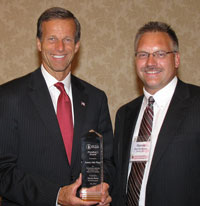 Members of the National Corn Growers Association meeting for their annual Corn Congress in the nation’s capitol made the VEETC extension a priority when they talked to their senators and representatives. NCGA President Darrin Ihnen says corn growers believe extension of the VEETC is vital to the industry. “As our board and voting delegates visited with members of Congress this week it was apparent that time is short and extension is in the best interests of the corn industry,” said Ihnen.

 I conducted a number of interviews with presenters at the recent