ACE Conference 2026

DuPont Acquiring Danisco in $6.3B Deal

Joanna Schroeder

DuPont Dansico has been in a multi-year powerhouse partnership to develop cellulosic ethanol. Today, DuPont has announced that it has entered into an agreement to acquire Danisco, a global enzyme and specialty food ingredients company to the tune of $5.8 billion along with the assumption of $500 million of Danisco net debt for a total of $6.3 billion. Once the ink dries on the deal, DuPont believes it will position them as a clear leader in industrial biotechnology with “science-intensive innovations” that will address two major global challenges: food and fuel.

“Danisco is a premier company, a long-time successful partner of DuPont and a proven innovator committed to sustainable growth,” said DuPont Chair and CEO Ellen Kullman. “Danisco has attractive, market-driven science businesses that offer clear synergies with DuPont Nutrition & Health and Applied BioSciences. This transaction is a perfect strategic fit with our growth opportunities and will help us solve global challenges presented by dramatic population growth in the decades to come, specifically related to food and energy.”

Kullman continued, “In addition, biotechnology and specialty food ingredients have the potential to change the landscape of industries, such as substituting renewable materials for fossil fuel processes and addressing food needs in developing economies, that will generate more sustainable solutions and create growth for the company.”

According to information from DuPont, the acquisition is to be financed with approximately $3 billion in existing cash and the remainder in debt. The purchase is expected to close early in second quarter of this year and be cash and earning accretive in 2010, the first full year of the combined entity. As a result of the purchase, DuPont has set its 2011 earnings per share outlook at a range of $3.30 to $3.60 per share and the impact of this transaction is anticipated to reduce the outlook between $.30 – $.45 per share on a reported basis.

“Danisco has two well-positioned global businesses that strongly complement our current biotechnology capabilities, R&D pipeline, and specialty food ingredients, a combination that offers attractive long-term financial returns,” said Killman. “This also would create new opportunities across other parts of the DuPont portfolio, including traditional materials science offerings.”

Today, Danisco has nearly 7,000 employees globally with operations in 23 countries. The transaction is subject to customary closing conditions, including certain regulatory approvals and the tender of more than 90 percent of the Danisco shares in the tender offer.


Cellulosic, Company Announcement, Ethanol, Ethanol News

High Oil Prices Threaten To Topple Tipsy Economy

Joanna Schroeder

High oil prices threaten to topple a tipsy global economy that is still fragile and has yet to find stable ground according to the International Energy Agency (IEA) who issued a wakeup call to the world. The IEA recommends that high oil-consuming countries, such as the U.S., boost efforts to cut back on oil use.

In response to these warnings, Bliss Baker, the spokesperson for the Global Renewable Fuels Alliance (GRFA) stated, “These sky-rocketing crude oil prices are already having an impact on other commodity prices and food inflation. The IEA’s warnings should be a wakeup call to all countries to reduce our crippling reliance on crude oil. The European Union’s oil imports alone grew by $70 billion last year.”

Also announced last week by the UN Food and Agricultural Organization (FAO) was that the Food Price Index has surpassed 2008 levels. The cause of these spikes, in part, is the increase in world energy prices, although many today are still blaming the increase in food costs on countries’ biofuel policies.

A 2008 report by the United Kingdom’s Department of Environment, Food and Rural Affairs and cited by the GRFA concluded that crude oil prices were a major factor behind the food price spikes. The report concluded, “the rapid increase in global energy prices increased the cost of agricultural inputs, especially fertilizers, so increasing the cost-base of agricultural producers, particularly in the cereals and oilseeds sector.”

Said Baker, “The GRFA issued its own warning with regards to rising oil prices and its effect on food in September 2010. This latest IEA warning and FAO report should encourage us all to reduce our reliance on oil. These food price spikes will continue unless we make concerted efforts to develop alternatives to crude oil like ethanol and biodiesel.”

Baker concluded, “The GRFA has long advocated that biofuels are the best way to reduce our reliance on conventional oil. Even OPEC said in a recent forecast that ‘energy efficiency policies along with the use of biofuel will put downward pressure on oil consumption worldwide’. As we have seen today from the IEA warnings and the UN FAO report, we are increasingly vulnerable to soaring crude oil prices,” said Baker.

Biodiesel, Ethanol, International, Oil

Soybean Checkoff Supports Biodiesel Promotion

Cindy Zimmerman

The United Soybean Board (USB) has recommitted itself to the support of biodiesel through the soybean checkoff program.

USB chairman Marc Curtis, a producer from Mississippi, and National Biodiesel Board chairman Gary Haer held a joint press conference at AG CONNECT Expo this past weekend to discuss the importance of biodiesel to the soybean industry. “We have research that shows over the last 4-5 years, biodiesel has contributed about 25 cents a bushel to the farm gate price of soybeans,” Curtis said. “So when you multiply 25 cents times several billion bushels, that makes a pretty good return on investment from the $30-40 million that have been invested from farmers’ checkoff money in the biodiesel industry.”

Listen to an interview with Marc Curtis here: Marc Curtis

USB is investing in an outreach effort by the biodiesel industry to spread the word that biodiesel is the only commercially available advanced biofuel. “It’s here today, it’s available now,” said Haer. “We have 1.4 billion gallons of production capability and we just need to get it going.”

Haer is vice president of sales and marketing for REG (Renewable Energy Group), the nation’s largest biodiesel producer, and he is very optimistic about the future now that the biodiesel tax credit has been extended retroactively and through 2011. He is also looking forward to a more upbeat National Biodiesel Conference in Phoenix next month.

Listen to an interview with Gary Haer here: Gary Haer

2011 AG CONNECT Expo Photo Album

Biodiesel, NBB

Wesley Clark at AG CONNECT Expo

Cindy Zimmerman

Retired General Wesley Clark visited the second AG CONNECT Expo Saturday in Atlanta to talk with farmers and ranchers visiting the event about the importance of ethanol to our nation’s security.

Representing Growth Energy, Clark greeted folks at the CASE IH exhibit on the floor of the agricultural trade show. He also made time for some media interviews to talk about ethanol issues, like what he thinks will happen with ethanol policy this year in Congress. “We need to be thinking ahead about how to fix America’s dependence on foreign oil,” Clark said. “We probably are going to need some incentives for service station owners to invest in blender pump technology and that can be done by giving them some of the credit that is being given right now to the blender itself.” So Growth will probably support some kind of a split in the current tax incentive structure to give some for infrastructure.

Clark also talks about EPA’s rule on E15. “Ethanol is not poison at E15,” he said. “So we need to be sensitive in terms of labeling. We want consumers whose cars can take E15 to use it. It’s good for America. And I think we’re going to win that discussion.”

Listen to my interview with Wesley Clark here: Wesley Clark

2011 AG CONNECT Expo Photo Album

Audio, Ethanol, Farm Bureau, Growth Energy

Ethanol All The Way In NASCAR

Chuck Zimmerman

AG CONNECT ExpoKenny Wallace, NASCAR driver, says, “Ethanol all the way in NASCAR!” That’s what he told me this afternoon in the American Farm Bureau Federation Pavilion on the floor of the AG CONNECT Expo. Thanks to Tricia Braid, Illinois Corn Growers, for setting up our interview and taking the photo. Kenny was signing autographs in the Nationwide Insurance exhibit.

You won’t find a bigger supporter of the American farmer and in particular that farm made fuel, ethanol. NASCAR is using E15 now and Kenny finds that exciting. Family farmers have supported Kenny recently and will be doing so in a bigger way in the future. He says that he wants farmers to know that he’s helping get their message out to the public. Kenny says he’s had a chance to run a combine and is amazed at the technology built into them! Here’s where you can follow Kenny on Twitter.

You can listen to my interview with Kenny here: Interview With Kenny Wallace

2011 AG CONNECT Expo Photo Album

Audio, Ethanol, Ethanol News, NASCAR, Racing

Biodiesel One of the Keys in Heating Oil Biz in 2011

John Davis

The use of biodiesel in heating oil, better known as Bioheat, will be one of the key stories for the heating oil business in 2011.

HeatingOil.com reports the green fuel for warm living will be in the top five stories for the new year:

Biodiesel-blended heating oil (also known by its trademarked brand name, Bioheat) continued to make its way to residential fuel tanks around the country in 2010, and is poised to continue its spread it 2011. Just last month, the biodiesel industry scored two huge victories: the rejection of the refining industry’s legal challenge to the national Renewable Fuels Standard and the reinstatement of the $1-per-gallon tax credit for biodiesel producers. With this support, the biodiesel industry is starting 2011 in a position of strength, which will probably mean increasing numbers of heating oil users gaining access to biodiesel heating oil, which could make 2011 the year that biodiesel heating oil really takes off.

While bioheat alone is the number three story of the year, it will have its fingers in the pies of all the other top 5 heating oil stories in 2011, including 1. Economic recovery and the price of crude; 2. New commodity trading regulations; 4. Low-sulfur requirements; and 5. The battle over US greenhouse gas emissions regulation.

Biodiesel

OriginOil CEO: 2011 Year of Algae Bio-based Chemicals

John Davis

This year will be the year of bio-based chemicals made from algae … that according to the CEO of OriginOil, algae-to-biofuel maker.

Riggs Eckelberry made the prediction on MoneyTV, an internationally-syndicated weekly business television program.

“2011 is the year of biochemicals made from algae.”

OriginOil on MoneyTV, 6 Jan 2011 from OriginOil on Vimeo.

Eckelberry says some major players in the algae-based biochemical business have received funding, especially in the plastics field. He says utilities will also be a big catalyst behind the growth of algae use.

“A power plant is never going to grow algae. They make power. So, for them, it doesn’t work unless an integrator that comes in and does all the engineering and operation. And those are the key players that are going to come into the market.”

Eckelberry points out all the things that use petroleum, such as plastics and fuels, can be substituted with the renewable oil from algae. Plus, the algae can also be used as a nutritional item.

He adds that his own company will be focusing on the oil extraction from algae process.

algae, biochemicals, biofuels, Video

Ethanol Alone Can’t Meet Renewable Fuel Goals

Joanna Schroeder

The U.S. is at the “blending wall” saturation point for ethanol use according to a new Purdue University study. The cause is lack of infrastructure to meet the federal mandate for renewable fuel use with ethanol, but the country could still meet the standard with significant increases in next-generation biofuels and cellulosic fuels.

Wally Tyner, the James and Lois Ackerman Professor of Agricultural Economics, and co-authors Frank Dooley, a Purdue professor of agricultural economics, and Daniela Viteri, a former Purdue graduate student, used U.S. Department of Energy and Environmental Protection Agency data to determine that without new technology or a significant increase in infrastructure, the country will not be able to consume more ethanol than is being currently produced.

This is not new news to an ethanol industry that has been struggling to overcome the blend wall hurdles for years. In fact, the E15 waiver, allowing conventional vehicles and light duty trucks to use 15 percent ethanol, is just one step, of many, to push the country in the right direction of overcoming the blend wall. Last year RFS required approximately 13 billion gallons of renewable fuel, the amount that Tyner predicts is the threshold for U.S. infrastructure and consumption ability. The RFS number for this year is even higher at 13.95 billion for ethanol.

“You can’t get there with ethanol,” said Tyner, whose findings were published in the December issue of the American Journal of Agricultural Economics.

Some of the “blend wall problems” include lack of flex-fuel vehicles (FFVS) that can use higher blends of ethanol up to E85 as well as not enough stations offering these same higher blends of ethanol. Then once you get the stations, Tyner said there is no way to distribute it. “We would need to install about 2,000 pumps per year through 2022 to do it. “You’re not going to go from 100 per year to 2,000 per year overnight. It’s just not going to happen.”

And then there’s the price issue. Even if the fuel were readily available, E85 would have to be priced right because of the lower mileage. For example, if gasoline were $3 per gallon, E85 would have to be $2.34 per gallon to break even on mileage.

So one way to meet the standards with current limitations are advances in the production of thermo-chemical biofuels, which are created by using heat to chemically alter biomass and create fuels. These fuels are also known as “drop-in fuels” because there is no infrastructure changes needed to blend the fuel, such as is the case with ethanol.

Tyner concluded, “Producing the hydrocarbons directly doesn’t have the infrastructure problems of ethanol, and there is no blend wall because you’re producing gasoline. If that comes on and works, then we get there. There is significant potential to produce drop-in hydrocarbons from cellulosic feedstocks.”

blends, Ethanol, Ethanol News, Research

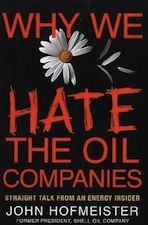
Book Review – Why We Hate The Oil Companies

Joanna Schroeder

Two, four, six, eight, who do we love to hate? The oil companies!

Despite my story lead, I was not a cheerleader in another life but I couldn’t get that cheer out of my head while I read this week’s book, “Why We Hate The Oil Companies Straight Talk From An Energy Insider,” by John Hofmeister. I recently gave Mr. Hofmeister some ink when he predicted that the country would see $5 per gallon of gas within the next 10 years so I thought, hey, I should read his book. See what’s he’s all about. He is, after all, the former president of Shell Oil Company.

What is Hofmeister all about? Bringing affordable, clean and sustainable energy to all Americans. He writes, “The truth is that affordable energy is essential for American economic growth. It is essential for our national security and position in world leadership. And it is necessary to maintain our quality of life.” He continues by saying affordable energy and environmental sustainability are challenges that require immediate attention.

Who is in charge of leading the way to affordable energy?  The oil and utility companies? Government? American Citizens? The answer is not so black and white as Hofmeister explains. No one believes the oil companies – they are ranked 24 out of 24 in the industry “Who do you trust” poll and the government is ranked at 22. Not swell by any standards. Then we have American citizens who have been fed “information, misinformation and no information” and they are still electing politicians who have spent 40 years not making good energy policy decisions. We Americans have bad voting histories.

So what do we have? Hofmeister says “there is an energy shortage, but there is no shortage of energy.”Read More

biofuels, book reviews, Ethanol, Geothermal, Natural Gas, Oil, Solar, Wind

Velasco Leaves UNICA for Amyris

Cindy Zimmerman

UNICAThe Brazilian Sugarcane Industry Association (UNICA) announced today that Joel Velasco, the organization’s Washington, DC-based Chief Representative for North America, is leaving the position he has held since 2007, to join Amyris, Inc., as Senior Vice-President, External Relations.

“Joel has provided UNICA with wise counsel, effective strategy and solid results. We wish him well at Amyris and will continue cooperating in the future, as we pursue what will often be common objectives,” said UNICA CEO Marcos Jank. Velasco will remain an informal advisor to UNICA on matters related to U.S. biofuels policy.

Joel Velasco“I have been honored to represent such a transformative industry at a particularly pivotal period. I am confident that our international successes over these last three years will yield dividends not only to UNICA member companies but to the communities they serve for years to come. As I embark on a new challenge with Amyris, I look forward to supporting UNICA’s trailblazing work to promote an even more vibrant sugarcane industry in Brazil and beyond,” added Velasco.

Amyris is an integrated renewable products company based in Emeryville, California. Subsidiaries include Amyris Brasil S.A., a majority-owned Brasilian company and Amyris Fuels, LLC, a wholly-owned subsidiary for U.S. fuels distribution capabilities.

With Velasco’s departure, UNICA’s activities in Washington will be carried out by Leticia Phillips and Ana Carolina Lessa. The organization’s international activities will continue to be overseen by UNICA’s Senior Advisor for International Affairs, Geraldine Kutas, based in Brussels.

Brazil, Ethanol, Ethanol News, UNICA