

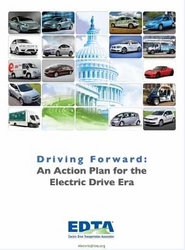
 The Electric Drive Transportation Association (EDTA) has released an action plan to help accelerate the growth of hybrid, plug-in, battery and fuel cell vehicles in the U.S. “Driving Forward: An Action Plan for the Electric Drive Era,” encourages public-private sector collaboration, encourages electric vehicle (EV) infrastructure development and outlines policies to speed up EV adoption.
“The nation is at an energy policy crossroads. Electric drive technologies – those available today and those on the horizon – can help the U.S. increase its energy security, spend more of its energy dollars domestically, expand competitiveness and create jobs – while creating a healthier environment, “ said EDTA President Brian Wynne. “The policies we are recommending will accelerate the opening of the electric drive era and ensure U.S. leadership in the effort.”
EDTA’s next-step policy recommendations will:
- * Reduce market hurdles to speed deployment of electric drive vehicles.
- * Educate consumers, communities and stakeholders about these new vehicles and charging options.
- * Ensure U.S. leadership in electric drive manufacturing.
- * Standardize regulatory policies for electric drive vehicles and infrastructure.
- * Accelerate technology breakthroughs.
Many experts believe that within the next 40 years, EV’s could have a solid hold on the marketplace. But to get there, more policies will need to be put in place to ensure both the infrastructure is in place as well as a variety of vehicles are available and on the road. EDTA is specifically recommending policies that will ensure these two things happen at an accelerated pace.
Other barriers to greater EV adoption include price and the EDTA encourage polices that will aid consumers in the purchase of EVs. These policies will also help manufacturers reach economies of scale in vehicle and component production, a necessity to drive down costs. In addition the plan call for legislation that will help the U.S. keep its current competitive advantage, which also keeps manufacturing and R&D jobs in the U.S., and finally the action plan asks for more coordination between regulators, technology leaders and stakeholders to ensure growth.





 “EPA’s decision today is a sound one, but it doesn’t address the issues that still remain regarding a segmented market place and the introduction of a new fuel,” said RFA President Bob Dinneen. “The RFA will continue to work with EPA and other regulatory bodies to expand ethanol use beyond even 15%. Simultaneously, we will continue our dialogue with lawmakers to develop and implement sound, tax-based policies that provide the proper incentives to grow ethanol use across a variety of blending levels.”
  “Today’s decision greenlights the use of E15 for nearly two out of every three cars on the road today and furthers proves ethanol is a safe, effective fuel choice for American drivers,” said Renewable Fuels Association President Bob Dinneen. “EPA continues to move in the right direction with respect to increasing ethanol blends, but challenges still remain. The RFA continues to urge EPA to extend the waiver for E15 use to all cars and pickups.”
  Brian Jennings, Executive Vice President of the American Coalition for Ethanol (ACE), says the move is another important step in making more renewable fuel choices available to consumers. “ACE continues to be confident that the scientific evidence proves E15 is safe and reliable for all cars, and is disappointed that EPA continues to insist of this confusing model-year division, especially when models earlier than 2000 are being excluded without scientific evidence of any issues with using E15 in those vehicles,” said Jennings. “We are pleased with this positive step, but remain concerned about the unnecessary confusion that will unfortunately be caused by EPA’s piecemeal, partial-waiver approach.”
 The U.S. Environmental Protection Agency (EPA) today waived a limitation on selling gasoline that contains more than 10 percent ethanol for model year (MY) 2001 through 2006 passenger vehicles, including cars, SUVs, and light pickup trucks. The waiver applies to fuel that contains up to 15 percent ethanol – known as E15. EPA Administrator Lisa P. Jackson made the decision after a review of the Department of Energy’s thorough testing and other available data on E15’s effect on emissions from MY 2001 through 2006 cars and light trucks.