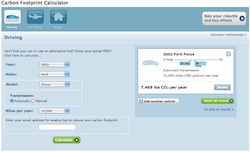
 Ever wonder how much carbon dioxide (CO2) you are emitting when you drive? How about when you’re driving an electric vehicle (EV)? Well, technically EVs don’t emit CO2 but there is CO2 emitted during the process of creating the electricity used to “charge up” the batteries. There is an online tool helps people calculate their greenhouse gas emissions (GHGs) from flying, driving and home energy use. Now this tool created by TerraPass makes it possible to calculate your GHGs from driving all electric vehicles.
Using the U.S. EPA’s figures, the TerraPass calculator uses the “miles per gallon-equivalent” figure shown on vehicle sales stickers as an input to its calculations. Since EVs don’t use gasoline, a “gallon-equivalent” was determined to be 33.7 kilowatt-hours, the quantity of stored electrical energy equivalent to the energy stored in one gallon of gasoline. For example, the EPA rates the all-electric Nissan Leaf at 99 miles per gallon-equivalent.
Not driving an electric vehicle? The calculator also works for those driving all gas cars, ethanol or biodiesel fueled vehicles and even those running on compressed natural gas. In these situations, the driver enters the miles per gallon (or gallon-equivalent) from their own driving experience or from the numbers published by the EPA. They also drive the number of miles they drive each year, and walla, you know now have many GHG’s you’re spewing out.
The calculator update also provides emissions estimates for all 2011-model cars on sale nationwide. This makes the TerraPass calculator the most comprehensive U.S. vehicle calculator available. While many calculators use EPA data, the EPA’s public dataset contained substantial errors and omissions this year.
“For literally hundreds of car models, we went back to source data and either corrected or supplemented the EPA dataset,” said Erin Craig, TerraPass’ CEO. “Our customers were helpful in road-testing our calculator to make sure we got it right.”
 Here is a quick look at a few of the most fuel-efficient vehicles provided the following figures (lbs of CO2 per year with 12,000 miles driven):
Toyota Prius: 4,661 lbs CO2
Lexus CT 200h: 5,549 lbs CO2
Nissan Leaf: 5,588 lbs CO2
Honda Civic Hybrid: 5,684
Honda CR-Z: 6,298 lbs CO2
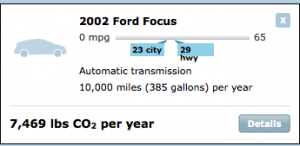
Ready to try out your own vehicle? I did and the pic included is of my GHG emissions. Now try it for yourself.


 Never thought there would be a biofuels angle to the Royal Wedding, but as the Duke and Duchess of Cambridge left Buckingham Palace for the royal residence Clarence House, they drove off in a “convertible Aston Martin Volante DB6 MKII in Seychelles blue is owned by his father HRH The Prince of Wales” that runs on 85 percent ethanol.