

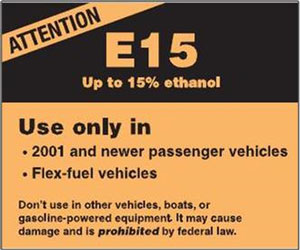
 Groups representing small engine, automakers and marine manufacturers announced a formal legal challenge to regulations and labeling proposed for the use of 15% ethanol blends (E15) in older model vehicles.
The Outdoor Power Equipment Institute (OPEI) and other organizations object to the Environmental Protection Agency’s “Regulation to Mitigate Misfueling” rule and labeling proposal meant to address concerns about improper use of E15, calling them “completely inadequate to protect consumers and avoid potential misfueling and damage to millions of legacy products not designed to run on any ethanol fuel higher than E10.”
Officials with the Renewable Fuels Association dismissed the groups’ new litigation, which would prevent EPA from finalizing a consumer label for the proper use of E15 in cars, pickups, and SUVs model year 2001 and newer.
“EPA’s label more than adequately informs consumers as to the proper use of E15,” responded RFA. “Similar labeling, such as for the use of E85 ethanol fuel, have been around for years without incident. In fact, since the adoption of the E85 label, we are not aware of any gas station being found liable for misfueling. EPA’s E15 label is far more descriptive as to the approved uses for E15 and eliminates the guess work for consumers. We believe the American motoring public will be quite capable of determining if E15 is right for their vehicles.”
RFA notes that the groups are already suing EPA over the decision that allows E15 to be used.
 “While we understand the pressures facing Congress, this is the wrong time to pull support from a growing American industry that is a rare bright spot in this economy,” said Anne Steckel, NBB vice president of federal affairs. “Our industry is having a record year of production, and the tax incentive is a key ingredient in that success. Stripping the incentive away this year would put thousands of jobs in jeopardy.”
  That claim was highlighted with the
  The
The  At the opening celebration of the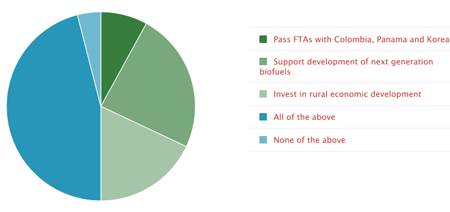

 Senators John Thune (R-SD) and Amy Klobuchar were recognized for their support of the ethanol industry today with the “Fueling Growth” award from
 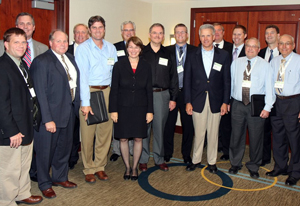 “We are grateful for the leadership and wisdom of these leaders,” said Growth Energy CEO Tom Buis. “This award serves as a reminder of our gratitude, and our continuing efforts to make this country’s national security and economic security stronger through a robust and viable alternative, renewable fuels industry. With their votes and actions in Congress, and their leadership within the administration, these individuals demonstrated loyalty and devotion to the cause of American energy independence.”
 In a letter to the co-chairs of the Joint Select Committee on Deficit Reduction, the so-called “super committee” assigned to find ways to cut the deficit, the
  Molecular biologist Zonglin Lewis Liu with ARS’ National Center for Agricultural Utilization Research in Peoria found a biorefinery yeast that successfully ferments plant sugars from cornstalks, wheat straw, and other rough, fibrous, harvest-time leftovers into cellulosic ethanol. According to Liu, the yeast overcomes some of the troublesome compounds in these materials that are created during dilute acid pre-treatment of the crop leftover. The compounds tend to damage yeast cell walls and membranes, disrupt yeast genetic material such as DNA and RNA, and interfere with yeast enzymes’ fermentation abilities, ultimately reducing potential cellulosic ethanol yields.
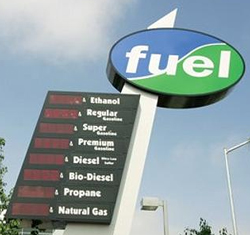 Ethanol, biodiesel, propane, natural gas, electricity – even regular gasoline – consumers should have choices at the pump and a new campaign is urging lawmakers in Washington to make that happen.
 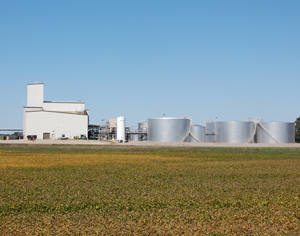 Fields of soybeans surround the newly re-opened
  Hill, pictured here on the left with REG president Dan Oh, says the economic benefits of biodiesel production in a rural community have a multiplier effect. “From the farmer, to the elevator to the tire salesman, to the people buying the biodiesel to blend it, for trucks and everything else, it just helps everybody,” Hill said, adding that it helps all of agriculture, including livestock producers who benefit because it helps reduce the cost of soybean meal.