ACE Conference 2026

Event to Promote Open Fuel Standard Act

Cindy Zimmerman

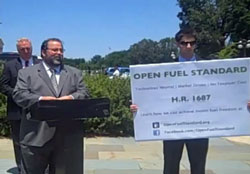
Ethanol and other alternative fuel industry leaders will be on Capitol Hill Tuesday to urge Congress to an Open Fuel Standard (OFS).

Representatives John Shimkus (R-IL) and Elliot Engel (D-NY) introduced the Open Fuel Standard Act in June with the support of the Open Fuel Standard Coalition. Tuesday’s event in the nation’s capitol will include an Energy Security Roundtable and press conference.
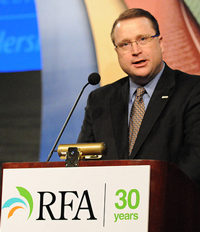
“Americans need a choice at the pump and the Open Fuel Standard would allow them to pick an ethanol blend that meets their needs,” said Renewable Fuels Association President and CEO Bob Dinneen who will be a panelist at the roundtable. “The OFS would also create market space for other alternative fuels that are critical to our nation’s energy future.”

Dinneen will be joined by former National Security Advisor Robert McFarlane, NASCAR driver Kenny Wallace, and others who will discuss alternative fuels and the dangers of our addiction to imported oil for the event hosted by Reps. Shimkus and Engel, in 2218 Rayburn HOB from 2:00 – 3:00 p.m. Other participants will include Methanol Institute executive director Greg Dolan, and President and CEO of ACT! for America Brigitte Gabriel.

Ethanol, Ethanol News, Government, NASCAR, RFA

Coaltion Wants Energy Title in New Farm Bill

Cindy Zimmerman

A coalition of nearly 50 trade groups and organizations representing renewable energy, energy efficiency, farm, and forest interests is urging leaders of the House Agriculture and Senate Agriculture Committees to include an energy title in any new Farm Bill legislation. A $23 billion reduction in funding has been proposed to the Joint Select Committee on Deficit Reduction by the committees for USDA programs, but no details have yet been decided.

In a letter to the leadership, the recently formed Agriculture Energy Coalition noted that programs in the Energy Title of the 2008 Farm Bill “have helped finance thousands of diverse renewable energy projects and improved energy efficiency at farms, ranches and businesses across rural America.”

“Agriculture has an indispensible role to play in our nation’s emerging clean energy economy. It is vital that we develop and commercialize a variety of clean, abundant, renewable energy resources and biobased products, and Farm Bill energy programs are crucial to achieving that goal,” said coalition co-director Lloyd Ritter.

Among the members of the coalition are the Renewable Fuels Association and Growth Energy.

Energy, Ethanol, Ethanol News, Government, Growth Energy, RFA

Navy Gets Electric Vehicle

Cindy Zimmerman

The U.S. Navy took delivery of its first fully electric car this week, a brand new Chevy Volt.

“This vehicle will save 280 gallons of fuel per year,” said Deputy Assistant Secretary of the Navy for Energy Tom Hicks. “This builds to our goals the Secretary of the Navy has laid out for us to reduce our petroleum consumption by 50% by 2015.”

Hicks accepted and tested the Volt on the Navy’s behalf Thursday in Arlington, Virginia. He says the 50% petroleum reduction goal is on top of the 30% reduction the Navy has already made in the last six years.

Electric Vehicles, Energy, Government

Petroleum Marketers Join Coalition for E85

Cindy Zimmerman

The Petroleum Marketers Association of America (PMAA) has become the newest member of the Coalition for E85 to help educate policymakers about the need for 85% ethanol blended gasoline to be designated as an alternative fuel in the tax code.

“If we don’t enable E85 to compete with gasoline, we could see the entire Flex Fuel industry disappear,” said Dan Gilligan, President of PMAA, which represents 8,000 independent petroleum marketing companies. “Our members, automakers, and 9 million American drivers have invested in E85 infrastructure and Flex Fuel vehicles. With E85 so close to self-sustainability, these investments must be protected.”

The recently-formed Coalition notes that E85 is the most widely adopted alternative fuel and is defined in the Energy Policy Act of 1992 as an alternative fuel, rather than a fuel additive. “E85 is an alternative fuel just as compressed natural gas, propane, and hydrogen,” contends the group. “These alternative fuels receive a 50-cent per gallon tax credit as part of the Alternative Fuel Credit and E85 should receive the same tax treatment.”

The Coalition for E85 is an alliance of retailers, producers, equipment manufacturers, automobile manufacturers, and others supporting E85. More than 2,500 small businesses across the country have installed E85 pumps to date.

E85, Ethanol, Ethanol News

RFA Chairman on Ethanol Issues

Cindy Zimmerman

Chuck Woodside, General Manager of farmer-owned KAAPA Ethanol in Minden, Nebraska, was just re-elected for a second year as chairman of the Renewable Fuels Association (RFA).

I caught up with him this week for an update on the state of the industry, how this year has been, progress on implementing EPA’s E15 waiver, challenges to the RFS2, the importance of exports and distillers grains, and more.

Ethanol Report PodcastWoodside thinks 2011 has been a positive year for ethanol production, despite the policy challenges the industry continues to face, and he is optimistic about the future, even as they expect the Volumetric Ethanol Excise Tax Credit (VEETC) to expire at the end of the year for good. “There will be some transition, but I think the industry is confident we can compete with gasoline without the tax credit,” he said. “The VEETC was an incredibly successful program and we think there’s opportunities to build on that investment that the taxpayers made in our industry.”

Listen to Chuck Woodside’s comments in this edition of “The Ethanol Report”: RFA Chairman Chuck Woodside

Ethanol, Ethanol News, Ethanol Report, RFA

Bioheat Campaign Blankets New York

Cindy Zimmerman

A new Bioheat® advertising campaign is underway in New York City targeting oilheat customers who want a better, cleaner fuel.

The message is that consumers who use oilheat to heat their homes have the power to change – without changing a thing – by choosing Bioheat®, “a home heating fuel made with biodiesel, a renewable, cleaner-burning fuel that supports American jobs.”

Starting Oct. 24, New York City buses and the subway system will be covered with Bioheat ads. Radio commercials are already airing on six highly rated CBS stations. “Choose the cleaner, renewable home heat without changing equipment. Bioheat. It’s the evolution of oilheat,” says one version of the radio commercial.

Bioheat is made by combining oilheat with at least two percent biodiesel. It is cleaner burning, cost-competitive with oilheat, and does not require modifications to the oilheat system.

“Our public opinion research shows that oilheat customers crave the benefits of Bioheat, yet most aren’t aware that it is an option for their oilheat systems,” said Paul Nazzaro, petroleum liaison for the National Biodiesel Board. “This campaign will drive customers to ask their oilheat dealers for Bioheat, and raise their understanding of the product and its benefits.”

The ads direct consumers to the Bioheat website, bioheatonline.com, which has been revamped in conjunction with the campaign to be more user friendly to consumers and oilheat dealers alike. Facebook users can also “join the evolution” on the new Bioheat Facebook page.

“This campaign is a critical step in empowering consumers to use a truly renewable product, contribute to energy security, and support American jobs,” said John Maniscalco, CEO of the New York Oil Heating Association. An early proponent of Bioheat, Maniscalco was instrumental in passing an air quality bill that ensures Bioheat is used within the city for heating homes and buildings. Starting in October 2012, all heating oil sold within New York City will contain at least 2 percent biodiesel.

Biodiesel

Biodiesel Scholarship Honors Minnesota Farmer

Cindy Zimmerman

An annual scholarship for Minnesota high school seniors has been launched under a new name to honor the memory of a soybean farmer.

This year’s scholarships are given in memory of the late father of Mike Youngerberg, senior director of field services for the Minnesota Soybean Growers Association. Reuben Youngerberg owned a farm in Blue Earth County, where he held a number of board positions in local agriculture organizations.

The Reuben Youngerberg Memorial Biodiesel Scholarship is open to any Minnesota high school senior and offers a $1,600 1st place and $500 2nd place award to the winners of an essay contest about biodiesel, a cleaner-burning alternative fuel produced and used in Minnesota. Rules and an online entry form can be found at www.cleanairchoice.org. Deadline for entries is March 30, 2012.

The scholarship is administered by the American Lung Association in Minnesota, which recognizes biodiesel as a “clean air choice” fuel that reduces emissions, and sponsored by the Minnesota Soybean Research and Promotion Council, with additional support from the Minnesota Soybean Growers Association, National Biodiesel Board, MEG Corp, and Renewable Energy Group, Inc.

Biodiesel, NBB, REG, Soybeans

Anti-Ethanol Blender Pump Amendment Pulled

Cindy Zimmerman

An amendment offered by Sen. John McCain (R-AZ) that would have stopped funding for Flex Fuel blender pumps was pulled before it came up for a vote this week.

“While the withdrawal of this amendment is an important milestone, we will continue to encourage Congress to oppose any other effort that would erect new barriers to the market,” said Growth Energy CEO Tom Buis.

The amendment was proposed to the 2012 agriculture appropriations bill, which allocates $4.5 million for blender pumps by USDA. Meanwhile, the House has a similar version of the bill that would allocate only $2.3 million for USDA’s energy program with the provision that the funding not be used for pumps.

blends, Ethanol, Government, USDA

Reports Blame Speculators for Higher Prices

Cindy Zimmerman

Two reports released earlier this week concluded that commodity market speculation is largely to blame for increasing prices of food and energy. The reports were issued in advance of the October 18 meeting of the Commodities Futures and Trading Commission (CFTC) which placed limits on speculation in a variety of commodities including oil, corn, gold and natural gas.

One report came from the non-profit organization Better Markets, which concluded, “Research analyzing commodity markets for the last 27 years shows that Wall Street’s speculative trading through commodity index funds is causing market disruptions, interfering with price discovery, increasing the costs for businesses to hedge, and needlessly pushing prices higher for all Americans.”

A second report from economic analysis firm Cardno Entrix had similar findings, concluding that commodity prices are “likely higher than justified purely by fundamentals and the commodity markets have become more volatile as the volume of trading by index funds and other non-commercial traders has increased sharply.”

In examining the activity of speculators in the corn futures market in the context of supply and demand fundamentals, the Cardno Entrix report found that “speculation is a major factor behind the recent sharp increase in both the level and volatility of corn prices.”

At this week’s CFTC meeting, federal regulators decided to cap the volume of futures trading for 28 different agricultural commodities, energy and metals in the hopes of limiting the impact of speculative trading on consumer prices.

corn, Ethanol, Ethanol News, Food prices, Oil

USDA Plans to Cancel Ethanol Co-Product Report

Cindy Zimmerman

In a cost-cutting measure, USDA’s National Agricultural Statistics Service (NASS) is planning to cancel the Distiller Co-Products for Feed Survey announced in March slated to be done in January 2012. The report, which was designed to better calculate the use of the ethanol co-product known as DDGS in livestock feed, is one of several that USDA plans to eliminate or reduce in light of funding reductions for the current fiscal year and expected reductions in FY 2012.

“We were very disappointed to hear the survey is being cancelled,” said Geoff Cooper with the Renewable Fuels Association. “NASS staff had prepared an excellent survey that was set to go out to thousands of livestock and poultry feeders in January 2012. Pulling the plug on this survey means many of the questions about how co-products are actually being used in the real world will remain unanswered. The feed industry, ethanol producers, and regulators alike desperately need the type of information this survey would have provided.”

NASS conducted a limited survey of DDGS use in 2007, funded by the Nebraska Corn Board, this report was anticipated to be much more comprehensive in scope. A Federal Register notice regarding the NASS program changes is expected to be published soon.

Distillers Grains, Ethanol, Ethanol News, USDA