A new public education project to reach drivers of FlexFuel Vehicles (FFVs) by working with state Motor Vehicle Administrations (MVA) was announced today by the Alliance of Automobile Manufacturers and the Clean Fuels Foundation.
 As a part of the national FFV Awareness Campaign, the “FlexFuel Vehicle/Motor Vehicle Administration” project will work with MVAs in six states on outreach opportunities such as developing an FFV owner database, vehicle registration and license renewals, safety inspection and emissions notices, and including information with the energy/emergency preparedness program, state websites, and at point of service. The six states are Iowa, Kansas, Nebraska, Maryland, Georgia, and Florida.
“Working together with MVAs and automakers we want to reach drivers of FFVs to make sure they are aware that their vehicles have the capability of using high-level ethanol blends,” said FFV Awareness Campaign Manager Burl Haigwood. “Educating drivers about fuel choice will result in proper refueling and protect ethanol’s stellar 30-year marketplace reputation.”
The Alliance of Automobile Manufacturers CEO Mitch Bainwol says they represent 12 companies of FFVs that see the need for consumer education. “FlexFuel Vehicles are a growing segment of the auto pool. We are pleased to help sponsor this project to increase the use of alternative fuels like E85 and in so doing, educate drivers to avoid the potential for misfueling.”
FFV Awareness Campaign supporters noted that reaching drivers in cooperation with the DMVs is essentially a no-to-low cost means to help states meet their goals to reduce petroleum use, support new biofuel technologies, and improve air quality. The Alliance now joins EPA, USDA, several Clean Cities Coalitions, and over 30 Ag/Energy/Environmental organizations that support the FFV Awareness Campaign.
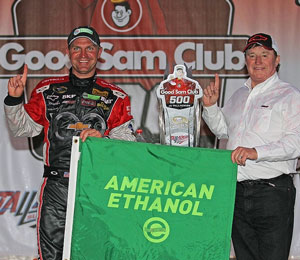
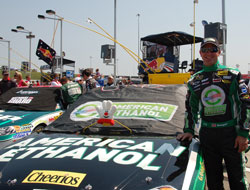 The No. 33 Richard Childress Racing Chevrolet race car will feature a special-edition American Ethanol paint scheme at the race and will be driven by American Ethanol spokesman and
 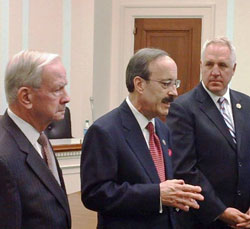 The two congressmen, pictured here with former National Security Advisor Robert McFarlane, outlined their Open Fuel Standard Act (HR 1687) which would set a deadline of 2017 for automakers to stop making cars that run on only gasoline. After than point, all American made cars must be either flex fuel (capable of burning gasoline, ethanol or methanol or any combination of these), or powered by natural gas, hydrogen, biodiesel, plug-in electric, or fuel cell.
  A research team discovered that when corn stover is processed to make ethanol, three distinct parts of it – the rind, pith and leaves – break down in different ways.
 ZeaChem has raised $19 million in Series C financing, led by Birchmere Ventures, and partner Sean D.S. Sebastian has joined the ZeaChem board of directors. “As an industry leader in the advanced biofuels and bio-based chemicals industries, ZeaChem’s proven capability to produce economical and sustainable petroleum alternatives is an innovation we are pleased to add to our portfolio,” said Sebastian.

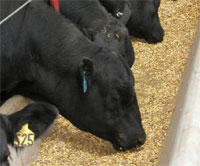 According to the report by USDA’s Economic Research Service (ERS), “We found that, on average, for the past 5 crop years (2006/07-2010/11), 1 mt of distillers’ grains substitutes for about 1.22 mt of corn and soybean meal combined in the United States.”
 The monthly Moderated Transaction System (EMTS) data from EPA is used to track requirements under the expanded Renewable Fuel Standard (RFS2) program for use of renewable fuels and Renewable Identification Number (RIN) transactions.