RFA E-15 Ad

Thanksgiving Meals Mostly Same As Last Year

Chuck Zimmerman

The ZimmPoll is one year old! And you can re-visit all of them since they are all archived right here on AgWired. Thank you Rhea + Kaiser for your sponsorship and support.

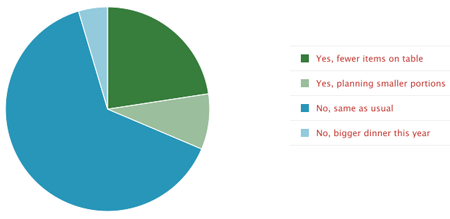
In our latest ZimmPoll we asked the question, “Will higher cost (13%) of Thanksgiving dinner affect your meal?” Apparently it won’t for most of our respondents. 64% said, No, same as usual; 22% said Yes, Fewer items on table; 9% said Yes, Planning smaller portions and 5% said No, Bigger dinner this year. A story in yesterday’s USA Today seems to reflect this response. It says that some will be cutting back.

Some are holding potluck dinners instead of springing for the entire feast. Others are staying home rather than flying. And a few are skipping the turkey altogether.
Our new ZimmPoll is now live. We’re asking the question, “Do you use Facebook or Google+?” Google+ now allows company pages but so far they don’t seem to have attracted the kind of audience found by companies using Facebook. Which “house” do you live in? Feel free to chime in. We appreciate it.

ZimmPoll is sponsored by Rhea+Kaiser, a full-service advertising/public relations agency.

ZimmPoll

U.S. Navy Successfully Runs Ship on Biofuel

Cindy Zimmerman

The U.S. Navy successfully concluded the largest demonstration of shipboard alternative fuel use last week when the Self Defense Test Ship (SDTS) arrived on November 17 at the Naval Surface Warfare Center Port Hueneme, Calif.

The SDTS is a decommissioned Spruance-class destroyer ex-Paul F. Foster (EDD 964) reconfigured to provide the Navy an at-sea, remotely controlled, engineering test and evaluation platform without the risk to personnel or operational assets.

The ship received approximately 20,000 gallons of a 50-50 blend of an algae-derived, hydro-processed algal oil and petroleum F-76 from the Defense Fuel Supply Point at Naval Base Point Loma on Nov. 16 and then traveled 17 hours to Port Hueneme on the fuel. According to the Navy, 100 percent of ship’s propulsion power and 50 percent of service power came from the algal oil/F-76 fuel blend.

“How can we have an impact?” asked Assistant Secretary of the Navy (Energy, Installations and Environment) Jackalyne Pfannenstiel at the demonstration’s kick-off. “We can have an impact as a technology leader, highlighting and demonstrating the viability of biofuels.”

Meeting the secretary of the Navy’s call for a drop-in fuel replacement, no changes were required to the infrastructure of the ship or fueling pier for the SDTS test. “From our perspective as the ship’s operators, there was absolutely no difference, whatsoever, in the operation or performance of the ship,” said Mike Wolfe, Naval Surface Warfare Center Port Hueneme Division underway project officer. “The fuel burned just like the traditional fuel we get from the Navy and have been burning for years. We could not tell the difference. The biggest success is that a Navy ship with engines identical to those in commissioned warships operated successfully on an overnight transit with the alternative fuel without a glitch in anything. Operationally, it was absolutely a success.”

The alternative fuels effort supports the Navy’s overall energy strategy to increase energy security and safeguard the environment.

advanced biofuels, algae, Government

Novozymes Urges Committee to Explore Oil Alternatives

Cindy Zimmerman

NovozymesThe president of biofuel enzyme producer Novozymes last week called on a House subcommittee to explore alternatives to drilling for oil to meet the country’s energy needs.

In a written statement prepared for the House Committee on Natural Resources’ Subcommittee On Energy and Mineral Resources, Adam Monroe encouraged the committee “to explore renewable fuels: new technology and innovation already making an impact on our energy supply and economy. American biofuels are reducing energy costs and creating jobs. They can also help realize savings that can be directed to our infrastructure needs. These savings can be directed towards America’s other pressing problems – in this case, the Committee’s concern about our roads, bridges, tunnels and other aging infrastructure.”

“For America to meet its energy challenges, we believe it is critical to view renewable fuels for cars, trucks and other vehicles as integral links in the country’s fuel supply. The technology and cost-savings they create are here – all we need now is continued public support,” Monroe concluded.

advanced biofuels, Cellulosic, Ethanol, Ethanol News

Major Global Companies Sign on to WindMade™ label

Cindy Zimmerman

Major global companies including Motorola Mobility, Deutsche Bank, Bloomberg, Method and BD (Becton, Dickinson and Co.) announced their commitment to use at least 25 percent wind energy and become certified under the new WindMade™ consumer label at a Global Launch event in New York last week.

The label allows participating companies to communicate the share of wind power and other renewable sources as part of the overall power demand of their operations. The objective behind WindMade™ is to drive demand in wind power, thereby boosting investment and growing the renewable energy market.
“These companies are at the forefront of the global sustainability movement,” said Henrik Kuffner, WindMade’s CEO. “We are delighted to have them on board the unique WindMade™ initiative, and are confident that many others will follow suit in the coming weeks and months.”

According to the WindMade™ requirements, companies using the label must source a minimum of 25 percent of the electricity consumed from wind power. The wind energy share can be procured through a company-owned wind power generation facility, a long-term power purchase agreement for wind power, or the purchase of high quality Renewable Energy Certificates approved by WindMade™. The exact percentage of the wind energy share will be stated on the label. Companies can choose to certify global, regional or facility level operations, a distinction that will be clearly communicated on the label itself.

WindMade™, which was introduced to the world at this past year’s World Economic Forum in Davos, is backed by the UN Global Compact, Vestas Wind Systems, World Wildlife Fund, Global Wind Energy Council, Bloomberg (as the official data provider), and the LEGO Group. PwC is the official verification partner.

A separate label for products is in development and will be released during 2012.

Wind

Challenges Continue for 15% Ethanol Blend

Cindy Zimmerman

Another challenge to the waiver allowing 15% ethanol blends in regular gasoline was made last week by Congressman Jim Sensenbrenner (R-WI) who introduced legislation to “require that the EPA certify, not only that a new fuel will not lead to emissions increases, but also that the fuel will not reduce fuel efficiency or damage engines.”

The Renewable Fuels Association says Sensenbrenner is “missing the point” when it comes to allowing American consumers the choice of using E15 ethanol blends and that EPA has already thoroughly tested E15 for safety – enough to make approximately 4,700 round trips from Washington to Milwaukee.

In an interview at the National Association of Farm Broadcasting annual meeting, RFA Director of Market Development Robert White talked about the status of the E15 waiver and when we can expect the fuel to become commercially available. “We’re close,” White says. “The EPA is going through some final information that we’ve submitted from an implementation plan to the health effects testing. We actually expect a green light at any moment.”

However, once it is approved at the federal level, White says the attention turns to the states, which have different statutory regulations for fuel sales. If the states require their own labeling, White says it will be in addition to the label already approved by the EPA, that clearly states how consumers should use E15. “We’re trying to make sure that consumers have all the information they need to make the right choice and we think they’re smart enough to figure that out,” he said, noting that RFA is complementing the efforts of EPA with a consumer education campaign.

Listen to my interview with Robert White here: RFA's Robert White

Audio, Ethanol, Ethanol News, RFA

Super Yeast Could Turn Pine into Ethanol

Cindy Zimmerman

Researchers at the University of Georgia have developed a “super strain” of yeast that can efficiently ferment ethanol from pretreated pine.

“Companies are interested in producing ethanol from woody biomass such as pine, but it is a notoriously difficult material for fermentations,” said Joy Doran-Peterson, associate professor of microbiology in the Franklin College of Arts and Sciences.

“The big plus for softwoods, including pine, is that they have a lot of sugar that yeast can use,” she said. “Yeast are currently used in ethanol production from corn or sugarcane, which are much easier materials for fermentation; our process increases the amount of ethanol that can be obtained from pine.”

Before the pinewood is fermented with yeast, however, it is pre-treated with heat and chemicals, which help open the wood for enzymes to break the cellulose down into sugars. Once sugars are released, the yeast will convert them to ethanol, but compounds produced during pretreatment tend to kill even the hardiest industrial strains of yeast, making ethanol production difficult.

Doran-Peterson, along with doctoral candidate G. Matt Hawkins, used directed evolution and adaptation of Saccharomyces cerevisiae, a species of yeast used commonly in industry for production of corn ethanol, to generate the “super” yeast.

Their research, published online in Biotechnology for Biofuels, shows that the pine fermented with the new yeast can successfully withstand the toxic compounds and produce ethanol from higher concentrations of pretreated pine than previously published.

Read more from UGA news and see a video about this research below:

Cellulosic, Ethanol, Ethanol News, Video

Biodiesel Board Announces Officers

Cindy Zimmerman

National Biodiesel Board members this week elected seven returning governing board members and one new member to serve on the leadership committee as part of the organization’s membership meeting in Washington D.C.

Officers elected to lead the board are:
Gary Haer, chairman, Renewable Energy Group, Inc. (Producer)
Ed Ulch, vice chair, Iowa Soybean Board (Farmer)
Ron Marr, secretary, Minnesota Soybean Processors, (Producer)
Jim Conway, treasurer, Griffin Industries (Producer)

Biodiesel board members also voted to fill eight board member spots, which include the officer team and:
Ed Hegland, Minnesota Soybean Research and Promotion Council (Farmer)
Kris Kappenman, Archer Daniels Midland (Producer)
Bob Metz, South Dakota Soybean Research & Promotion council (Farmer)
Robert Stobaugh, Arkansas Soybean Promotion Board (Farmer)

Biodiesel, NBB, Soybeans

USDA Announces Biomass to Energy Project Funding

Cindy Zimmerman

USDAUSDA has announced funding for a series of projects to convert biomass to energy through USDA’s Rural Energy for America program (REAP). The announcement this week concludes 2011 biomass project funding assistance for a total of 52 projects with just over $31 million in grant and loan note guarantees through program.


Among the companies receiving funding is NC-CHP Owner I, LLC of Asheville, N.C., which received a $5 million loan for the installation of a combined heat and power system in Montgomery County. The system will generate steam by using a boiler system powered by wood chips and will also generate 5.25 million kWh of electricity per year. Also in Montgomery County, applicant EWP, LLC will receive a $146,000 grant to install equipment at an existing hydroelectric plant so it can be reopened. The project has the potential to generate an estimated 2.8 million kWh per year.

Other projects to be funded include:

Alaska Alaskan Brewing – $448,366 grant for biofuel from waste grain
Iowa Iowa Firewood Products – $24,232 grant for firewood kiln
Mass. CommonWealth Resource – $49,875 grant for biofuel from waste
S.D. Legend Seeds – $17,035 grant for boiler installation
Tenn. Mountain Wood Products – $500,000 grant for Wood Pellet Processing
Utah Washakie Renewable Energy – $496,750 grant for biofuels pretreatment/ products plant

biomass, Energy, USDA

AE Biofuels Changes Name to Aemetis

Cindy Zimmerman

AE Biofuels has a new name to better reflect the company’s business strategy.

The industrial biotechnology company which produces renewable chemicals and advanced fuels using patented microbes and processes became Aemetis, Inc. as of November 15.

In June 2011, AE Biofuels acquired Zymetis, Inc., a Maryland industrial biotechnology company. The name Aemetis was derived from “AE” which means “The One” in Scottish, and “Metis” which means “Prudent Wisdom” in Greek. “Aemetis” means “The One Prudent Wisdom,” referring to the prudence and wisdom of replacing petroleum with renewable sources of chemicals and fuels.

The Aemetis Biorefinery technology platform is based on a unique patented aerobic marine organism (the “Z-microbe”) and propagation process that enables Aemetis to produce a variety of specialty biochemical and renewable fuels products for large markets using renewable feedstocks. Aemetis holds 4 granted patents and 14 pending patents on its microbial and enzymatic technology and production processes. Aemetis currently operates a 55 million gallon per year ethanol plant in Keyes, California and a 50 million gallon capacity biofuels plant in India.

advanced biofuels, Ethanol, Ethanol News

POET CEO Update on Cellulosic Ethanol

Cindy Zimmerman

Ethanol industry leader POET is making “tremendous strides” in the development of ethanol from biomass for commercial use, according to company CEO Jeff Broin.

Broin talked with farm broadcasters at last week’s National Association of Farm Broadcasting meeting last week in Kansas City to provide an update on Project LIBERTY, a cellulosic ethanol plant project in Emmetsburg, Iowa. “When we got into this research ten years ago, it was a long shot,” Broin said in an interview with Jody Heemstra of KWAT Radio in Watertown, SD. “Today, we’re actually less than $3 on production costs so we’re competitive with gasoline and we’re very excited about that.”

Broin says they have cut enzyme costs by about a third and are planning to use the lignin from a grain ethanol plant next door to power both plants. “We’ll have a 25 million gallon cellulosic plant next to a 50 million gallon grain plant and there will be virtually no fossil fuel used to power those facilities,” Broin says.

Listen to all of Heemstra’s interview with Broin here: Jeff Broin, POET CEO

Audio, Cellulosic, Ethanol, Ethanol News, POET