

The bacteria that is most commonly associated with triggering food recalls could be a catalyst to convert sugars into biodiesel.
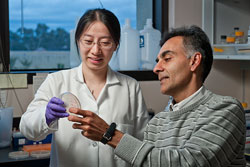 Researchers at Stanford University believe that Escherichia coli, better known as E. coli, could convert sugar to biodiesel at “an extraordinary rate.”
Biodiesel can be made from plant oil or animal fat – usually the former. Used cooking oil from restaurants is common, but for biodiesel to contribute significantly to reducing fossil fuel use, there needs to be a way to mass produce it from plant-derived raw materials. The problem is that synthesizing biodiesel is complicated. That is where E. coli comes in.
The bacteria, often discussed in terms of the human digestive tract, also act as a catalyst in generating biodiesel by converting inexpensive sugars into fatty acid derivatives that are chemically similar to gasoline. But E. coli’s natural conversion capability is not up to snuff, commercially speaking, and researchers tinkering with its internal machinery have yet to boost its capability enough to cross the commercial threshold.
So Chaitan Khosla, a Stanford professor of chemistry and of chemical engineering, decided to investigate whether there might be a natural limit that holds back E. coli’s conversion capabilities. In other words, does the basic catalytic engine in E. coli have enough horsepower to do the job at the needed scale?
“The good news is that the engine that makes fatty acids in E. coli is incredibly powerful,” Khosla said. “It is inherently capable of converting sugar into fuel-like substances at an extraordinary rate. The bad news is this engine is subject to some very tight controls by the cell.”
It turns out that like any high performance engine, the catalytic process in E. coli can only attain peak efficiency when all the controls are tuned just right. The research is described in a paper published in Proceedings of the National Academy of Sciences. Khosla is a coauthor of the paper, which is available online.
 Crown Express Mart is opening Raleigh’s first E85/Biodiesel fuel station today.
  In addition to the shorter name, the company has a new leadership team for the business. Steven J. Mirshak has been named business director, DuPont Cellulosic Ethanol. He was most recently the president of DuPont Tate and Lyle Bio Products, a joint venture between DuPont and Tate and Lyle in Loudon, Tenn. DuPont also named Keith Gibson as the plant manager for the planned cellulosic ethanol facility in Nevada, Iowa. Gibson joins DuPont Industrial Biosciences from Iroquois Bio-Energy Company, LLC, where he served as the general manager and president. At Iroquois, he was instrumental in the company formation, operation, financing, and marketing of ethanol.



 The 2011 edition of the
  “This is a deeply disturbing picture that the IEA has painted for the world,” said Bliss Baker, spokesperson for the
 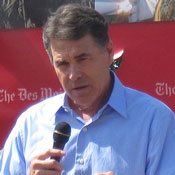 As presidential candidate Rick Perry returned to Iowa today, the
  “How in the world does Governor Perry justify 20 more years of tax subsidies for oil companies?” asked IRFA President Walt Wendland. “The renewable tax credits cease at the end of this year. But despite that some of the oil subsidies go back 100 years, now we’re told that Perry wants to give oil companies another 20 years of subsidies. Given this extreme position, Perry’s talk about not picking winners and losers and having a level playing field is simply hollow rhetoric.”