ACE Conference 2026

New Ethanol Blender Pumps in Illinois

Cindy Zimmerman

Three new pumps that can dispense a range of ethanol blended fuel were officially opened in Princeton, Illinois last week.

Growth EnergyGrowth Energy, Horizon Fuels, the American Lung Association and Marquis Energy partnered to help with the promotions and labeling for the three new Flex Fuel pumps at the Princeton Fast Stop. “It was time to upgrade our gasoline pumps, so we went with Flex Fuel pumps that will give our customers a choice between E85, E30 and E20,” said Bob Sandhu, owner of Princeton Fast stop and the CEO and President of the MGS Petro Inc. Princeton Fast Stop celebrated the opening of the pumps last Friday, December 16, with special deals on ethanol blends and other promotions. Sandhu is picture here at one of the new pumps with Mark Orr, general manager of Ag View FS in Princeton, a local farmers cooperative that is part of the GROWMARK system.

“By giving consumers more choices at the pump that include higher blends of clean, green homegrown ethanol, we’re not only helping decrease our dependence on foreign oil, but also supporting our local farmers,” said Growth Energy Market Development Vice President Mike O’Brien.

Marquis Energy has a 140 million gallon per year ethanol production facility located just southeast of Princeton in Hennepin, Illinois. “We want consumers right here at home to understand that and now they have the chance to choose for themselves. Marquis is glad people in our local community will be able to use clean burning, renewable fuel that is made just 30 miles away,” said Director of Public Relations of Marquis Energy, Dana Gustafson.

Marquis Energy has contracted with Horizon Fuels to develop opportunities to install Flex Fuel pumps at area retail gas stations and then manage the project scope, equipment installation and promotional efforts for each.

blends, Ethanol, Ethanol News, GROWMARK, Growth Energy

USDA Helps Install Ethanol Blender Pumps

The United States Department of Agriculture’s (USDA) Rural Energy for America Program (REAP) has used more funds to install 54 ethanol blender pumps in twelve different locations. The REAP program funded a total of 266 ethanol blender pumps in 30 states at a total cost of $4.2 million dollars in Fiscal Year 2011.

“The REAP Blender Pump program is a completely new approach to encouraging marketers to install the equipment needed to offer more ethanol blended fuel choices to consumers,” said the American Coalition for Ethanol (ACE) Senior Vice President Ron Lamberty. “266 pumps in 30 states is especially impressive when you take into account how different this program is from the ones used by marketers in the past, and how short a timeframe USDA had to get the information out to marketers.”

Through the program, petroleum marketers were introduced to a competitive grant process that was unfamiliar to most of them, and they had a very short application window of about two months.

“The Blend Your Own (BYO) Ethanol campaign is pleased to have been involved in the planning,” Lamberty said. “Through webinars, grant writing assistance, and face-to-face meetings, we’re glad to have played a part in this program’s success. Funds will be lower in the upcoming fiscal year, so the process will be even more competitive, and ACE and BYO will continue to promote the program and assist marketers who want more information about the REAP flex fuel infrastructure program.”

blends, Ethanol

Brisk Sales of E85 in Minnesota During 2011

clean air choice mnStrong sales of E85 continue across the Midwest and especially in Minnesota, according to organizations that track sales.

In the first eight months of 2011, Minnesota E85 sales increased 26 percent compared to the same period in 2010. Reports from Iowa and North Dakota also show significantly higher E85 sales this year than in 2010.

Minnesota has more than 360 E85 retail outlets, more than any other state. Plus, the state also continues to make progress to reduce gasoline consumption in state-owned vehicles. Between July 2010 and June 2011, the state fleet used more than one million gallons of E85, setting a new record for a 12-month period.

According to the Minnesota SmartFleet Committee, E85 now accounts for approximately 19 percent of their light-duty fuel purchases. State agencies used 736,885 gallons of E85 from January through September, up from the 724,827 gallons during the same period in 2010.

“This increase is all the more notable because many of the state’s 3,000 flex fuel vehicles that are capable of using E85 were not driven during a 20-day state government shutdown in July,” said Tim Morse, chair of the SmartFleet Committee and director of Fleet and Surplus Services for the Minnesota Department of Administration.

“Using these fuels not only reduces lifecycle emissions and air pollution, they also help reduce our dependence on petroleum, a majority of which is imported into Minnesota from tar sand sources,” said Kelly Marczak, director of the Clean Air Choice program of the American Lung Association in Minnesota and SmartFleet Committee member.

E85, Flex Fuel Vehicles

Researchers Find More Pollution from Sugarcane Ethanol

Cindy Zimmerman

University researchers from California, Iowa and Chile have found that sugarcane ethanol production creates up to seven times more air pollutants than previously estimated, according to news from the University of Iowa.

The research team used agricultural survey data from Brazil to calculate emissions of air pollutants and greenhouse gases from the entire production, distribution, and lifecycle of sugarcane ethanol from 2000 to 2008.

The estimated pollutants were 1.5 to 7.3 times higher than those from satellite-based methods, according to lead author Elliott Campbell of the University of California, Merced.

Greg Carmichael, Karl Kammermeyer Professor of Chemical and Biochemical Engineering in the UI College of Engineering and co-director of the Center for Global and Regional Environmental Research (CGRER), and UI assistant professor Scott Spak note that the findings reflect continued practices and trends that are a part of the production of sugarcane ethanol. These include the practice of burning sugarcane fields before harvest, as well as the fact that sugarcane production in Brazil continues to grow.

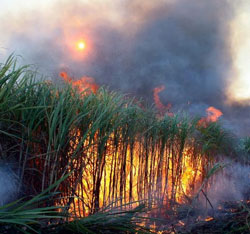
“We found that the vast majority of emissions come from burning the sugarcane fields prior to harvesting, a practice the Brazilian government has been moving to end,” says Spak. “However, the sugarcane industry has been expanding rapidly and moving into more remote areas, which makes it much more difficult to enforce new regulations over this growing source of air pollution and greenhouse gases.

“As people try to determine how to integrate biofuels into the global economy, Brazilian sugarcane ethanol has often been considered a more environmentally friendly fuel source than U.S. corn ethanol. In fact, the U.S. Environmental Protection Agency considers sugarcane ethanol an ‘advanced biofuel’ with fewer greenhouse gas emissions than conventional biofuels like corn ethanol. These new findings help us refine those estimates and move closer to making more informed comparisons between different fuel sources, and ultimately make better decisions about how to grow and use biofuels,” Spak says.

The study, titled “Increased estimates of air-pollution emissions from Brazilian sugarcane ethanol,” is featured in the Nature Highlights section and published in the Dec. 11 Advance Online Publication of the journal Nature Climate Change.

Brazil, Environment, Ethanol, Ethanol News, Research

Congress Urged to Extend Biodiesel Tax Incentive

Representatives of the U.S. biodiesel industry are urging Congress to pass a seamless extension of the biodiesel tax incentive. The $1-per-gallon biodiesel tax credit is slated to expire on Dec. 31. Bipartisan legislation has been introduced in the U.S. House and Senate to extend it for three years. Proponents of the bill testified this week in a hearing on alternative energy tax incentives, held by the Senate Finance Committee’s Subcommittee on energy, natural resources and infrastructure.

“This tax incentive is a job creator and Congress will be putting jobs in jeopardy if it adjourns without passing an extension,” said Anne Steckel, vice president of federal affairs at the National Biodiesel Board (NBB).

The tax incentive was allowed to expire in 2010 but was reinstated this year. Since the reinstatement, the biodiesel industry has set a new production record of more than 802 million gallons through October. That is more than double last year’s volume of about 315 million gallons. Increased production supports more than 31,000 jobs this year while generating at least $3 billion in gross domestic product and $628 million in federal, state and local tax revenues, according to a recent economic study conducted by CardnoENTRIX, an international economics consulting firm.

“Stable, long-term federal incentives are necessary for this industry to continue to grow,” Paul Soanes, president and CEO of Texas-based Renewable Biofuels, Inc (RBF) said at the hearing.

Soanes said RBF has increased production at its plant in Port Neches, Texas from 9 million gallons in 2010 to more than 62 million gallons this year, hiring new employees and investing in capital improvements. Similar stories are taking place within the biodiesel industry across the United States.

Biodiesel, Legislation, NBB

Alliance AutoGas Achieves EPA-Certification

Alliance AutoGas is now EPA-certified to convert more than 200 vehicle types to propane autogas utilizing the Prins System. The company is a conversion equipment provider and co-founding partner of American Alternative Fuel.

American Alternative Fuel privately funded these EPA certifications to ensure fleet owners and managers nationwide can choose from a wide variety of vehicle makes and models when converting to clean-burning autogas. With more than 200 eligible vehicles, this is the largest privately financed portfolio of autogas vehicle certifications in the United States. New certifications include the latest model years for the popular Ford Crown Victoria and E-series vans and additional certifications for several medium duty GM platforms.

Fleets running on autogas see savings on both fuel and maintenance costs. Autogas is an average of $1.25 per gallon less than gasoline and many Alliance AutoGas fleets report reduced maintenance needs and increased vehicle engine life after shifting to autogas. In addition to the cost-savings benefits of autogas, it is also a clean-burning fuel that is 90 percent domestically produced.

Alliance AutoGas provides both bi-fuel and propane-dedicated conversions using Prins vapor and liquid injection technology. The bi-fuel Prins VSI system gives drivers peace of mind because vehicles automatically switch back to gasoline if the autogas tank runs low when a fueling station cannot be reached.

biofuels, Flex Fuel Vehicles, Propane

E85 Now Offered at Station in St. Petersburg, Fla

Starting this week, E85 is now available to flex-fuel vehicle drivers in St. Petersburg, Fla. at Bollinger’s Gas Station. This is the first E85 station in the area.

The station, which specializes in auto repair, partnered with Protec Fuel, to install the E85. Protec, based in Florida, is a turnkey E85 company specializing in station conversions and fuel distribution. Bollinger’s offers three types of fuel including gasoline, diesel and E85. Bollinger’s also offers conversions for gas-engine vehicles to become flex-fuel vehicles.

“It just made sense to offer a product that’s good for the environment and the U.S. economy and at the same time help my environmentally-conscious customers,” said Ted Bollinger, owner.

E85

Illinois Legislature Extends State Biodiesel Program

The Illinois state legislature has approved an extension of the state’s biodiesel blending program. The bill extends the sunset date for the biodiesel state sales tax incentives to Dec. 31, 2018. Any biodiesel blend of more than 10 percent continues to be eligible for fuel tax exemption.

Since the inception of the B11 blending credits in 2004, more biodiesel has been blended in Illinois annually than any other state, says the Renewable Energy Group.

Illinois has more than 1,500 “green collar” jobs in the state, according to data from a recent Illinois biodiesel economic impact study. The biodiesel industry generated $1.5 billion of household income and was responsible for more than $2.6 billion of Illinois gross domestic product between 2004 and 2010.

“REG applauds the Illinois legislature for promoting green collar jobs, Illinois agriculture, rural economic development and sound environmental policy,” said Daniel J. Oh, president of REG.

REG markets biodiesel from its REG Danville (45 mmgy capacity) and REG Seneca (60 mmg capacity) facilities as well as several Chicago-area terminal locations.

Biodiesel, Legislation, REG

Christmas Gift List Choices

Chuck Zimmerman

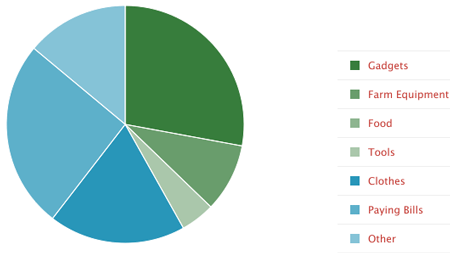
Gadgets – 28%, are tops on the Christmas gift list according to our latest ZimmPoll, followed closely by Paying Bills – 25%. Those choices were followed by Clothes, 19%; Other, 14%; Farm Equipment, 9% and Tools, 5%. I find it very interesting that no one chose Food! Wow. Food makes a great gift don’t you think? Maybe we’re all so well fed that our focus has turned to other things? What do you think?

Our new ZimmPoll is now live. We’re asking the question, “Is Ethanol production good for ALL of Agriculture?” There’s a huge amount of on-going rhetoric about this subject and it seems to be a very divisive issue within the ag community. Let’s put it this way, the most heated arguments/debates I’ve heard or participated in this year were on this subject! What do you think?

ZimmPoll is sponsored by Rhea+Kaiser, a full-service advertising/public relations agency.

ZimmPoll