ACE Conference 2026

National Biodiesel Conference Preview

Cindy Zimmerman

Only a couple days now until the kick-off of the Super Bowl – and the 2012 National Biodiesel Conference.

We caught up with National Biodiesel Board CEO Joe Jobe at the Iowa Renewable Fuels Summit to get a preview of what promises to be a great conference. “Attendance is up, exhibitors are up, sponsorship is up, which is really a reflection of the fact that the industry’s back,” Jobe says. “The industry has come back and it’s really one of the most exciting come back stories since maybe Harley-Davidson.”

Jobe says there’s enthusiasm and excitement, but also a lot of work that needs to be done. “We need to talk about how we think about the industry going forward through the lens of the RFS, which is going to be the cornerstone of the industry moving forward,” he noted.

The conference will be held February 5-8 at the Gaylord Palms Convention Center in Orlando and while on-line registration is closed, there will be on-site registration for last minute attendees.

Listen to an interview with Jobe here: Joe Jobe interview

Audio, Biodiesel, Biodiesel Conference, NBB

Eight Students Selected for Conference Scholarship

Eight students will receive a scholarship to attend the 17th Annual National Ethanol Conference: Accelerating Industry Innovation, according to the Renewable Fuels Association (RFA) and the Renewable Fuels Foundation (RFF).

RFAThis is the third year the scholarship has been available to students in higher education. Recipients receive complimentary registration to the conference and the opportunity to connect with hundreds of ethanol leaders, policy makers and experts in the renewable fuels industry.

The National Ethanol Conference (NEC) is one of the preeminent conferences for delivering accurate, timely information on marketing, legislative and regulatory issues facing the ethanol industry. This year’s program will highlight how the ethanol industry continues to evolve to meet the demands of a rapidly changing marketplace. With federal policy changing, the global, market-driven environment in which the industry must compete comes with new market challenges. Industry leaders and experts will address how we are meeting these new demands by accelerating innovation in technology, marketing, logistics and feedstocks for the production of advanced ethanol.

“It is very encouraging to see such high levels of interest in biofuels from students year after year through this program,” said Mike Jerke, RFF Chairman and General Manager for Chippewa Valley Ethanol Company. “Networking with experts in the U.S. ethanol industry gives these students a first-hand look behind an evolving industry and the direction it is heading. This is a chance for them to explore the opportunities the industry has to offer.”

Each scholarship recipient has focused their studies on renewable energy and biofuels and is interested in pursuing a career in the industry. Read more about the eight recipients of the NEC Scholarship.

conferences, Ethanol, RFA

NBB Testifies Before Senate Finance Committee

The National Biodiesel Board (NBB) testified this week to the Senate Finance Committee about the importance of reinstating the industry’s tax incentive. The $1-per-gallon biodiesel tax incentive expired on Dec. 31 for the second time in three years.

Anne Steckel, NBB vice president of federal affairs, said in her testimony, that when the incentive was reinstated last year after a lapse in 2010, it helped boost biodiesel production to a record volume of nearly 1.1 billion gallons in 2011. That volume – triple the production of 2010 – supported more than 39,027 jobs and $3.8 billion in GDP, according to a recent study conducted by Cardno ENTRIX, an international economics consulting firm.

“The biodiesel industry is poised to continue that momentum so long as Congress and the Administration continue supporting strong policies such as the biodiesel tax incentive,” Steckel said. “The recent expiration of the $1 per gallon biodiesel tax incentive poses a significant threat to the industry’s continued growth.”

Under projected expansion, with the tax incentive in place, the industry is expected to support more than 74,000 jobs by 2015 and some $7.3 billion in GDP.

Bipartisan legislation has been introduced in the House and Senate to extend the tax incentive for three years.

Biodiesel, Legislation

Indiana Ethanol Industry Eager to Expand

Cindy Zimmerman

Leaders in the ethanol industry got together last week in Indianapolis to discuss the future of the industry in Indiana.

Steve Pittman, Director of the Indiana Ethanol Producers Association and General Manager of POET-Portland, is especially excited about the future of the cellulosic ethanol industry. “We see corn ethanol still stay as the basis of what we do and then we’ll see growth in cellulosic over the next ten years,” Steve said. “We don’t see corn going away. The concept is to reap the corn stover off the same fields we’re harvesting corn off of. We’ll have another opportunity for farmers to sell another product without having to grow another crop.”

Listen to an interview with Pittman here: Steve Pittman interview

Right now, infrastructure is important to expanding consumer choice, according to Rosalind Leeck, Director of Biofuels for Indiana Corn Marketing Council (ICMC). “Our farmers believe that expanding infrastructure to allow consumers more access to ethanol-blended fuel is crucial to the success and growth of the industry,” said Leeck, adding that ICMC is funding a program to encourage fuel retailers to add flex fuel pumps that offer mid-level blends, like E30, in addition to E85 to drivers of Flex Fuel Vehicles. “Through this program, 14 flex fuel pumps will be added to fuel stations across the state over the next several months.”

Listen to an interview with Rosalind Leeck here: Rosalind Leeck interview

Growth Energy CEO Tom Buis agrees that building infrastructure is critical to the increasing consumer choice. Buis told Gary Truitt of the Hoosier Ag Today (HAT) that he is optimistic about the future of ethanol in Indiana and nationwide. “Unlike Big Oil, ethanol is not stuck in the past, we’re focused on moving forward. With the introduction of E15 into the marketplace and increased build out of Flex Fuel pumps, American consumers will finally have choice when they fill up at the pump,” Buis says. “We know we can do more, we know it’s good for America.”

Listen to Truitt’s interview with Buis here: Tom Buis interview

Indiana produces 1.1 billion gallons of ethanol every year in 13 different ethanol plants across the state. Thanks to Gary Truitt of HAT for attending the Indiana ethanol forum and provided the photos and audio interviews.

Audio, corn, Ethanol, Growth Energy

More Clean Renewable Energy Please

Chuck Zimmerman

In our latest ZimmPoll we asked the question, “Do you agree with President Obama’s call for more clean (renewable) energy?” Overwhelmingly, the answer was Yes at 74%, however, there were 24% saying no. Feel free to comment on the reason for your choice.

Our new ZimmPoll is now live and asks the question, “What do you think about the proposed Egg Products Inspection legislation?” Let us know what you think. You can find the currently proposed House Bill here.

ZimmPoll is sponsored by Rhea+Kaiser, a full-service advertising/public relations agency.

ZimmPoll

Novozymes to Research Ethanol From Seaweed

Cindy Zimmerman

Novozymes has announced a new research agreement that will explore enzymatic technology to produce fuel ethanol, fine chemicals, and protein from seaweed.

NovozymesThe industrial biotech firm has entered into an agreement with India-based Sea6 Energy to jointly develop a process for the production of biofuels from seaweed. The research alliance will use enzymes to convert seaweed-based carbohydrates to sugar, which can then be fermented to produce ethanol for fuel, fine chemicals, proteins for food, and fertilizers for plants.

NovozymesNovozymes will research, develop, and manufacture enzymes for the conversion process, while Sea6 Energy contributes its offshore seaweed cultivation technology. “Seaweed is a natural complement to our efforts to convert other types of biomass to fuel ethanol,” says Per Falholt, Executive Vice President and CSO of Novozymes. “More than half of the dry mass in seaweed is sugar, and the potential is therefore significant.”

Sea6 Energy is currently trialing its cultivation technology in partnership with a few fishing communities around the coastal areas of South India. Novozymes’ Indian arm will work closely with Sea6 Energy to develop the conversion technology.

algae, biofuels, Biotech, Ethanol, Ethanol News

Preparing for E15 in the Market

Cindy Zimmerman

At some point in 2012, the final i’s will be dotted and t’s will be crossed so 15% ethanol can finally become the new consumer choice at the pump.

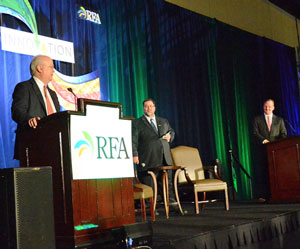
The final panel of the day at last week’s 6th Annual Iowa Renewable Fuels Summit focused on preparations that are being made to make sure retailers and consumers have all the information they need to make an informed choice when it comes to E15.

“A lot of what consumers know now is wrong,” said Ron Lamberty with the American Coalition for Ethanol (ACE).

Lamberty says while there are consumers who are opposed to the use of ethanol and are unlikely to change their minds, there is a good percentage of people who say they would use E15 if it were available. “When we do get E15 out to the marketplace, one of the things we have to make sure we tell people is that it’s out there and they can use it,” he said, noting that the main thing consumers need to know about E15 is that it is the most tested of fuel in history.

Another point that Lamberty believes is important for consumers to know is that the E15 approval for cars and light trucks newer than 2001 is not a mandate. “Approved for and not required,” Lamberty said. “No stations have to sell it and nobody has to buy it,” he said, although the industry believes that once consumers do try it they will want to use it.

As to when E15 will make it to the market, Lamberty says it is anyone’s guess, but he expects Iowa will be one of the very first places it will be available.

Listen to a Lamberty’s presentation at the summit here: Ron Lamberty at Iowa RFA Summit

Listen to an interview with Lamberty here: Ron Lamberty interview

Greg Emick of W&H Cooperative Oil Company spoke as a retailer that has adopted the use of blender pumps last year so they are already offering E15 as a choice in three different locations, along with other mid-level ethanol blends. “Our E15 sales were somewhat slow to increase but the E30 sales jumped right away,” he said. “I feel with promotion, advertising and pubic awareness about E15, it could become a larger percentage of sales at our retail facilities.”

Emick says their customers appreciate that they are promoting flexible fuels because of their environmental friendliness and competitive pricing, and he sincerely believes in the product and wants to see it continue to grow.

Listen to Greg Emick at the summit here: Greg Emick at Iowa RFA Summit

Photos from 2012 Iowa Renewable Fuels Summit

ACE, Audio, blends, Ethanol, Ethanol News, Iowa RFA

USDA Invites Applications for Energy Projects

The USDA is seeking applications to provide assistance for ag producers and rural small businesses to complete a variety of energy efficiency and renewable energy projects.
USDA
“Renewable energy development presents an enormous economic opportunity for rural America,” said Agriculture Secretary Tom Vilsack. “This funding will assist rural farmers, ranchers and business owners to build renewable energy projects, providing opportunities for new technologies, create green jobs and help America become more energy self-sufficient.”

The Rural Energy for America Program (REAP) is designed to help agricultural producers and rural small businesses reduce energy costs and consumption and help meet the Nation’s critical energy needs. For 2012, USDA has approximately $25.4 million budget authority available to fund REAP activities, which will support at least $12.5 million in grant and approximately $48.5 million in guaranteed loan program level awards.

USDA is accepting the following applications:

  • • renewable energy system and energy efficiency improvement grant applications and combination grant and guaranteed loan applications until March 30, 2012;
  • • renewable energy system and energy efficiency improvement guaranteed loan only applications on a continuous basis up to June 29, 2012;
  • • renewable energy system feasibility study applications through March 30, 2012; and
  • • energy audits and renewable energy development assistance applications through February 21, 2012.

More information on how to apply for funding is available in the Jan. 20 Federal Register, pages 2,948 through 2,954.

Agribusiness, Energy, Ethanol, USDA

Farmworkers Install Solar Photovoltaic Systems

Cindy Zimmerman

New Mexico farmworkers are receiving green job training installing solar panels, according to the Association of Farm Worker Opportunity Programs.

HELP-New Mexico, a statewide community-based organization headquartered in Albuquerque, helped prepare a group of farmworkers to obtain certifications that will provide them with the skills, knowledge, and ability to work together with journeyman electricians to design and install solar panel systems. The 48-hour training culminated over the weekend with a hands-on solar panel installation of a system on the homes of two low-income families in Berino, New Mexico.

“The class has provided workforce participants, many of whom are currently unemployed and/or underemployed, with a way to enhance their skills in targeted industries and provide them with a “leg up” in the job market”, states Roni Spetalnick, Southwest Regional Manager, HELP-NM.

Classes began on November 15, 2011, at the El Paso Electricians Apprenticeship Training Facility where a journeyman electrician/trainer helped prepare the New Mexico trainees to take the entry level North American Board of Certified Energy Practitioners (NABCEP) certification exam. Last Saturday, the trainees used their new skills to install solar systems on two homes built by Tierra Del Sol Housing, a nonprofit agency that builds affordable homes for low income individuals. They worked under the guidance and direction of a local solar installation company, Border Solar.

Solar

Butamax and Gevo Continue Battle

Cindy Zimmerman

The battle between Butamax™ and Gevo over isobutanol technology continues.

Last week, Gevo received a landmark patent from the United States Patent and Trademark Office for its GIFT(R) separation unit, a central part of the company’s fermentation technology for the production of isobutanol. The patent, “Recovery of Higher Alcohols From Dilute Aqueous Solutions,” addresses the separation technology used to produce propanols, butanols, pentanols, and hexanols, and also address how ethanol plants can be retrofitted to produce higher alcohols.

At the same time, Gevo also filed a lawsuit against Butamax™ Advanced Biofuels and DuPont charging that those companies infringe the newly issued patent. Gevo contends that Butamax and DuPont “perform the methods described” in the patent without Gevo’s authorization and should pay unspecified damages after a jury trial.

butamaxToday Butamax™ officials called the lawsuit allegations “unfounded.”

“Let us state emphatically, Butamax does not infringe the generic product separation technology claims in Gevo’s recent patent, which is already subject to a validity challenge by a Brazilian inventor,” declared Paul Beckwith, Butamax™ CEO. “While it does not surprise us that questions are being raised as to the validity of Gevo’s latest patent and whether Gevo provided sufficient disclosure in their patent application, Butamax does not use this technology.” Butamax has filed a motion to dismiss Gevo’s previous case against Butamax, and also will pursue early resolution of this latest suit.

Butamax officials claim that because vacuum flash fermentation technology was found to require high energy and water consumption to meet commercial productivity, Butamax developed fundamentally different product recovery systems. “The Butamax™ approach combines energy integration, reduced environmental impact and attractive production metrics. Butamax™ technology is covered by the 7,993,889 patent which is the subject of the Butamax™ lawsuit against Gevo for their unlawful infringement. This patent has significant priority over all of Gevo’s patent filings.”

The battle between the two companies goes back over a year ago to when Butamax was first awarded its patent in December 2010 and filed suit for infringement against Gevo in January 2011.

advanced biofuels, Ethanol, Ethanol News, isobutanol