ACE Conference 2026

Agriculture Secretary Encourages E15 Adoption

Cindy Zimmerman

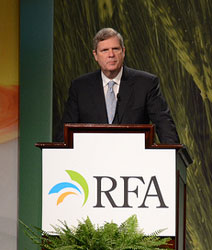
vilsack at national ethanol conferenceThe best way to help the U.S. ethanol industry right now is to encourage the adoption of E15 by fuel retailers, according to Agriculture Secretary Tom Vilsack.

During a telephone press conference on Tuesday promoting USDA’s Rural Energy for America Program (REAP), Vilsack was asked by a reporter what can be done to help the struggling ethanol sector right now.

“If you take a look at the long term history of ethanol, you’ll see that there are peaks and valleys in this commodity,” Vilsack noted. “Our focus is primarily on encouraging blenders to embrace E15. EPA has authorized the use of E15 and this obviously would be a God send.”

Vilsack added that they want blenders to register with EPA to get E15 in the market and they are looking for ways to encourage distribution. “At the same time, we’re also looking at alternative ways to produce ethanol through non-food feedstocks so we can spread the good work this industry’s doing in keeping gas prices down further than they would otherwise be.”

The secretary referenced an Iowa State University study that concluded ethanol helps save motorists up to $1.30 per gallon. “So we obviously need a robust biofuel industry,” he said.

Listen to or download Vilsack’s comments here: Secretary Vilsack on E15

Audio, Ethanol, Ethanol News, USDA

First Rooftop Sun-tracking Solar Power System Installed

New sun-tracking solar devices have been installed by NEXUS EnergyHomes to the rooftop of a row house residence on Federal Hill in Baltimore, Md.
The device, a Dual-Panel Tracker (DPT), consists of two 235 Watt solar panels attached to a sun-tracking mount affixed to the roof. An advanced GPS-controlled drive unit rotates the panels to follow the sun and capture 30 to 45 percent more energy than conventional fixed panels on a flat roof. DPT is manufactured by Advanced Technology & Research (ATR) Corp. based in Columbia, Md.

“With electricity prices reaching unprecedented rates, American home owners are demanding better energy choices,” says NEXUS CEO and President, Paul Zanecki. “This sun-tracker system is the first of its kind to offer higher performance results that make it that much easier to reach electric net-zero goals.”

In 2010 alone, Maryland residential customers paid an average of 24 percent (14.32/kW) more than the national average (11.54/kW per hour).

Carl Chirichella, the row house home owner and an engineer for ATR, was initially intrigued by the technology but says the financial incentives were also very compelling to him as a homeowner. He can expect to see a nearly 20 percent reduction in his electric bill with just the one dual-panel system installed so far. But he can add more at any time. Five such systems would allow him to achieve an electrical “net-zero” balance for his home—eliminating the electrical bill, and potentially offering him energy credits.

“Utilizing the dual-panel tracker is an innovative solution to generating on-site renewable energy within the small footprint that city living affords,” Chirichella says.

Financial incentives beyond the reduction or elimination of power bills include solar renewable energy certificates (SRECs), clean energy grants, and residential renewable energy tax credits. These incentives combined with monthly energy savings will allow homeowners to recoup their solar investment in about 5 years. After that, the system is paid for and will supply free electric power for many years.

Company Announcement, Solar

Miscanthus Genetic Map Completed

Joanna Schroeder

The first comprehensive genetic mapping of miscanthus has been completed. Researchers have been studying the feedstock as a possible source for bioenergy. The goal of the project is to accelerate product development. The results were published in the online journal PLoS One and the project is a collaboration between Ceres and the Institute of Biological, Environmental and Rural Sciences (IBERS) at Aberystwyth University in Wales.

The project entailed creating a collection of genetically related plants and then sequencing and analyzing DNA. Researchers mapped all 19 chromosomes of mischanthus and over several years have analyzed more than 400 million DNA sequences. The benefit of this research is that by isolating positive genes, for example a marker that would yield more biomass per plant, researchers can then focus on that gene, along with others, to create bioenergy superior feedstocks.

Today, miscanthus is primarily grown in Europe and used for electricity generation. It is not commercially viable as a bioenergy feedstock due to high production costs and few miscanthus producers. Ceres Chief Scientific Officer Richard Flavell, PhD, FRS, CBE said that the company will be able to more rapidly introduce important crop traits. The company is currently evaluating various varieties in several locations and anticipates that its varieties of miscanthus will require less time, effort and money to be bred for different environments.

In the past the majority of miscanthus research focused on field trials and this is the first large-scale project of its kind to focus on its genetics. Iain Donnison, PhD and head of the bioenergy team at IBERS added that, “The joint miscanthus development programme with Ceres has provided new insight into the evolution of the species as well as the similarities and differences in populations across different countries and environments.”

advanced biofuels, bioenergy

USDA Plays Biofuels “Matchmaker”

Cindy Zimmerman

USDAThe U.S. Department of Agriculture will be hosting a “match making day” later this month to promote connections between agricultural producers of energy feedstocks with biorefiners seeking to produce biofuels for commercial sale and consumption.

Officials from the U.S. Department of Navy, U.S. Department of Energy, and the Federal Aviation Administration will also attend the March 30 event at USDA headquarters with the goal being to improve awareness and increase understanding of the biofuels supply-chain links between those involved in feedstock production and the processors of that feedstock into biofuels, including logistical challenges, potential roles of service providers, and potential pitfalls.

At this meeting, federal officials will provide a short profile of each section of the supply chain and representatives from the participating stakeholders will respond with brief presentations that outline their experiences in that respective supply chain sector, barriers encountered and lessons learned. They will outline potential growth and opportunities.
Short presentations will be made at the top of each hour leaving time for discussion at each table, at which a representative from each of the sectors of the biofuels supply chain should be seated, as well as one or more government official.

The event is free but participants must register by sending an email to: OSEC-RESupplyChain@osec.usda.gov with information on company, names and titles of attendees and position on the biofuels production value chain (i.e., feedstock seed developer or provider, feedstock grower or harvester, feedstock processor, feedstock transporter, feedstock storer, bio-refiner, feedstock machinery manufacturer/provider, other). More information is available by calling 202-401-0461.

biofuels, Ethanol, Ethanol News, feedstocks, USDA

Cobalt Forms New Bio n-Butanol Partnership

Joanna Schroeder

The Naval Air Warfare Center Weapons Division (NAWCWD) is in the final stage of a biojet fuel project using bio n-butanol produced by Cobalt Technologies. Albemarle Corporation, a chemical company, will use NAWCWD technologies to process Cobalt’s fuel into renewable jet fuel. The project is underway in Albemarle’s Baton Rouge, Louisiana processing facility.

Dr. Michael D. Seltzer, head of NAWCWD’s Technology Transfer Program said its production run of Cobalt’s bio n-butanol is proving to be another attractive pathway to create sustainable jet fuel for both the military as well as commercial aviation.  “We are proud to be working in partnership with Cobalt and Albemarle to create this renewable jet fuel and we look forward to testing the end result.”

The project is funded by NAWCWD and was launched in February 2012. Once completed the bio jet fuel will be tested by the U.S. Naval Air Warfare Center – Aircraft Division as part of the process to achieve military certification for the use of the fuel. The next step after testing will be to engage in larger production runs and additional test flights.

“This is a significant milestone not only for our collective team, but for the greater industry looking to advance sustainable jet fuels,” commented Bob Mayer, CEO of Cobalt Technologies. He added that it has been a pleasure working with the U.S. Navy to advance testing and are pleased with the choice of Albemarle as their processing partner.

biobutanol, biofuels

Ethanol Report on E15 Plan

Cindy Zimmerman

RFA retailer handbookAfter more than a year of waiting since EPA approved its use for 2001 and newer vehicles, 15% ethanol blended motor fuel could be hitting the streets by this summer.

In January 2011, EPA approved a waiver for the use of E15 in 2001 and newer vehicles. Since then, a pump label has been finalized, health effects testing approved and finally, last week, the approval of the Misfueling Mitigation Plan developed by the Renewable Fuels Association.

Ethanol Report PodcastThis edition of “The Ethanol Report” includes comments from RFA president and CEO Bob Dinneen, Vice President of Technical Services Kristy Moore, and Director of Market Development Robert White about the MMP, as well as RFA’s E15 Retailer Handbook, and the E15 Education and Outreach plan for consumers. More information on RFA’s education and outreach plan can be found at e15fuel.org.

Listen to or download the Ethanol Report here: Ethanol Report on E15 Plan

Subscribe to the Ethanol Report here.

Audio, Ethanol, Ethanol News, Ethanol Report, RFA

RFA Ready for 15% Ethanol to be Legal

Cindy Zimmerman

RFAThe Renewable Fuels Association (RFA) is ready for 15% ethanol (E15) to become street legal – something that could happen at any moment.


RFA president and CEO Bob Dinneen, Vice President of Technical Services Kristy Moore, and Director of Market Development Robert White gave an overview of the most recent developments in the commercialization of E15 ethanol blends. Specifically, they discussed EPA’s acceptance of the RFA’s Misfueling Mitigation Plan (MMP) and the release of its E15 Retailer Handbook.

“The job now is largely the industry’s to make E15 a commercial reality and we are working hard to make sure that happens,” said Dinneen.

“RFA has been working on our plan for months,” said Moore. “The (MMP) plan includes not only requirements for the label and appropriate use, it also includes tools and resources to insure that proper wording appears on shipping and product transfer documents and the development of a fuel survey.”

“The exciting time of educating retailers and ultimately consumers is upon us,” said White. “As of today, we will have the new E15 retailer handbook in the hands of more than 13,000 retailers.”

Read RFA’s Misfueling Mitigation Plan.

Read RFA’s E15 Retailer Handbook

Listen to of download all comments from Dinneen, Moore and White here: RFA Media Call on E15 Developments

Audio, Ethanol, Ethanol News, RFA

Susie The Biodiesel Bike Ready For The Highway

Chuck Zimmerman

The COO for the National Biodiesel Board, Donnell Rehagen, proudly displayed Susie, the Biodiesel Bike, to a local audience at the organization’s headquarters in Jefferson City, MO. The event happened just in time for National Biodiesel Day on March 18.

National Biodiesel Board member CIMA Green partnered with Paul Sr. and Orange County Choppers to craft a high performance diesel motorcycle ready to run on biodiesel. The motorcycle will be featured on two episodes of the hit Discovery Channel show American Chopper on March 19th and April 9th.

Originally unveiled at the Biodiesel Conference & Expo in Orlando, FL, the bike is scheduled for several stops from coast to coast to promote biodiesel.

• March 22-24, Mid-America Trucking Show – Louisville, KY
• May 1-3, Atlantic Region Energy Expo – Atlantic City, NJ
• May 14-17, ACT Expo – Long Beach, CA
• August 28 – September 3, Farm Progress Show – Boone, IA
• October 2-3, Green Fleet Conference – Schaumburg, IL

You can listen to my interview with Donnell here: Interview with Donnell Rehagen

Biodiesel, biofuels, National Biodiesel Conference

Sorghum for Ethanol Increases

Joanna Schroeder

Early March is an important time for the agricultural industry when they come together for Commodity Classic. With the challenges facing both the ag and energy industries, which go hand-in-hand, Terry Swanson, Chairman of the National Sorghum Producers said, “We have to be unified.”

When compared to other commodities used to produce biofuels, sorghum growers are a relatively small group. Today, about one third of the sorghum crop is used to make ethanol. However, the industry is hoping to see that number grow. For this to happen, Swanson said they need to speak with one voice.

Swanson, who is a grower in Colorado, said that biofuels and the issues surrounding them, including the RFS, are very important. The RFS is the major driver of increased ethanol use in the U.S. today.

To learn more about sorghum and ethanol, listen to Chuck Zimmerman’s interview with Terry Swanson. Interview with Terry Swanson

Agribusiness, Audio, biofuels, Commodity Classic, Ethanol, sorghum

EPA Readies for 15% Ethanol Rollout

Cindy Zimmerman

The Environmental Protection Agency (EPA) is getting even closer to letting 15% ethanol blended gasoline (E15) make its debut in the marketplace.

This week, EPA notified the Renewable Fuels Association (RFA) that the model Misfueling Mitigation Plan for E15 the organization submitted meets the requirements of EPA’s waiver decision. In January 2011, EPA expanded upon its October 2010 decision and approved the use of E15 for light duty passenger vehicles Model Year (MY) 2001 and newer.

In a letter to RFA President and CEO Bob Dinneen, EPA’s Compliance Division acting director stated that the RFA Misfueling Mitigation Plan “would generally be sufficient to satisfy the partial waivers’ requirements.”

RFA“Americans will soon have a safe and effective new fuel option at the pump that is domestically-made and significantly cheaper than gasoline,” said Dinneen. “EPA is clearing the way for E15 and allowing America’s ethanol industry to turn its full attention to educating retailers and consumers on the benefits of higher level ethanol blends and ensuring that state fuel regulations allow for their sale.”

The next steps will include ensuring companies seeking to offer E15 are registered with EPA, they have submitted the Misfueling Mitigation plan, and are addressing lingering fuel regulatory requirements at the state level. Some states, including Iowa, Illinois, and Kansas, are prepared to welcome E15 and drivers in those states will be among the first to see E15 at the pump.

Coinciding with EPA’s approval of RFA’s Misfueling Mitigation Plan, the RFA released the E15 Retailer Handbook. This Handbook provides guidance for retailers in evaluating existing infrastructure compatibility, safety and conversion practices and state specific regulatory requirements.

Ethanol, Ethanol News, Government, RFA