

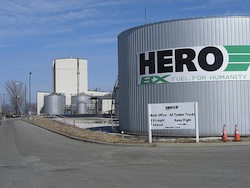
 HERO BX has adopted a new biodiesel technology developed by Arisdyne Systems called the Controlled Flow Cavitation (CFC) process, which reduces catalyst consumption by more than 25%. This also contributes to the reduction of monoglycerides. These two factors have helped HERO BX reduce costs and produce better biodiesel.
“HERO BX and Desmet Ballestra worked together with Arisdyne to test Arisdyne’s cavitation process. After two months of testing, we proved that the technology demonstrated significant cost savings, streamlined operations and improved overall output of biodiesel at our plant,” said John Schenker, plant manager of HERO BX.
The CFC process creates intense energy peaks that result in nano-sized droplets. This enables a more effective mass transfer for instantaneous transesterification, or biodiesel production. Ultimately this leads to greater catalyst savings. According to Arisdyne, the technology can be used in most biodiesel plant and can be installed without having to shut down production.
“In today’s weak economic conditions, margin improvement is everything,” said Dr. Peter Reimers, president and CEO of Arisdyne. “CFC can be applied to the entire value chain for Oleochemical processes starting with yield enhancement in the refining/degumming step and now as well in biodiesel catalyst savings. Having catalyst savings and yield improvements in degumming, neutralization of crude oils is crucial to the oils and fat processing industries.”

 The
The  AFBA president Michael McAdams testified before the U.S. House Small Business Committee’s Subcommittee on Agriculture, Energy and Trade on Thursday, sharing some of the advance biofuels success stories which have occurred over the last year.



 In the Senate Agriculture Committee markup of the 2012 Farm Bill on Thursday, an amendment was added to reauthorize mandatory funding for several national renewable energy programs.