
Dashing through the fields comes GROWMARK and the FS member cooperatives with a load of fuel to make your holiday season warm and bright!

Just the Ethanol Facts
The National Corn Growers Association has created a simple website that offers just the facts about ethanol.
 The website EthanolFacts.com offers information about E15, food versus fuel, energy security, jobs in rural America and more. There is a lot of discussion about ethanol these days, and plenty of need for a look at the facts. That’s why the National Corn Growers Association has created the EthanolFacts.com website as a simple place to get the facts and links to a lot more information about our favorite domestic renewable fuel.
“For years, NCGA has been at the forefront of promoting ethanol as an important choice for today’s drivers, who are demanding fuels that are not only cleaner-burning, but powerful and made right here in the United States,” said Chad Willis, a Minnesota corn farmer who serves as chairman of NCGA’s Ethanol Committee. “EthanolFacts.com provides the key information to people who want to know the simple truth about a very complex subject so they can continue the conversation about how farmers are not only helping feed the world, but fuel it, too.”
EthanolFacts.com was designed for simplicity and clarity on a number of platforms, especially mobile platforms such as tablets and smartphones – and NCGA also has print versions available.
Solectria Renewables Named A Top Job Creator
Solectria Renewables has been named by Inc.’s Hire Power List, as a top job creator. The awards recognized private businesses that have generated the most jobs in the past three years. The company generated 105 jobs between 2008-2011, ranking them #1 Energy Sector job creator in Massachusetts. The company was also one of the top 10 private business job creators within the U.S. Energy Industry during the same time frame. Today, Solectria has more than 160 employees in various positions including engineering, quality, customer service, assembly, administration, sales, marketing and management.
 “Solectria Renewables is extremely honored to receive this prestigious award from Inc. Magazine,” said Aybike Doganci Crott, Chief Operating Officer of Solectria Renewables, who accepted the award during an award ceremony. “Solectria Renewables has been profitable for over 6 years, doubling or tripling sales each year. With this amount of growth, our staff has grown tremendously and we predict this will continue.”
The inaugural Hire Power Awards were sponsored by Bank of America and Merrill Lynch. The awards were created to honor American companies who have increased their workforces.
Eric Schurenberg, Inc. editor-in-chief added, “The top 100 companies on the list have created 73,032 American jobs in the three-year period from 2008 to 2011 – an amazing feat, given that much of that job growth came during the heart of the recession. And it isn’t just the big guys that are adding jobs. Companies with less than $50 million in annual revenue make up nearly one-third of the Hire Power list.”
Movie Review – Chasing Ice
 I spent the weekend in the Twin Cities attending several environmental events. The first event was a screening of the documentary Chasing Ice, produced by environmental photographer James Balog who founded Extreme Ice Survey. It is hard for me to put my emotions into words after watching this moving. It was simultaneously incredibly beautiful and yet horrific. Beautiful in that the imagery of the ice was stunning and horrific because the crew caught on film the melting of glaciers.
James Balog, along with several teams, installed 25 cameras in Greenland, Iceland, Alaska and Montana and over the course of three plus years, the cameras took photos every 20-30 minutes and as I write this, have taken thousands of photos of the glaciers. Every six months, the teams traveled in oftentimes heralding weather to check the cameras, take additional photos and video and switch out memory cards. The results was stunning time lapse photography – who knew that ice could be so beautiful.
Yet what might have been most amazing, was that his cameras and crew caught what is to believed the largest calving incident ever recorded on film. A portion of a glacier in Greenland broke off (nearly the size of Manhattan) over the course of 75 minutes. It was amazing to watch but then the reality of what you are witnessing takes hold – watching the disappearance of the glaciers. While glaciers have calved for centuries, they typically stay about the same in size – one piece breaks off while more ice forms. Yet today, these glaciers are not being replenished, per say, they are vanishing.
One element of the film that could be most interesting, was that James Balog began as a climate skeptic and now believes that climate change is real, and a major part of it is caused by human actions. For those who already believe in climate change, or those who continue to be climate skeptics, this is a must see film. And for those climate skeptics who still deny that climate change is real after seeing this film, well then nothing will change your mind. (I would like to thank the Will Steger Foundation for providing 840 free tickets to see Chasing Ice).
Solar Exceeding Performance Expectations
According to SunPower Systems, who has solar systems operating at 25 California Water Agencies, their power systems have exceeded expectations for overall performance. The company estimates that the systems have saved the state’s public agencies a cumulative total of approximately $5.3 million over the past 12 months.
 SunPower has designed and built nearly 25 megawatts of solar power systems at 43 water facility sites over the past decade. The company says on average, those systems are generating 102 percent of expected production.
“Water agencies and facilities typically have huge energy demand and a responsibility to rate payers to minimize operational costs,” said Howard Wenger, SunPower president, regions. “SunPower delivers the most efficient and reliable solar technology on the market today, with guaranteed performance that ensures these facilities lock in positive financial returns. We are very pleased that our water agency and district customers are seeing returns above and beyond expectations, delivering added value to the public agencies and their ratepayers.”
SunPower has two new water agency projects currently under construction in California: a 922-kilowatt system for Western Municipal Water District located in Riverside, California, and a 1.2 megawatt system for Oceanside, California. This system is estimated to provider between 25-30 percent of electricity for the facility and save more than $1.6 million in electricity costs over the next 20 years.
Both systems will use the SunPower T0 Tracker, a ground-mounted technology that rotates the solar panels to follow the sun during the day, that the company says increases energy capture by up to 25 percent over conventional fixed-tilt systems, while reducing land use requirements.
FAPRI: RIN Prices Could Be on the Rise
 There could be big money in store for Renewable Identification Numbers (RINs)… or not. A new report from the Food and Agricultural Policy Research Institute at the University of Missouri (FAPRI-MU) says that the ethanol blend wall could have the biggest effect on how RIN prices rise or fall:
Expanding ethanol use in the future could require more E15 and E85 sales. More E15 or E85 could require costly infrastructure development and the prices of these fuels might have to be discounted to coax consumers to buy them. Based on this understanding of the fuel market, pushing more ethanol through the system would be increasingly difficult for fuel blenders, meaning that conventional RIN prices could rise in the future.
If the mandates will become more difficult to meet as they force ethanol use to exceed the blend wall, then RIN prices could rise in the future. RINs can be stored, up to a point, so current RINs might reflect expectations about future RIN prices. However, the price of conventional RINs generated in 2012 is less than $0.05 per gallon – 1-2% of the current wholesale price of ethanol – as of November 2012.
But… on the other hand…
There are reasons why the conventional RIN price would remain low despite the looming blend wall.
1. The blend wall could be less of a constraint than expected if ethanol expansion is easy, drop-in biofuels become commercially viable, or more biofuel is used other than as in motor fuels.
2. RIN stocks in the future are expected to exceed the maximum permitted amount, although 2012 market data about biofuel disposition cast some doubt on this explanation in the short run.
3. RIN buyers and sellers could expect that the EPA would waive the broad mandates in the future in the event that the associated RIN prices rise sharply, but this question goes well beyond our analysis.
The report looks at three possible scenarios, and some of those expectations include expanding the Renewable Fuels Standard (RFS). The bottom line is that the change in RIN prices could mean billions of dollars.
Ethanol Groups Respond to EU Investigation
 The European Commission today issued a “general disclosure document” setting forth its proposed ruling in the anti-dumping investigation involving U.S. ethanol exports to Europe.
Growth Energy and the Renewable Fuels Association (RFA) issued a joint statement on the issue:
 “We continue to cooperate with the Commission’s investigation. We are troubled by news that the Commission is recommending a 9.6 percent anti-dumping duty to its Member States. We remain convinced that if all the facts are considered, the European Union will decide not to impose any anti-dumping duties on imports of ethanol produced in the United States.”
Last year, the European Union (EU) initiated anti-dumping and countervailing duty investigations regarding U.S. exports of ethanol to Europe and current U.S. policies surrounding ethanol production and use, specifically the expiring volumetric ethanol excise tax credit, or VEETC, available to blenders of ethanol and gasoline. Allegations by EU ethanol producers suggested that U.S. ethanol exports to Europe were taking advantage of the tax incentive before export, thus lowering its price and harming EU ethanol producers. However, by August of this year it appeared the issue had been resolved and the EU would not be taking any action.
EIA Releases 2013 Annual Energy Outlook Forecast
The Energy Information Agency (EIA) has released its 2013 Annual Energy Outlook forecast summary. While the report looks at all forms of energy with estimates going as far as 2040, there were two areas pertinent to biofuels. The summary forecast stated that renewable fuel use will grow at a much faster rate than fossil fuel use, and the share of generation from renewables will grow from 13 percent in 2011 to 16 percent in 2040.
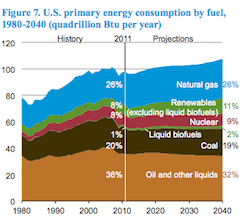 The summary forecasts that while total liquid fuels consumption will fall, consumption of produced biofuels increases significantly, from 1.3 quadrillion Btu in 2011 to 2.1 Btu in 2040, and its share of total U.S. liquid fuels consumption will grow from 3.5 percent in 2011 to 5.8 percent in 2040.
“The increases are much smaller than those in AEO2012, however, as a result of diminished FFV penetration, a
smaller motor gasoline pool for blending ethanol, and reduced production of cellulosic biofuels, which to date has been well under the targets set by the EISA. (EPA issued waivers that substantially reduced the cellulosic biofuels obligation under the RFS for 2010, 2011, and 2012.) In addition, the production tax credit for cellulosic biofuels is scheduled to expire at the end of 2012.”
At first glance the outlook for biofuels looks good, but the ethanol industry doesn’t want the take-away being all is good, but rather cautions that this news is not an invitation to curbing or eliminating the RFS.
“Doing so would only prove their lack of understanding of EIA’s report and, more importantly, show their ignorance of the purpose of the RFS,” said ACE Executive Vice President Brian Jennings. “Congress designed the RFS as a flexible and forward-looking policy to serve as a catalyst for biofuel use, and by design, the RFS is built to help break through the blend wall.”
“EIA, on the other hand, makes its projections based on market conditions and known technology. Ten years ago, the EIA Outlook said we could only make 3.4 billion gallons of ethanol in the U.S. by 2020. Congress deemed that  unacceptable, and passed the RFS to encourage alternatives to oil, and they were right. The RFS works. Our industry produced almost four times that much ethanol two years ago – ten years ahead of schedule.”
The blend wall is one that is not very high and we’re already at the top but now we can’t get over and down the other side. Scaling the blend wall and increased market access is key, explained Tom Buis, CEO of Growth Energy.
“Currently the blend wall is preventing additional use of biofuels. While grain-based biofuels, such as corn ethanol have not only met, but exceeded the goals, the blend wall has prevented full saturation into the commercial marketplace and has discouraged investments in next generation biofuels.”
Buis added that Growth Energy and the biofuels industry will continue to work with retailers and consumers to educate them on higher blends, such as E15 and continue to garner the support necessary to break through the blend wall.
So if there is one takeaway its this – biofuels are growing and will continue to grow but only if the RFS stays in place and communities across the country work together to bring choice to Americans at the pump.
Chamber CEOs: Prioritize Clean Energy
How many Americans realize that we’re still on a fiscal cliff and that the danger has not been averted? Hopefully the majority of us realize this as Congress debates away during this year’s lame duck session. Many issues are under the microscope, but one that many believe is a key priority in economic growth and policy discussions, including the local chamber of commerce CEOs, is further development of clean energy.
The Chambers for Innovation and Clean Energy (CICE) said it plans to be at the table when clean energy options are being discussed in Congress. Among other clean energy initiatives, the chamber CEOs are urging a renewal of the wind energy Production Tax Credit (PTC) that is currently the key incentive responsible for growing wind  energy manufacturing and development in the U.S. Failing to renew the PTC would cause economic harm – layoffs in states throughout the country.
“Our largest wind turbine blade manufacturer in Arkansas, LM Wind Power, has already announced more than 200 layoffs as a result of uncertainty around the PTC,” said Jay Chesshir, President and CEO of the Little Rock Regional Chamber of Commerce. “Wind energy has been a huge economic development success for Little Rock, attracting jobs and investment to our community. Continuing to diversify our energy portfolio is smart business. Allowing the tax credit for wind energy to expire now would only take us backwards and hurt our local and national economy.”
Local chamber CEOs have emphasized homegrown clean energy is helping to diversify local economies and create business growth nationwide. In 44 states across the country, nearly 500 facilities now manufacture for the wind industry, supporting well-paying jobs in red and blue states. The solar industry—including manufacturers, installers, and other service providers—supports more than 100,000 American jobs.
There is proof that clean energy is an economic driver. For example, with leadership from the Merrimack Valley Chamber of Commerce, businesses in northeastern Massachusetts will save upwards of $30 million over the next 30 years. In Cleveland, Ohio, businesses saved a collective $1.5 million in 2011 alone by participating in the local chamber’s leading energy efficiency program.
CICE said community businesses across the nation are ready to lead the world in clean energy. The missing piece – a clear market signal from Congress.
Austin Dillion Wins Rookie of Year Award
American Ethanol sponsored driver Austin Dillion has won the 2012 NASCAR Nationwide Series Sunoco Rookie of the Year award. The ethanol industry has congratulated him and now fans have an opportunity to congratulate Dillion during the American Ethanol live Twitter chat that he will host Monday, December 10, 2012 from 10:30 am to 11:30 am CST.
 Dillon was officially named the 2012 NASCAR Nationwide Series Sunoco Rookie of the Year at Homestead-Miami Speedway. He joins his younger brother, Ty Dillon, as a 2012 Sunoco Rookie of the Year. The younger Dillon clinched the NASCAR Camping World Truck Series version of the award on Friday evening.
“All of the American Ethanol partners are so excited for Austin,” said National Corn Growers Association NASCAR Advisory Committee Chairman Jon Holzfaster. “Rookie of the Year is a big win both for him personally and for farmers across the country. With all eyes on Austin, NASCAR fans also get to see the performance and benefits another homegrown winner offers when E15 fuels the race. Every car in every series races to the finish with E15 in the tank, but we are particularly proud that such a talented young driver speaks on our behalf.”
Austin Dillon, who drives the No. 3 car for Richard Childress Racing, culminated his first full season in NASCAR’s No. 2 tour with two race wins, sweeping both Kentucky Speedway events, along with 16 top-five finishes, 27-top-10s and 3 pole awards. Dillon finished third in the championship point standings and was formally honored for his 2012 accolades at the NASCAR Nationwide Series and Camping World Truck Series championship awards banquet.