Arkansas, home to the Tyson chicken empire, could be the home to a new feedstock for biodiesel… chicken fat.
This story from UPI says researchers in that state are looking at ways to perfect the chicken fat-to-biodiesel process:
 Chemical engineers at the University of Arkansas were successful in using so-called supercritical methanol to transform chicken fat and tall oil fatty acid into biodiesel fuel, the university said Wednesday in a news release. The yield was greater than 90 percent, the university said.
Graduate student Brent Schulte subjected low-grade chicken fat and tall oil fatty acids to a chemical process known as supercritical methanol treatment. Substances become “supercritical” when they are heated and pressurized to a critical point, the highest temperature and pressure at which the substance can exist in equilibrium as a vapor and liquid.
The process is more efficient than other methods of turning chicken fat into biodiesel… as few other chicken fat biodiesel plants have started to pop up, mostly near poultry-processing plants.
 The Earthrace, a biodiesel-powered boat out of New Zealand, will be making another attempt to set the world record for circumnavigation of the globe.
 The credits are “absolutely critical for making a market in the United States,” said Rhone Resch, president of the Solar Energy Industries Association. “What will happen is you will see solar installations start to drop off in the second quarter of 2008 if they are not extended.”
 Congressional action in the early part of 2008 is needed “to keep investors from getting nervous,” said Greg Wetstone, governmental affairs director for the American Wind Energy Association.
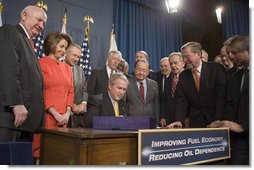 President Bush’s signing of H.R. 6, the Energy Independence and Security Act of 2007, has gained the praise of the National Biodiesel Board.
 “The U.S. biodiesel industry praises President Bush, Speaker Pelosi, Majority Leader Reid and the bipartisan supporters of biofuels in Congress who worked tirelessly to enact an expanded Renewable Fuels Standard (RFS). This is good public policy that meets the needs of consumers and addresses America’s pressing energy security concerns by increasing the use of clean burning, domestically produced biofuels like biodiesel to reduce our dependence on foreign oil. The nearly five-fold expansion of the RFS in this legislation is truly a landmark achievement.
 The “2 Million Mile Haul”… halfway through the study at this point… is looking at the benefits of using 20 percent biodiesel blend (B20) and is being conducted by the Iowa Soybean Association (ISA) in partnership with Iowa Central Community College, Decker Truck Line Inc., Caterpillar Inc., the National Biodiesel Board, Renewable Energy Group, Inc. and the U.S. Department of Agriculture.
  “The trucking industry is by far the single largest consumer of diesel fuel, using 38 billion gallons annually,” said Grant Kimberley, ISA director of market development. “This study demonstrates in a real-world environment that biodiesel can be used successfully year-round.”
 Don Heck, coordinator of biotechnology and biofuels programs at Iowa Central Community College in Fort Dodge, Iowa, said, “Although we have data from only the first year of the study, we are pleased with the results to date. Preliminary results are that B20 biodiesel performs similarly to 100 percent diesel. We found a slight decrease in overall fuel efficiency for the B20 group of trucks, but it was not statistically significant. In fact, the difference was several times smaller than the driver-to-driver variability in fuel efficiency within each group.”
 Smiling Earth Energy has plans to build a 320-million-gallon-a-year biodiesel plant along the Chesapeake Bay in Virginia. But the company has had its troubles recently, including a lawsuit by an Oregon biodiesel company for failing to provide the promised $310 million in financing for a West Coast biodiesel plant… and then refusing to return a $100,000 deposit to the Oregon company (see
  The National Biodiesel Board is applauding the U.S. House’s passage of the Energy Independence and Security Act of 2007 by a 314-100. The U.S. Senate passed identical legislation last week, and President Bush has indicated he will sign it.
 “We congratulate the House and the Senate for the bipartisan efforts of policymakers who worked together to pass this landmark legislation that will help America depend less on foreign oil and more on clean-burning, domestically produced biodiesel,” said NBB CEO Joe Jobe. “Biodiesel producers across America stand ready to meet the aggressive renewable goals provided for in this bill.”