RFA E-15 Ad

EPA Approves New Biofuel Pathways Under RFS

Cindy Zimmerman

Camelina, energy cane and renewable gasoline are now added to the list of qualifying feedstocks and fuels approved by the Environmental Protection Agency for use under the Renewable Fuel Standard (RFS).

EPA released its final rule to identify additional fuel pathways that meet the “lifecycle greenhouse gas (GHG) reduction requirements for biomass-based diesel, advanced biofuel, and cellulosic biofuel” under the RFS.

This final rule describes EPA’s evaluation of biofuels produced from camelina oil, which qualify as biomass-based diesel or advanced biofuel, as well as biofuels from energy cane which qualify as cellulosic biofuel. This final rule also qualifies renewable gasoline and renewable gasoline blendstock made from certain qualifying feedstocks as cellulosic biofuel.

nbb-logoThe National Biodiesel Board (NBB) is pleased with the addition of camelina oil as a feedstock. “This decision adds to the growing list of biodiesel feedstocks that meet the EPA’s standards for Advanced Biofuel and gives us yet another option for producing sustainable, domestic biodiesel that displaces imported oil,” said Anne Steckel, NBB’s vice president of federal affairs. “This is important for our energy security, for our economy and for addressing climate change, and we thank the EPA for conducting a thorough and fair review.”

Read EPA’s final rule here.

advanced biofuels, Biodiesel, biofuels, Cellulosic, Ethanol, Ethanol News, NBB

No Industry Input for Ethanol Hearing

Cindy Zimmerman

The House Committee on Science, Space and Technology Subcommittee on the Environment will hold a hearing tomorrow on mid-level ethanol blends, but without any input from the ethanol industry. Witnesses scheduled to testify include representatives from AAA, motorcyclists and a research council that works for the petroleum industry and auto makers.

Growth_Energy_logoGrowth Energy CEO Tom Buis CEO of Growth Energy says the committee regularly holds biased hearings on ethanol. “It seems to me that if the Science Committee continues to hold these one-sided, sham hearings, they out to change their name to the Science Fiction Committee – because that is exactly how their treatment of ethanol and biofuels have been,” said Buis. “By only inviting vocal critics to discuss mid-level ethanol blends and refusing to invite a single producer or stakeholder in the ethanol industry to testify exemplifies a colossal waste of time and taxpayer money.”

RFA Logo“It both saddens and angers me that in this day and age such a lopsided, stacked hearing could actually happen,” said Renewable Fuels Association president and CEO Bob Dinneen, who submitted a letter to protest the one-sided nature of the witness list as well as note the extensive testing of E15 and the benefits of the blend.

Ethanol organizations have submitted written testimony for the hearing which will begin at 2:00 pm Eastern time on Tuesday.

E15, Ethanol, Ethanol News, Government, Growth Energy, RFA

Gas Prices Up, Up and Away

Joanna Schroeder

As gas prices have been on the rise for more than 32 days, Bob Dinneen, President and CEO of the Renewable Fuels Association (RFA) says that AAA might want to reconsider its recent attacks on ethanol. He writes in a post titled, “As Prices at the Pump Go Up, Up, Up American Ethanol is the Motorist’s Friend,” that through Memorial Day, gasoline prices will likely keep going up up, up.

Gas Prices in Soux City Photo Credit AP“Over the past five years,” writes Dinneen, “gasoline prices have risen an average of $0.51 per gallon between New Year’s Day and the Memorial Day weekend. That means we could be looking at prices well above $4 per gallon as summer begins and families hit the road for vacation.”

“America’s growing use of domestically-produced ethanol reduced wholesale gasoline prices by an average of $1.09 per gallon in 2011, the most recent year for which complete statistics are available, according to a recent study conducted by economics professors at the University of Wisconsin and Iowa State University for the Center for Agricultural Research and Rural Development (CARD).”

Dinneen, after reviewing the positive impacts ethanol is having on both gasoline prices as well as dependence on foreign oil, concludes:

“All of this is something members of Congress need to consider as they assess legislation promoted by the oil industry to repeal or reform the Renewable Fuels Standard (RFS). The RFS is working to expand domestic energy supply, encourage investment in new technologies, and reduce gasoline prices at the pump.”

biofuels, Ethanol, RFA

Solar Energy to Get Boost from New Forecasting

Joanna Schroeder

The National Center for Atmospheric Research (NCAR) is spearheading a three-year, nationwide project to create an unprecedented, 36-hour forecasts of incoming energy from the Sun for solar energy power plants. The research team is designing a prototype system to forecast sunlight and resulting power every 15 minutes over specific solar facilities. This should enable utilities to forecast the amount of available solar energy. The project is primarily funded with a $4.1 million DOE grant.

Clouds“It’s critical for utility managers to know how much sunlight will be reaching solar energy plants in order to have confidence that they can supply sufficient power when their customers need it,” said Sue Ellen Haupt, director of NCAR’s Weather Systems and Assessment Program and the lead researcher on the solar energy project. “These detailed cloud and irradiance forecasts are a vital step in using more energy from the Sun.”

According to NCAR, the research will take aim a one of the biggest challenges in meteorology- accurately predicting cloud cover over specific areas. Solar energy output is affected both by when and where clouds form and  also by the types of clouds present. The thickness and elevation of clouds have greatly differing effects on the amount of sunlight reaching the ground. Wispy cirrus clouds several miles above the surface, for example, block far less sunlight than thick, low-lying stratus clouds. Therefore, cloud predictions can both improve the accuracy of short-term weather forecasts in addition to aiding utilities to tap solar energy more effectively.

“Improving forecasts for renewable energy from the Sun produces a major return on investment for society,” added Thomas Bogdan, president of the University Corporation for Atmospheric Research, which manages NCAR on behalf of the National Science Foundation. “By helping utilities produce energy more efficiently from the Sun, we can make this market more cost competitive.”

Electricity, Energy, Renewable Energy, Solar

EcoEngineers Offers Help with RIN & RFS Compliance

John Davis

rammNavigating the regulatory compliance path of the Renewable Fuels Standard and the associated Renewable Identification Numbers (RINs) can be a daunting task for ethanol, biodiesel and other renewable fuel producers. During the recent Iowa Renewable Fuels Associaton’s conference, Joanna caught up with Jim Ramm (pictured in the middle of the group) with EcoEngineers, a Des Moines-based firm that offers technical and regulatory compliance advice to producers of the green fuels.

“We help those producers to comply with the RFS and to particpate in RIN markets,” Jim said.

He added that RIN prices have gone up dramatically on the ethanol side of the house, and since those higher prices are a reflection of spiked corn prices and dropped ethanol production, it shows the RIN system is working. For biodiesel, RIN prices have dropped because supply increased after the renewal of the $1-a-gallon blender’s credit. It gets even more complicated when you start to factor in whether it is a cellulosic RIN and how fuel producers have to have quality assurance plans to qualify for certain types of RINs. That’s why EcoEngineers has been working since 2009 with producers to develop a web-based platform for RIN management.

“How do I as a producer generate the RINS, sell ’em, match ’em up with the sale,” as well as all of the other compliance issues that allows producers to remain in good standing with the RIN program are what his company works on. Recent stories of RIN fraud hurt the biodiesel RIN market, so quality assurance of those RINs has become more important than ever. “Producers want to differentiate their product and have a RIN that’s been vetted and approved by us.”

More information is available on the company website, www.EcoEngineers.us.

Listen to Joanna’s interview with Jim here: Jim Ramm

View the IRFA Renewable Fuels Summit Photo Album.

Audio, Biodiesel, Ethanol, Iowa RFA, RFS

Bioenergy Bytes

Joanna Schroeder

  • BioEnergyBytesDFA new report has been released “Global Markets and Technologies for Biofuel Enzymes,” that includes an overview of the global market for biofuels enzymes, including amylases, lipases, cellulases, and proteases; and fuels, which include biodiesel, cellulosic ethanol, and biogas. The report also includes an analysis of global market trends, identification of markets by industrial end users, such as the aviation industry, road transport, heating purposes, and off-road equipment, and a discussion of new and different types of regulations.
  • ReneSola Ltd has announced its 72-cell polysilicon modules have been listed by UL (“Underwriters Laboratories”) as meeting required standards for use in PV systems up to 1,000 volts. At the same time, the Company’s 60-cell and 72-cell modules have been listed by UL as meeting required standards for use in PV systems up to 600 volts.
  • Real Good Solar is partnering with Smart Center San Francisco to giveaway a three-year lease on a 2013 smart electric drive vehicle and 1.5kW solar power system to off-set the energy required to charge it. Entrants must live in CA, CO, CT, MA, NJ or VT.
  • Amyris has appointed Zanna McFerson as Chief Business Officer.
  • The Eagle Leasing Company has completed two photovoltaic solar systems at the company’s facilities in Orange, CT and Oxford, MA.  Eagle Leasing teamed with Dynamic Energy to install systems totaling 246.74 kW, consisting of 978 solar panels on the roof of the facilities.


Bioenergy Bytes

DF Cast: Biodiesel Innovators Recognized in BioVegas

John Davis

When you think of Las Vegas, you probably picture the bright lights, wild nightlife and gambling… probably not a home for environmentally friendly biodiesel innovation. But if you think about it, the gambling aspect really came out for a group that was an early adopter of the green fuel.

In this edition of the Domestic Fuel Cast, we talk to Russell Teall, President and Founder of Biodico; Gary H. Weinberg, who was with Haycock Petroleum and is now with Western Sierra Services; Frank Giordana, a transportation director with the Clark County School District; and James Morwood, Fleet Services Manager Support Services at the Las Vegas Valley Water District. These biodiesel pioneers gambled big on biodiesel and are now part of the group recognized with the Eye on Biodiesel: Inspiration award during the 10th Annual National Biodiesel Conference and Expo. Listen to their story about how they overcame their own doubts about the green fuel and how all of what we’re now calling BioVegas came up big winners.

You can listen to the Domestic Fuel Cast here: Domestic Fuel Cast - Las Vegas Biodiesel Innovators

You can also subscribe to the DomesticFuel Cast here.

2013 National Biodiesel Conference Photo Album

See more coverage on the Biodiesel Conference Blog

Audio, Biodiesel, Domestic Fuel Cast, National Biodiesel Conference, NBB

State-by-State Ethanol Update

Joanna Schroeder

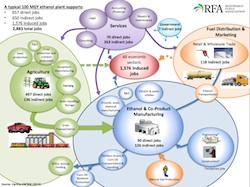
The Renewable Fuels Association has released a state-by-state update to the “Contribution of the Ethanol Industry to the Economy of the United States,” an economic impact analysis performed by Cardno ENTRIX. The original report, released earlier this month at RFA’s National Ethanol Conference, found that the industry has supported over 383,000 direct and indirect and induced jobs across all sectors of the economy last year. The industry contributed $43.3 billion to GDP and $30.2 billion in household income.

Ethanol Jobs FlowchartCommenting on the state-by-state breakout, Bob Dinneen, RFA’s president and CEO, said, “It is clear that the ethanol industry is a powerful economic driver. We are successfully creating job and economic opportunities in a tough economy. Not only are we helping revitalize rural communities across this country, we are positively impacting states outside of the Corn Belt. We are building ethanol refineries and hiring staff for newly operational plants across this nation. We are becoming an economic engine coast to coast, border to border.”

“This economic momentum should not be jeopardized by tampering with the Renewable Fuel Standard (RFS). The RFS is a proven success when it comes to creating jobs, increasing American energy independence, and improving the environment. Don’t mess with the RFS,” concluded Dinneen.

The top ten states experiencing the economic benefits of having ethanol plants operating locally are: Iowa, Illinois,  Nebraska, Minnesota, Indiana, South Dakota, Wisconsin, Ohio, Kansas, and North Dakota.

Click here to read the full report.

biofuels, Ethanol, RFA

RMI Announces Solar Research Project

Joanna Schroeder

Rocky Mountain Institute (RMI) is launching a Simple BoS project, or Balance of Systems, in partnership with Georgia Tech Research Institute (GTRI), to explore the cost divide between the U.S. and Germany for residential solar photovoltaic systems. BoS costs now account for more than 60 percent of the price of U.S. rooftop PV systems, according to RMI, yet such costs are 75 percent lower in Germany, who is the solar PV global leader.

gI_87078_solarpanelinstallerRMI sees reducing BoS costs—all the related solar energy system costs besides the panels themselves including permitting, financing, installation, and inspection—as a critical pathway to affordable PV and widespread solar adoption. RMI and GTRI are partnering with key solar installers across the two countries to explore specific components of the cost divide between solar installation processes in the U.S. and Germany. Using survey data and time-and-motion studies, the project will measure the status quo in both countries, analyze key differences, and then propose solutions to improve the installation process in the U.S. and beyond.

“Despite the U.S.’s failure to lower soft costs to date, others—notably Germany—show it can be done,” said Jon Creyts, program director at RMI. “Identifying the key drivers of price differences between the two markets will help us understand how U.S. installers can dramatically lower these costs and drive the industry into the future.”

Building on the recommendations of RMI’s 2010 charrette on achieving low-cost solar PV, the Simple BoS project will delve deeply into the installation processes and will look at several key factors in the solar installation process, including the labor hours of PV installation, the impact of local government involvement and permitting regulations on installation time and pricing, and the difference in time-to-system activation—the length of time it takes for a solar project to go from signed contract to energized system—between the U.S. and Germany.

RMI is actively recruiting installers now to participate. Interested companies should click here.

Alternative energy, Research, Solar

North Carolina Releases PEV Readiness Plan

Joanna Schroeder

The North Carolina Plug-In Electric Vehicle (PEV) Taskforce has released the first draft of its PEV Readiness Plan along with four regional plans. The plans were created through the N.C. PEV Readiness Initiative: Plugging-in from Mountains to Sea and was one of 16 projects awarded from the U.S. Department of Energy. The project covered the entire state of North Carolina with a focus on four metropolitan areas in the Greater Asheville, Charlotte, Piedmont Triad and Triangle areas.

The report includes a survey of incentives offered by neighboring states and provides recommendations for state and local policy options. North Carolina offers no state incentives for the purchase of PEVs or charging stations while nearby South Carolina, Georgia, Tennessee and Maryland do, the report reveals.

NC PEV Plan“Electric vehicles offer substantial gains in efficiency, emissions and long term savings to the purchaser and incentives can play an important role to spur more wide spread adoption,” said Anne Tazewell, the N.C. Solar Center’s Transportation Manager.

Other key highlights from the NC PEV Roadmap Plan include: there are more than 700 PEVs registered in North Carolina and estimates indicate there will more than 750,000 PEV on state’s roads by 2030; and there are 350 public and 170 private charging stations in the state.

“Currently, North Carolina is still in the beginning stages of plug-in electric vehicle adoption and the statewide NC PEV Roadmap recommends continuing to move forward with collaborative efforts to ensure a more seamless integration of these vehicles and to maintain its position as a leader in plug-in electric vehicle readiness,” said Katie Drye, project manager, Transportation Initiatives, Advanced Energy.

The N.C. Solar Center was one of five principle partners who worked on the PEV project. The Center’s Clean Transportation program co-lead the Piedmont Triad PEV planning process with Piedmont Triad Regional Council and lead the state wide Incentives and Economic Development (IED) Work Group with the N.C. Dept. of Commerce Green Economy team.

Electric Vehicles