NEC 2027

New Technology for Offshore Wind

Joanna Schroeder

A new technology has been released for the offshore wind turbine industry. According to DNV who developed the software, it includes dynamic simulations, advanced fatigue calculation and code check in one analysis package. The module is powered by FEDEM Windpower and is integrated SesamWind_graph_181_tcm4-548092with Sesam. Sesam Wind Coupled Analysis powered by FEDEM Windpower has capabilities ranging from the purely mechanical aspects of a wind turbine to customizable control systems and detailed wind and wave load simulations. The company says its software will increase efficiency and save cost.

“It saves costs by optimisation of wind turbine design and work processes, says Svein Gjølmesli, Fedem Technology’s software manager. He notes that this software is a complete solution for wind turbine design, strength and fatigue analysis.

“The demand for renewable energy is growing rapidly and offshore wind is a significant part of renewable energy sources. Offshore wind installations are facing the same structural integrity challenges as traditional offshore engineering with structural design, hydrodynamic loads, global stresses and fatigue,” said Are Føllesdal Tjønn, Managing Director at DNV Software.

Tjønn concluded, “In addition there are challenges with loads generated from the turbine itself and turbine rotor blades. As offshore wind is moving into deeper waters, engineering of offshore wind installations will take full benefit of Sesam, whether the installation is based on fixed structures, floating structures, shallow waters or deeper waters. With its leading position within offshore engineering, the offshore wind segment is a natural part of the Sesam strategy going forward.”

Electricity, Energy, Renewable Energy, Wind

USDA Aims to Simplify REF Apps

Joanna Schroeder

USDA Rural Development LogoThe U.S. Department of Agriculture has proposed a series of changes to make it easier for agricultural producers and rural small businesses to apply for renewable energy and energy efficiency funding.

“These changes are intended to help agricultural producers and rural small businesses throughout America,” Agriculture Secretary Tom Vilsack said. “They will streamline and simplify the application process and give businesses more time to do what they do best: innovate, create jobs and serve their rural communities.”

The proposed changes would affect applications for loans and grants through USDA Rural Development’s Rural Energy for America Program (REAP). They would:

  • Reduce paperwork, especially for projects under $80,000;
  • Implement a more objective and uniform system to score applications;
  • Authorize funding for refurbished and retrofitted renewable energy systems;
  • Reduce certain reporting requirements; and
  • Establish a quarterly application period for applicants seeking only guaranteed loans. This change is intended to make the program more appealing to lenders and to ensure that funds are available year-round.

USDA is accepting comments on the proposed rule through June 11, 2013. For details on how to submit comments, or for additional information, see Page 22044 of the April 12 Federal Register.

energy efficiency, Renewable Energy

Biofuels Can’t Get Overcome with Negativity Overhang

John Davis

cannon-vilsackThere’s some real negativity hanging over the biofuels industry these days. And while any industry has risks, it seems that the setbacks loom larger over the renewable energy sector compared to what their competitors in the conventional energy sector face. In his talk before the Advanced Biofuels Leadership Conference, “De-Risking a Risky World,” Fred Cannon, the CEO of cellulosic fuel maker KiOR, told the group that the biggest challenge facing the biofuels industry is perception, and they have to shift their thinking to a perception of success for others to see them as successful (his infectious positive attitude is probably why USDA chief Tom Vilsack singled him out to talk with him one-on-one at the conference).

I caught up with him afterwards, and he told me the way to overcome the negatives hanging over the industry is to highlight the wins out there.

“You build it one success at a time,” Fred says. “Every company that starts producing and putting fuel in American cars, you just build on that momentum. And that mitigates the risks.”

But there’s an old saying that I remember from my days in the Air Force (and we’ll clean it up here for general audiences): one “Oh, shoot!” kills a hundred “attaboys.” Fred says we can’t get overwhelmed by the setbacks and feed more into the negative attitudes sometimes around biofuels, because everything seems to get amplified when you’re talking renewable energy. And he says there’s a good way to overcome all the negativity … outside and within the biofuels industry.

“Put clean, sustainable fuel in American cars,” adding that when KiOR’s Columbus, Mississippi cellulosic fuel plant is fully operational, it will put that clean fuel in 25,000 cars a year. He also urges patience, because it takes time to create a new technology.

“We have so much opportunity: a massive market, RFS2, technologies developing. We just have to get through this perception issue of the industry. And we will … one success at a time.”

Listen to my interview with Fred here: Fred Cannon, CEO, KiOR

advanced biofuels, Audio, biofuels

NREL: Biodiesel Quality Shows Dramatic Improvement

John Davis

NRELNew information from the U.S. Department of Energy shows biodiesel quality is better than ever.

This news release from DOE’s National Renewable Energy Laboratory (NREL) found that 95% of the samples from 2011-12 met ASTM International fuel quality specifications… a dramatic improvement from just a few years ago:

“The survey showed a major improvement over results from previous years,” NREL Senior Chemist Teresa Alleman said. “In our 2007 survey of B100 biodiesel, less than half of the samples met quality specifications. More stringent quality requirements, along with the voluntary BQ-9000 quality management program, are among the reasons for this marked improvement.”

The report goes on to say that this improvement comes as production of the green fuel also rose dramatically, up from just under 28 million gallons in 2004 to more than 1 billion gallons in 2012.

You can read more of the survey here.

Biodiesel, Government

RFS Shown to Work Because It Makes Big Oil Nervous

John Davis

coleman1How can we tell the Renewable Fuels Standard (RFS) is working? By how nervous it’s making the big oil companies. That was the message attendees at the Advanced Biofuels Leadership Conference near Washington, D.C. heard.

“We are disrupting an existing marketplace,” says Brooke Coleman, Executive Director of the Advanced Ethanol Council. “We are not social media. We are not creating a new search engine. We are not doing something new… we just happen to be doing what other people are doing, better.”

Brooke says that has made some pretty powerful enemies of biofuels, who are spending a lot of money to destroy the biofuel brand … from corn ethanol to biodiesel to cellulosic biofuels. But he’s confident their attempt to change the Clean Air Act, and thus the RFS, will fail, ultimately because of the political allies biofuels have made.

“You’ve got Republicans and Democrats who see this thing [RFS] work, create jobs … just shy of 400,000 … and it’s just hard to change,” adding the political environment is not conducive to wholesale changes to either the Clean Air Act or the RFS.

Brooke says the diverse group that makes up the biofuels coalition is more together than ever, with efforts like Fuels America, a coalition to protect the RFS and the renewable fuels industry, and more collaboration than ever … without getting hung up on differences within the biofuels sector.

“We don’t agree on everything, [but] the trick is not to get so focused on the one or two things we don’t agree on … and focus on what we DO agree on.”

Listen to more of my interview with Brooke here: Brooke Coleman, AEC

advanced biofuels, AEC, Audio, Cellulosic, Ethanol, Government, News, RFS

Vilsack, LaHood Extend Aviation Biofuels Commitment

John Davis

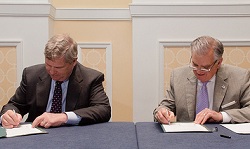
vilsack-lahood3Two members of Pres. Obama’s cabinet today have signed their names to an agreement that will extend the administration’s commitment to the production of biofuels for use in airplanes. Secretary of Agriculture Tom Vilsack and Transportation Secretary Ray LaHood have extended by five years the “Farm to Fly” program, an initiative to partner the USDA and Federal Aviation Administration (FAA) to help develop a viable biofuel for the aviation industry.

During remarks at the ceremony at the Advanced Biofuels Leadership Conference (ABLC) near Washington, D.C., Vilsack said this is a real job producer, especially for rural parts of the country.

“By continuing to work together to produce American made ‘drop-in’ aviation fuels from renewable feedstocks, we will create jobs and economic opportunity in rural America, lessen America’s reliance on foreign oil and develop a thriving biofuels industry that will benefit commercial and military enterprises,” Vilsack said. “USDA is pleased to partner with the FAA in our quest to develop alternatives to fossil-based fuel, which is critical to reducing carbon emissions and protecting the environment.”

LaHood pointed out that it’s been the hard work of people in attendance at the ABLC that made this agreement even a possibility.

“Through the use of sustainable alternative jet fuels, we are showing the world that we can come together to solve our greatest environmental challenges,” said LaHood.

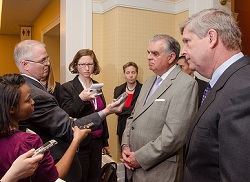
vilsack-lahood4During a news conference after the signing, Vilsack said that while there are some that want to derail the renewable fuels industry through the destruction of programs such as the Renewable Fuels Standard (RFS), he remains one of biofuels’ biggest allies.

I asked Vilsack how they overcome objections from automakers who don’t approve of E15 for most cars on the road, and he bristled and remained steadfastly behind the studies that show it would work in model years 2001 and after.

“The testing would suggest that there would not be damage to the engines. And I think if consumers were given the option, consumers would choose [E15] because they want to be supportive of a domestic fuel industry.”

And while there might be some who dispute on how much renewable energy is saving consumers and creating jobs, Vilsack said there are some things that are crystal clear.

“I am positive consumers benefit from this. I am positive that hundreds of thousands of jobs are connected to this industry. And I am positive that it has stabilized farm income,” he said.

Listen to Vilsack and LaHood’s remarks here: Secs. Vilsack and LaHood at ABLC

advanced biofuels, Audio, aviation biofuels, biofuels, USDA

Advanced Biofuels Leadership Conf. Underway in DC

John Davis

Hello from the Advanced Biofuels Leadership Conference, just a few miles south of the Nation’s capital at the Gaylord National Resort & Convention Center! A lot has been going on already this morning, but before it all got started, I caught up with Jim Lane, the editor for Biofuels Digest, who is putting on this event.

lane1He told me that today will feature the signing of the “Farm to Fly” agreement between Secretary of Agriculture Tom Vilsack and Transportation Secretary Ray LaHood … an agreement that will extend helping develop viable renewable fuels for the aviation industry.

In addition, there are obviously lots of stakeholders from the biofuels industry, including ethanol and biodiesel makers, as well as the big oil companies which have to blend the green fuel into their non-renewable products and the folks from the finance industry who put the money into so many of these ventures. Jim said it’s important to get a diverse group of interests such as these together in one forum to talk about the way forward.

“You don’t have to reach out too hard [to get them together], because they all want to know each other and network like crazy,” he said. He added that policy, finance, production, research … they all come together in this forum.

If you’re not already here, you should try to make it down to the Advanced Biofuels Leadership Conference, going on today, tomorrow and Wednesday (April 15-17). Hope to see you around!

Listen to my interview with Jim here: Jim Lane, Biofuels Digest

We’ll have more later!

advanced biofuels, AEC, Audio

Blend Wall Myth Buster

Joanna Schroeder

Biofuel opponents are crying wolf, so it would seem, claiming that the blend wall is insurmountable. However, the Renewable Fuels Association (RFA) today has published an infographic that busts the myths surrounding the blend wall.

9c345da53735509fb0_pem6bxffy“This graphic perfectly captures the ridiculous myth that an insurmountable blend wall exists,” said Bob Dinneen, RFA CEO and president. “The blend wall is a false façade built by the oil companies to protect their oil monopoly. The real walls are the ones they are building to keep legitimate, well-tested, cost-saving renewable fuel alternatives, like E85 and E15, out of the marketplace. They are building walls between consumers, gas stations, and the freedom to choose. Denial is the mortar holding these walls together — the denial that the Renewable Fuel Standard is a proven success and a powerful energy policy that needs to continue unchanged well into the future if the gains we have made in reducing our dependence on foreign oil, creating valuable jobs domestically, and improving our environment are to be sustained.”

Dinneen continued, “You could say oil companies are building a wall between America’s future and America’s petroleum-dependent past… but given recent events in Arkansas and New Hampshire, perhaps it is more of a moat of toxic ground water and spilled oil.”

Still need the thousand words behind the picture? A brief explanation of each brick in the wall blocking proper implementation by the oil industry of the Renewable Fuel Standard (RFS) and E15 is available here.

Miscellaneous

Passive Solar Conference Offers Free Public Lectures

Joanna Schroeder

Solar 2013As part of the American Solar Energy Society (ASES) National Solar Conference that is kicking off tomorrow, April 16-20 at the Baltimore Convention Center, the 38th Annual Passive Solar Conference will explore two broad themes – the emerging architectural discipline of passive solar design, and the rapidly growing science of building technology. A free lecture open to the public will be given by American Institute of Architects (AIA) Fellow and architect Travis Price, author of “The Archeology of Tomorrow: Architecture and the Spirit of Place,” on Friday April 19 at 3:30. Price will discuss “The Mythic Modern: Mythology, Ecology and Technology…the Spirit of Place.”

The Passive Solar Conference will cover a broad range of themes in emerging architecture, including the Department of Energy road map for Building Integrated Solar Technologies (BIST), which aims to double building efficiency by 2050. ASES notes that today buildings in the US consume more than 70 percent of the electricity and 50 percent of the natural gas produced, accounting for 40 percent of U.S. energy consumption.

Other sessions will explore “Passive Haus,” design, a concept originating in Germany to minimize energy consumption, the trend in Net Zero building, and the impact of climate change on regional design. In a series of sessions oriented around building technology, the conference will present the latest research on energy modeling for buildings, automated controls, and daylighting strategies. Finally, several forums will address important regulatory issues including building codes, zoning and the right to solar access.

The conference exhibition hall will be open to the public starting at 10:00 am from April 17-19 for $10, with a special public day on Saturday, April 20 priced at $5. On Thursday, April 18, two evening sessions, Young Professionals in Renewable Energy (YPiRE) and Emerging Transportation, beginning at 6:30 pm and 7:00 pm respectively, are free and open to the public. The Travis Price lecture on Friday April 19 at 3:30 pm is also free and open to the public.

conferences, Electricity, Energy, Solar

U.S.-Israel Bio-Energy Challenge Heads to DC

Joanna Schroeder

More than a dozen of Israel’s top academic and industrial biofuels research scientists and innovators will be arriving in Washington this week to begin a week-long dialogue with their American counterparts at the U.S. Departments of Energy (DOE) and Agriculture (USDA), as well as with the Navy, FAA and the private sector. Isreal Energy PartnershipThe group be meeting with White House officials and with top government energy program managers and scientists in Washington, DC and will also be meeting with researchers from DOE labs in Oak Ridge Tennessee and in California. The scientific exchange is designed to help build U.S.-Israel collaboration mechanisms for research and innovation to produce alternative fuels that can substitute for petroleum-based gasoline, diesel oil and aviation fuel currently produced from imported oil.

The elite Israeli delegation was chosen through a competition held over several months, ‘The U.S.-Israel Bio-Energy Challenge,‘ in which the initial selection was made in Israel and the final participants were selected with input from the U.S. agencies. The project has been sponsored and coordinated by two U.S. not-for-profit organizations, The Israel Energy Partnership (TIEP) and the U.S.-Israel Science and Technology Foundation (USISTF) and by the Israeli Industry Center for R&D (MATIMOP) on behalf of the Office of the Chief Scientist (OCS) in the Ministry for Trade and Industry.

Project sponsors stress the importance of finding alternatives to petroleum imports at a time when high oil prices once again are a drag on the economy and some oil-producing nations are using oil revenues to develop weapons that threaten their neighbors.

“The one-half trillion dollars of oil revenue OPEC nations collect each year provides enormous geopolitical power to nations that oppose U.S. and Israeli interests, helps fund terrorism, undermines peace, and drains money from our economy,” said TIEP President Jack Halpern. “So, this effort to reduce the industrialized world’s dependence on oil imports will be of benefit to both Israel and the U.S. One of the most important benefits will be the reduction of income for Iran, half of whose government revenue comes from the sale of oil. Without that oil revenue, it will be much more difficult for them to pursue their nuclear ambitions.”

Neil Goldstein, Vice president of TIEP noted that Israel’s role as a scientific, engineering and entrepreneurial leader is well known. “Cutting-edge research and development is taking place in Israel in the selection, bio-engineering, and modification of fuel feed-stocks; in growing novel feed-stocks on non-arable land and without using fresh water; and in the more-efficient and cost effective production of fuels from feed-stocks using innovative chemical, physical and biological processes. Building on that research base, we are establishing a scientific, technical and economic collaboration between Israel and the U.S. to help both nations achieve our energy goals.”

advanced biofuels, Energy, International, Research