NEC 2027

November 2013 Short-Term Energy Outlook

Joanna Schroeder

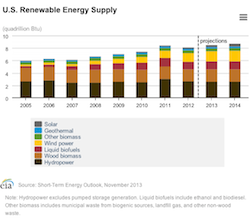
2013 STEO RenewableThe U.S. Energy Information Administration (EIA) has released its November 2013 Short-Term Energy Outlook and Winter Fuels Outlook. The report comes at the same time the 2013 World Energy Outlook was released by the International Energy Agency.

Here are some highlights from the report:

  • The weekly U.S. average regular gasoline retail price has fallen by more than 40 cents per gallon since the beginning of September. EIA’s forecast for the regular gasoline retail price averages $3.24 per gallon in the fourth quarter of 2013, $0.10 per gallon less than forecast in last month’s STEO. The annual average regular gasoline retail price, which was $3.63 per gallon in 2012, is expected to average $3.50 per gallon in 2013 and $3.39 per gallon in 2014.
  • The North Sea Brent crude oil spot price averaged nearly $110 per barrel for the fourth consecutive month in October. EIA expects the Brent crude oil price to decline gradually, averaging $106 per barrel in December and $103 per barrel in 2014. Projected West Texas Intermediate (WTI) crude oil prices average $95 per barrel during 2014.
  • The projected discount of the WTI crude oil spot price to Brent, which averaged more than $20 per barrel in February 2013 and fell below $4 per barrel in July, increased to an average of $9 per barrel in October, driven in part by the seasonal decline in U.S. demand and the resulting increase in crude oil inventories. EIA expects the WTI discount to average $10 per barrel during the fourth quarter of 2013 and $8 per barrel in 2014.
  • U.S. crude oil production averaged 7.7 million barrels per day (bbl/d) in October. Monthly estimated domestic crude oil production exceeded crude oil imports in October for the first time since February 1995, while total petroleum net imports were the lowest since February 1991. EIA forecasts U.S. crude oil production will average 7.5 million bbl/d in 2013 and 8.5 million bbl/d in 2014.
  • Natural gas working inventories ended October at an estimated 3.81 trillion cubic feet (Tcf), 0.12 Tcf below the level at the same time a year ago but 0.05 Tcf above the previous five-year average (2008-12). EIA expects that the Henry Hub natural gas spot price, which averaged $2.75 per million British thermal units (MMBtu) in 2012, will average $3.68 per MMBtu in 2013 and $3.84 per MMBtu in 2014.

EIA Administrator Adam Sieminski issued the following comments about the findings.

Renewables: “Wind power generation is forecast to grow by 17% this year and by nearly 4% in 2014, accounting for more than 4% of total U.S. electricity generation next year. EIA expects continued robust growth in solar power, with solar generation by the U.S. electric power sector increasing 82% this year and jumping another 84% in 2014. However, utility-scale solar power will continue to be a small share of total U.S. electric generation at less than 1%.”

U.S. Liquid Biofuels: “U.S. ethanol production has recovered from last year’s drought. Ethanol production increased from an average of 806,000 barrels per day in October 2012 to 892,000 barrels per day this October, and is forecast to grow to 900,000 barrels per day during 2014.“Read More


biofuels, Electricity, Energy, Natural Gas, Oil, Renewable Energy, Solar, Wind

Call for EU Climate & Energy Framework

Joanna Schroeder

Eight European companies are calling for a strong 2030 EU climate and energy framework based on mutually reinforcing tools and targets, including an ambitious and legally binding target for the share of renewable energy in the energy mix of more than 30 percent. Collectively, the group represents 176,000 jobs and over EUR250 billion annual turnover and is providing cleaner generation technologies, equipment and energy to more than 70 countries worldwide.

According to the group, Europe must remain on the path it has chosen. The energy sector has long investment cycles, and investment decisions in the EU’s liberalised energy Screen Shot 2013-11-14 at 9.43.18 AMmarkets need as much policy certainty as possible. The group also says the key to minimizing costs is a stand-alone, stable and predictable 2030 framework with an ambitious binding renewables target alongside an ambitious binding greenhouse gas reduction target and a robust CO2 price.

“Mutually reinforcing and coordinated targets will significantly minimise uncertainty, lower investment risk, reduce the costs of capital and hence the level of additional financial support needed,” the group writes in a statement. “This framework will help Europe’s competitiveness by driving innovation and technological leadership, and job creation. It will bring down our energy and electricity bills, and help remove the need for renewable energy support in future. It will help ensure a reliable, low-cost supply of clean energy for Europe’s citizens and industry.”

In addition, the group call for a need to reduce energy prices and risks, a fair market, and the need for a coherent overall energy system. Finally, they say, this change will not be possible without a true European market.

“The European single energy market must be rolled out and all efforts should be made to finalise the deployment of vital transnational networks and power exchange mechanisms whilst ensuring the viability of the other parts of the energy system. In this way Europe will maximise its consumption of clean renewable energy, reduce its enormous energy dependence and reduce energy prices for Europe’s citizens,” the statement concludes.

International, Renewable Energy, Wind

BioEnergy Bytes

Joanna Schroeder

  • BioEnergyBytesDFMidAmerican Energy recently reached an agreement with Highland Wind Energy LLC, an Invenergy Wind LLC company, for the acquisition of the approximate 500MW Highland wind project site in O’Brien County. Agreements also were reached with EDF Renewable Energy for the acquisition of the approximate 250MW Lundgren wind project site in Webster County, and with two RPM Access LLC companies for the acquisitions of the approximate 138.6MW Wellsburg wind project site in Grundy County and the approximate 117MW Macksburg wind project site in Madison County. In addition, MidAmerican Energy’s existing Vienna wind farm, constructed in 2012, is being expanded by 44.6MW in Marshall County (Vienna II wind project). MidAmerican Energy has selected Siemens Energy as the turbine supplier for all project sites. All of the blades for the expansion will be manufactured at Siemens’ Fort Madison, Iowa, facility, while the nacelles will be manufactured at Siemens’ Hutchinson, Kan., facility. Siemens will provide turbines utilizing technology from its 2.3MW, G2 platform for all five projects. The contract also includes a service, maintenance, and warranty agreement.
  • Pattern Energy Group has announced that it has erected the first wind turbine at its El Arrayan wind project, a 115 megawatt (MW) project located on the coast of Chile, near Ovalle. Pattern also announced it has passed the mid-point of overall construction at South Kent Wind, its 270 MW project in the municipality of Chatham-Kent in southern Ontario and has erected 50 turbines on the site.
  • Huaneng Power International, Inc. has announced that Guizhou Pan County Jiaoziding Wind Farm Project and Dapanshan Wind Farm Project (each of which is wholly-owned by the Company) had recently obtained the approvals from the Energy Bureau of the Guizhou Province. Jiaoziding Wind Farm Project has a planned installed capacity of 48MW and Dapanshan Wind Farm Project has a planned installed capacity of 48MW.
  • Goldpoly New Energy Holdings Limited has announced that it entered into a framework agreement with China National Petroleum Corporation’s subsidiary Kunlun Trust Co., Ltd. for joint acquisition of 500MW of solar power plants. According to the agreement, Goldpoly and Kunlun Trust will jointly invest and acquire the entire equity interest of approximate 500 MW on-grid solar power plants projects in Xinjiang, Gansu and Inner Mongolia etc, during the period from 2013 to 2015.
Bioenergy Bytes

Houston VA Hospital to Get Biodiesel Generator

John Davis

HoustonVABiodiesel is going to be part of care for our nation’s veterans at a Veterans Administration hospital in Houston. The Michael E. DeBakey VA Medical Center will use a Fairbanks Morse Engine for a 3 MW combined-heat-and-power (CHP) system to general contractor SpawGlass for a power plant expansion.

The Fairbanks Morse dual-fuel, opposed-piston, engine-driven system is designed to operate on either biodiesel fuel or natural gas and has been selected for its ability to meet the multiple requirements set for the project, said Steve Smith, Fairbanks Morse sales manager for the project. These requirements include helping the facility meet the VA’s requirements for the amount of power to be generated from renewable resources. Other project considerations were energy efficiency, reliability, fuel flexibility and the ability to meet stringent local emissions regulations.

The 12-cylinder, turbo-blower Fairbanks Morse genset will be a standby power unit. When in use, it will operate for a designated period on B99 biodiesel fuel, and for the remainder of its operating time, on natural gas, with a one percent biodiesel pilot. The electricity the system generates will be sent to the grid, offsetting the VA’s power consumption from the local utility. Heat from the engine will be recovered and used to heat water for the hospital.

This genset is just part of a 12 MW power plant expansion that includes several smaller gensets fueled solely by biodiesel.

Biodiesel, Natural Gas

Biodiesel Board: Weak RFS Could Cost 8,000 Jobs

John Davis

nbb-logoA strong Renewable Fuels Standard that sees 2 billion gallons of biodiesel production would mean about 66,600 jobs for the U.S. biodiesel industry. But a weak RFS, producing just 1.28 billion gallons of the green fuel as a leaked EPA proposal would call for, means losing about 8,000 of those jobs. This news release from the National Biodiesel Board (NBB) says that’s a lot of paychecks as the current record pace of 1.7 billion gallons this year supports more than 62,000 jobs and $2.6 billion in wages.

“This is further evidence that a growing biodiesel industry and a strong Renewable Fuel Standard (RFS) are good for the economy,” said Anne Steckel, vice president of federal affairs at the National Biodiesel Board (NBB). “Biodiesel is a true RFS success story, and we should continue that momentum next year with modest growth that will create even more jobs.”

Biodiesel is made from an increasingly diverse mix of resources such as recycled cooking oil, agricultural oils and animal fats. The study, which can be found here, found that employment supported by the industry would drop by almost 8,000 jobs if the EPA were to limit production to 1.28 billion gallons, the volume proposal included in a recently leaked EPA document outlining potential RFS standards next year.

“The negative impact of that proposal is clear – it would force biodiesel plants to close and put people out of work,” Steckel said. “The EPA and the Obama Administration can avoid that by supporting a strong 2014 standard that is at least consistent with this year’s production.”

LMC International, a global economic research firm, did the study on behalf of NBB.

Biodiesel, NBB, RFS

Industrial, Commercial, to Dominate EV Market

Joanna Schroeder

According to a new report from IDTechEx, over the next decade, the largest global electric vehicle (EV) value sector will be industrial and commercial for land, water and air – accounting for nearly 50 percent of the total hybrid and pure electric vehicle business. “Industrial and Commercial Hybrid & Pure Electric Vehicles 2013-2023: Forecasts, Opportunities, Players,” finds that the EV industry is expected to grow five-fold to over $300 billion in 2024.

The report find that those EVs not bought primarily on up-front price, such as buses and military vehicles and the heavy lifting or pushing vehicles such as forklifts and earthmovers, will continue to dominate. These customers are companies and governments primarily EV Reportconcerned about the total cost of ownership and performance. Less important are private individuals with concerns about up-front price when they buy smaller or lighter duty EV vehicles or electric bikes.

In addition, the EV market will grow with consumers also buying leisure boats, light aircraft with this category to dominate about 35 percent of the EV business to 2024. Military e-vehicles, land, water and airborne will be most of the remaining value market in 2024 and, as with industrial and commercial ones, they are not bought primarily on up-front price.

Dr. Peter Harrop, Chairman of IDTechEx said, “Manufacturers of industrial and commercial electric vehicles and their parts/services tend to be profitable whereas those making personal electric bikes and cars report most losses and bankruptcies. That said there are far too many manufacturers of light industrial and commercial e-vehicles. Their profitability can be improved even further by mergers and a shakeout of those that are neither niche nor volume players, as happened in the heavy lifting, pulling or pushing industrial and commercial sector with electric forklifts, ten years ago.”

The report shows that within the on-road types, buses are particularly important vehicles primarily due to the massive program of the Chinese government followed by electric vans and delivery trucks, conventional electric cars and special designs used as taxis and converted golf cars converted as people movers in airports, theme parks and hotel grounds. Finally, the report finds that indoor forklifts will continue to be the main subsector of industrial and commercial vehicles but with largest growth from relatively new applications such as agriculture, mining, utility and construction vehicles and outdoor forklifts.

Electric Vehicles, Research

Football for Hope. Energy for Hope.

Joanna Schroeder

Yingli Solar has announced a milestone in its work with Federation Internationale de Football Association’s (FIFA) Football for Hope program. The 16th center has been officially inaugurated in Alexandra, South Africa. To honor the occasion, Deputy Minister of Sport and Recreation, Mr. Gert Oosthuizen, FIFA’s General Secretary, Mr. Jerome Valcke, representatives of the non-profit organization Grassroot Soccer (GRS), the South African Football Association (SAFA) and Yingli Green Energy (the parent company of Yingli Solar) jointly addressed the media.

The FIFA “20 Centres for 2010” campaign, which was launched as part of the 2010 FIFA World Cup official corporate social responsibility program “Football for Hope,” is nearing YINGLI GREEN ENERGY HOLDING COMPANY LIMITEDcompletion. Alongside FIFA, Yingli Green Energy, an Official Sponsor of the FIFA World Cup and one of the world’s largest PV module manufacturer, utilized its expertise in renewable energy to provide solutions for this campaign to assist FIFA in improving the social environment for children in Africa with solar power. For the centre in Alexandra, Yingli Green Energy provided PV modules for the solar street lighting system.

“I would like to thank Yingli Green Energy for their contributions in our social campaign ’20 Centres for 2010′ and the installation of the solar panels that are crucial for the sustainability of the Centres,” said Mr. Jerome Valcke, General Secretary of FIFA.

Yingli Green Energy has equipped all centers with a total of 258 pieces of PV modules with a supply capacity of 23 kilowatt peak. Each center was able to choose between a variety of photovoltaic systems such as a solar-powered lighting system for the playing field, a water pump including water reservoir or a photovoltaic power supply system. Since the launch of the campaign, 16 centers have been built across the African continent and four remaining centers pending by the end of the year or in 2014.

FIFA has closely and constantly collaborated with the communities where the center had been built, in order to ensure that the new infrastructure would meet the local needs. Each Football for Hope center consists of a playing field for football and a building where educational projects take place and football is viewed as an instrument for promoting motivation and dialog within the community.

“We are happy to bring light and hope to the children in Africa,” said Judy Tzeng Lee, Vice President of Global Marketing at Yingli Green Energy. “Even though the project is coming to an end, the Centres will keep on supporting young people for many years. We look forward to continuing our partnership with FIFA in creating a more sustainable future through our expertise in renewable energy products and our passion for football.”

Electricity, International, Renewable Energy, Solar

World Energy Outlook 2013 Released

Joanna Schroeder

According to the International Energy Agency’s (IEA) 2013 edition of the World Energy Outlook (WEO-2013), technology and high prices are opening up new oil resources, but this does not mean the world is on the verge of an era of oil abundance. The report also finds that the Middle East, the only large source of low-cost oil, will take back its role as a key source of oil supply growth beginning in the mid-2020s. Between now and then, America and Brazil will play a key role in providing oil.

WEO_2013_Cover_WEB1The annual report presents a central scenario in which global energy demand rises by one-third in the period to 2035. The shift in global energy demand to Asia gathers speed, but China moves towards a back seat in the 2020s as India and countries in Southeast Asia take the lead in driving consumption higher. The Middle East also moves to center stage as an energy consumer, becoming the world’s second-largest gas consumer by 2020 and third-largest oil consumer by 2030, redefining its role in global energy markets. Brazil, a special focus in WEO-2013, maintains one of the least carbon-intensive energy sectors in the world, despite experiencing an 80 percent increase in energy use to 2035 and moving into the top ranks of global oil producers.

Energy demand in OECD countries barely rises and by 2035 is less than half that of non-OECD countries. Low-carbon energy sources meet around 40 percent of the growth in global energy demand. In some regions, rapid expansion of wind and solar PV raises fundamental questions about the design of power markets and their ability to ensure adequate investment and long-term reliability.

“Major changes are emerging in the energy world in response to shifts in economic growth, efforts at decarbonisation and technological breakthroughs,” said IEA Executive Director Maria van der Hoeven. “We have the tools to deal with such profound market change. Those that anticipate global energy developments successfully can derive an advantage, while those that do not risk taking poor policy and investment decisions.”

The availability and affordability of energy is a critical element of economic well-being and, in many countries, also of industrial competitiveness. In WEO-2013, large variations in energy prices persist through to 2035, affecting company strategies and investment decisions in energy-intensive industries. The United States sees its share of global exports of energy-intensive goods slightly increase to 2035, providing the clearest indication of the link between relatively low energy prices and the industrial outlook. By contrast, the European Union and Japan see their share of global exports decline – a combined loss of around one-third of their current share.

“Lower energy prices in the United States mean that it is well-placed to reap an economic advantage, while higher costs for energy-intensive industries in Europe and Japan are set to be a heavy burden,” said Fatih Birol, IEA Chief Economist.Read More

Energy, Renewable Energy, Solar, Wind

BioEnergy Bytes

Joanna Schroeder

  • BioEnergyBytesDFA new 1.4-megawatt utility-owned fuel cell is now in full operation at Cal State San Bernardino. The commissioning of a Direct Fuel Cell DFC1500 power plant, a joint project with Southern California Edison, was recently completed. Now integrated into the campus’s central plant, the fuel cell is generating electricity to the utility grid with waste heat to the campus at no cost to the university.
  • Sasol and General Electric’s GE Power & Water have together developed new water technology that will clean waste water, while also providing biogas as a by-product for power generation. This new technology, known as Anaerobic Membrane Bioreactor Technology (AnMBR), will be further developed at a new demonstration plant at Sasol’s R&D Campus at its Sasol One Site in Sasolburg, South Africa.
  • Abengoa has been selected by AES Gener, one of the leading energy companies in Chile, to develop a new reverse osmosis desalination plant for AES Gener’s Angamos power plant. The company will manage the engineering, construction and subsequent operation of the project which will have a total budget of US $26 million and will provide 19,200 m3/day of water for reliable energy generation for Angamos and third party clients.
  • Ecotech Institute, the first and only school in the U.S. solely focused on renewable energy and sustainability, announced the appointment of David Needham as its new president. Needham will be responsible for implementing the vision and strategic direction of the school; ensuring student, graduate and employer satisfaction; and making sure all staff at Ecotech Institute meet the high expectations of Ecotech Institute students and its parent company, Education Corporation of America.
Bioenergy Bytes

Renewable Energy Education Coming from NFU

John Davis

NFUlogoSeparating fact from fiction is the goal of a new curriculum from National Farmers Union (NFU) focusing on renewable energy. The curriculum will be made available free to organizations, schools, institutions and businesses that build cultural awareness and acceptance of renewable fuels.

“Renewable energy is fast becoming a way of life for millions of Americans,” said NFU President Roger Johnson. “Technological advances are delivering sustainable, reliable, and increasingly affordable sources of renewable energy. At the same time, Americans are curious about the economic and environmental costs of relying on fossil fuels.”

Lessons are available for use with students in high school grades 9-12, as well as separate lessons for both college and adult students. Each module contains three unique areas of focus, for a total of nine different lesson plans. The sessions are tailored to appeal to the specific audiences and use a variety of educational activities to engage students in the learning process. The lessons come with separate guides and resource sheets to assist teachers in understanding and implementing the curriculum.

The curriculum is available here or by contacting NFU Director of Education Maria Miller at mmiller@nfudc.org.

Farming