ACE Conference 2026

Greenbelt Resources: Why Small Is the New Big

Joanna Schroeder

On the surface it may seem like the technology for producing ethanol is pretty advanced. But when you talk with Darren Eng, CEO of Greenbelt Resources Corporation, they don’t believe today’s technology is near where it could be so they are continually striving for innovation.
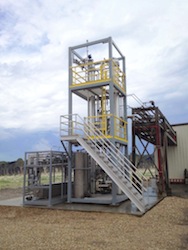
Greenbelt_revised photo_FinalUnlike the traditional biofuel producers who look at producing 25 million plus gallons per year, and send their ethanol all over the country and in some cases across the wide oceans, Eng says Greenbelt’s strategy is working with local communities to convert their waste to biofuels that are then used locally. And for a small community, a “small-scale,” system can range between 500,000 gallons per year (gpy) up to 2 million gpy.  In line with this thinking, under 2 million gpy ethanol modules could soon be the new “big-scale”. In other words, Greenbelt’s technology is the perfect example of “community energy,” or locally owned energy projects, and they can produce modules from 100,000 to 2 million gpy.

“Our model is for our technology to be used to locally recycle (or process) locally generated feedstocks (ideally waste materials) into products that can be consumed locally,” said Eng. Greenbelt’s target feedstock is waste material and their suite of products include ethanol, filtered water and fertilizer. “So our target market,” continued Eng, “is anyone generating an appropriate feedstock at quantities too small to make it worth transporting long distances but large enough to take advantage of one of our systems.”

Eng explained that their technology can use a wide range of feedstocks to produce cellulosic ethanol and byproducts. Feedstock types include wastes from the ag and food industries; waste beverages and beverage bottling process waste; corn harvested for local dairy cow consumption; non-food alternative energy crop growers; island communities; and developing countries. In addition, he said farming consortiums in remote areas who can aggregate their wastes and/or low value crops and convert them into products they would otherwise have to pay high prices for due to the high cost of transportation because of their remoteness, is also a great target for their technology.

The Greenbelt technology is different than large-scale technologies in several ways. The company provides a commercially viable, small scale, modular, energy efficient feedstock-to-product ethanol production system. The overall system is semi-automated with their distillation and dehydration modules fully automated, explained Eng. “The front-end (typically fermentation) module only requires a minimal amount of manual labor each day for feedstock input. Additionally, the load out of products requires some oversight if not manual handling in some instances,” he added.

A key component to the system’s uniqueness and its high efficiency is the inclusion of a patent pending membrane dehydration module. Greenbelt is the only biofuel company that offers membrane technology. “Membrane use allows for a less complicated system design and requires about a third less energy compared to a molecular-sieve as a result of the complexity,” said Eng.

There is also a slight but simple difference in how it works. Read More

advanced biofuels, Cellulosic, Ethanol, technology

Firefighters Brew Up Own Biodiesel

John Davis

rioricofdFirefighters are certainly some of the best public servants, and now at least one group of them in Arizona is trying to be ecological heroes, too. This story from KGUN-TV in Tuscon says the Rio Rico fire department is converting waste cooking oil into biodiesel.

“There’s a lot of technical processes to go through and there’s a few of us that know how to do it,” said Patrick McCarthy, public information officer for Rio Rico Fire.

The Rio Rico Fire District is one of only a handful of districts actually making Biodiesel.

“As far as I know, what we’re doing is industry leading as far as producing our own Biodiesel,” said McCarthy. “We would like all the departments to start doing it because it benefits their communities and the environment also.”

The district converts used cooking oil it collects from restaurants, but also more and more people are starting to drop off oil at the district’s three stations.

“It’s just really really catching on and I think the community is starting to see the benefit of recycling their oil instead of throwing it away,” said McCarthy.

Right now, more than half of the Rio Rico fire department fleet runs on biodiesel, and they’re shooting to have all their trucks running on the green fuel. Area residents wanting to help out can donate their used cooking oil.

Biodiesel

Impact of RFS on Ethanol Industry

Cindy Zimmerman

nec14-panel-1The first panel of the 2014 National Ethanol Conference dealt with the impact of the Renewable Fuel Standard (RFS) on the ethanol industry – today and tomorrow. Renewable Fuels Association (RFA) Senior Vice President for Research and Analysis Geoff Cooper moderated the panel which featured remarks from Bruce Babcock, Cargill Chair of Energy Economics at Iowa State University and Steffen Mueller, Principal Economist with the University of Illinois at Chicago and Genscape, Inc.

Babcock shared some of his research on the feasibility of meeting expanded ethanol targets and the impact that could have on fuel prices. He summarized some of the results of a recent analysis from the Center for Agricultural and Rural Development (CARD) at Iowa State University that shows the RFS reduces gas prices.

Listen to Babcock’s remarks here: Comments by Bruce Babcock, Iowa State University

Mueller talked about his research into how biofuels have helped to reduce greenhouse gas emissions. “The RFS2 works as intended,” he said. “It reduces greenhouse gas emissions relative to petroleum. The biofuels industry has a very high rate of technology adoption – much higher than in other sectors – and that reduces the greenhouse gas balance. The RFS2 encourages the adoption of that technology and will so in the future.”

He specifically noted that “tight oils” or fracking have higher greenhouse gas emissions or carbon intensity values compared to traditional petroleum.

Listen to Mueller’s comments here: Comments by Steffen Mueller, University of Illinois-Chicago

Hear the entire panel discussion here: NEC RFS Impact Panel

2014 National Ethanol Conference Photo Album

NEC Coverage sponsored by Patriot Renewable Fuels LLC

advanced biofuels, Ethanol, Ethanol News, National Ethanol Conference, RFA, RFS

BioEnergy Bytes

Joanna Schroeder

  • BioEnergyBytesDFPresident Obama has called upon the U.S. Department of Transportation and Environmental Protection Agency to develop critically important new fuel economy standards for millions of semi-trucks, large vans, buses, and other large trucks that ply America’s highways. A new report from the Consumer Federation of America, Paying the Freight: The Consumer Benefits of Increasing the Fuel Economy of Medium and Heavy-Duty Trucks, finds that efficiency improvements for big trucks could save the average American household $250 dollars per year in the cost of consumer goods and services.
  • This year 1412 students around the world are participating in the Valeo Innovation Challenge. A total of 969 teams of engineering students from 55 countries and representing 455 universities have submitted their projects, with the goal of winning the €100,000 first prize. Nearly 60 Valeo experts and a number of independent scientists will review each of the submitted projects to select the 20 teams that will continue on to the next stage of the contest. The 20 short-listed teams will be announced on April 15, 2014, and Valeo will grant each of them €5,000 to create a functioning prototype.
  • BBI is calling for proposals for its upcoming International Fuel Ethanol Workshop and Expo taking place in Indianapolis, Indiana June 9-12, 2014. Tracks include: Production and Operations; Leadership and Financial Management; Coproducts and Product Diversification; and Cellulosic and Advanced Ethanol. Deadline to submit proposals is February 26, 2014.
  • Microgrid Solar, headquartered in St. Louis, announced that is has received certification as a B Corporation. Certified B Corporations are a new type of corporation which use the power of business to solve social and environmental problems. These B Corporations are leading a global movement to redefine success in business. By voluntarily meeting higher standards of transparency, accountability, and performance, Certified B Corps are distinguishing themselves in a cluttered marketplace by offering a positive vision of a better way to do business.
Bioenergy Bytes

A Word from the Chairman of RFA

Cindy Zimmerman

nec14-neillThe chairman of the Renewable Fuels Association this year is Neill McKinstray, President of the Ethanol Group for The Andersons, Inc.

McKinstray welcomed attendees to the 19th annual National Ethanol Conference on Tuesday in beautiful, sunny Central Florida. “Like many of you here I’m very happy to be away from the polar vortexes and the snow drifts of the Midwest,” he said, noting that his company is headquartered in Toledo, Ohio and is part owner of four ethanol plants located in Ohio, Iowa, Indiana and Michigan. NEC Welcome by Neill McInstray, RFA Chairman

During an interview with Domestic Fuel, McKinstray expressed optimism about the future of the ethanol industry as it heads into the future. “We have our challenges, but the industry continues to show strength and vitality,” he said.

Commenting on the keynote remarks made by Dave Whikehart of Marathon Peteroleum, which is a partner of The Andersons, McKinstray noted that “Marathon is a pragmatic and capitalistic company” just like his company. “I think they believe long-term, as we do, that the economic viability (of the ethanol industry) will sustain our industry without the need – necessarily – for government mandate,” said Whikehart. “On the other hand…the RFS establishes at least some stability for that industry to grow.” Interview with Neill McInstray, The Andersons, RFA Chairman

2014 National Ethanol Conference Photo Album

NEC Coverage sponsored by Patriot Renewable Fuels LLC

Audio, Ethanol, Ethanol News, National Ethanol Conference, RFA

Green Charge Networks Help Save Green

Joanna Schroeder

Green Charge Networks can help retail chain customers and city municipalities save some green. The company, which specializes in intelligent energy storage, has signed agreements for 1 MW of energy storage with several organizations that are looking to reduce their electricity bills via smart grid technologies.

GreenStationFor example, it is common in California and New York City for business to pay 40 percent or more for their monthly electric bill in “demand charges” based on their electricity use during peak times. To reduce these costs, Green Charge Network uses its GreenStation technology. It works by collecting utility and weather data to predict peak use and store energy accordingly.

7-Eleven stores have been using GCN’s GreenStation successfully for the past two years. One 7-Eleven GreenStation in New York endured Hurricane Sandy and then went on to save the business 56 percent on their electricity bills during the 2013 summer heat wave. Green Charge Networks is adding to its list of customers including 7-Eleven, Walgreens, office buildings, community colleges, and municipalities, adding up to 1 MW as listed on the DOE’s Global Energy Storage Database.

“It is a big accomplishment to our company to help businesses and local governments use power more efficiently,” said Vic Shao, CEO at Green Charge Networks. “1 MW marks a very significant milestone for Green Charge Networks as we continue to diversify our customer base and increase our penetration in the rapidly growing intelligent energy storage market. Energy efficiency initiatives can only take us so far. The era of power efficiency using advanced software is the next frontier in energy savings.”

It is no secret that America’s aging grid needs to be reborn. Yet with the billions, if not trillions, of dollars it would take to accomplish this and ongoing fights on who should pay for the updates (utilities/consumers or state and federal governments) smart grid technologies can help immediately reduce electricity demand on the overstressed grid.

Experts also say that they are also a good tool in both climate change adaptation and mitigation. Green Charge Networks points out that GreenStation is designed to withstand storms as fierce as Hurricane Sandy or temperatures as extreme as the recent polar vortex. In addition, Green Charge Networks says if smart grid technologies like GreenStation were implemented nationally they could save the energy equivalent of 4,000 coal plants per year.

Electricity, energy efficiency, Energy Storage, Smart Grid

Marathon Exec Keynotes Ethanol Conference

Cindy Zimmerman

nec14-marathonIt is often said that the goal of a keynote speaker is to set the tone for a conference but the goal of the address given by Dave Whikehart of Marathon Petroleum Company at the National Ethanol Conference was more to allow the ethanol industry to hear the perspective of a fuel refinery partner.

Whikehart tried to explain why the petroleum industry has problems with the Renewable Fuel Standard (RFS). “Marathon petroleum supports corn ethanol because it is a transportation fuel and we are in the transportation fuel business,” he stressed, noting that they have a history of investing in and marketing corn ethanol blends. “What we do not support is government intervention in our markets and mandates that attempt to force products on our customers.”

As director of Product Supply and Optimization for Marathon, Whikehart made quite a few comments that the ethanol industry disputes when it comes to refiners being able to comply with the RFS going forward. He stated that demand for E85 is “non-existant” and that “E85 sales have limited growth potential.” In addition, Whikehart called introduction of E15 a “non-starter” due primarily to liability issues.

The ethanol industry disagrees and the rest of the NEC program this week is dedicated to proving that the RFS is working and that refiners and retailers can do what is needed to meet the goals of the program.

Listen to or download Whikehart’s complete remarks here: NEC Address by Dave Whikehart, Marathon Petroleum

2014 National Ethanol Conference Photo Album

NEC Coverage sponsored by Patriot Renewable Fuels LLC

Audio, Ethanol, Ethanol News, National Ethanol Conference, Oil, RFA, RFS

Ethanol Industry Rising Tides, Falling Walls

Cindy Zimmerman

nec13-themeFalling Walls, Rising Tides is the theme for the 19th annual National Ethanol Conference being held this week in Orlando.

Calling it a “mixed metaphor,” Renewable Fuels Association president and CEO Bob Dinneen said in his “State of the Ethanol Industry” address today that it is appropriate and will come to define the year ahead.

nec14-dinneen“2014 will be the year the blend wall comes crashing down. 2014 will be the year the cellulose wall is cracked.” said Dinneen. “And 2014 had better be the year we take the brick and mortar away from Big Oil and deny them their wall of ignorance and misinformation that undermines public support for ethanol.”

“How will these walls tumble? By reminding people time and again that ‘a rising tide lifts all boats.'”

Dinneen hammered home the simple message
they will be delivering to Washington this year. “Keep. Your. Word.” when it comes to the Renewable Fuel Standard.

Read the full text of Dinneen’s speech here, watch the video in the previous post, listen to or download full remarks here:
RFA's Bob Dinneen state of ethanol industry address

2014 National Ethanol Conference Photo Album

NEC Coverage sponsored by Patriot Renewable Fuels LLC

advanced biofuels, Audio, Ethanol, Ethanol News, National Ethanol Conference, RFA, RFS

Live Stream of State of Ethanol Industry Speech

Chuck Zimmerman

National Ethanol ConferenceHello from the National Ethanol Conference in Orlando, FL. This morning we’ll live stream Bob Dinneen’s, Renewable Fuels Association, annual state of the industry address. Introductions will start at 8am, est., with Bob scheduled at 8:15am. We’re also recording it to post afterward. When you click on the player below it will start with a short commercial before the live feed.

Post Update: You can now watch the recorded video of the live stream below.


Video streaming by Ustream

2014 National Ethanol Conference Photo Album

NEC Coverage sponsored by Patriot Renewable Fuels LLC

Audio, biofuels, Ethanol, Ethanol News, National Ethanol Conference

Student Talks Biodiesel By-Product at Conference

John Davis

pickett1The cutting edge of innovation was certainly on display at the recent National Biodiesel Conference & Expo in San Diego. Among the many innovations was a University of Kansas graduate student, who, with a little financial assistance from the folks at the Kansas Soybean Commission (KSC), talked about a new use for the biodiesel by-product, glycerin.

Derek Pickett … was part of the Next Generation Scientists for Biodiesel (NGSB) program that aimed to educate and collaborate with young scientists.

Pickett presented his findings about using glycerin for power generation during a conference session specifically designed for student-scientists to share their cutting-edge research. Glycerin is a byproduct of biodiesel production, with each gallon of biodiesel producing about 1 pound of glycerin. His research found glycerin that is converted to a synthetic gas has the potential to be an inexpensive source of power.

“Kansas soybean farmers are excited to see young scientists so enthusiastic about research related to biodiesel, which can be made from our crop,” said Dennis Gruenbacher, Andale, who represents the commission’s south-central district. “Those students already are working hard to find even more opportunities for biodiesel to benefit America’s environment and energy security.”

This year, the National Biodiesel Board’s NGSB program brought 36 students from 18 universities to the conference, with 18 of them received scholarships from state soybean organizations and USB. Last month’s gathering also marked the new session that focused solely on university biodiesel research.

Biodiesel, Biodiesel Conference, NBB, Research, Soybeans, University