RFA E-15 Ad

Ethanol Education for Motorcyclists

Cindy Zimmerman

sturgis-15-robertAn expanded schedule for free fuel happy hours at the Sturgis Buffalo Chip this year is giving the Renewable Fuels Association (RFA) even more opportunity to educate motorcyclists about ethanol.

“We here on two different levels,” said RFA VP of Industry Relations Robert White. “The first is to make sure everyone knows they shouldn’t use more than 10 percent ethanol in their bikes.”

“On the next level, all of these people have engines at home – car, truck, SUV, lawn mower, chainsaw, weed eater, whatever – we want them to know that should be either 10 percent in their smaller engines, E15 in newer vehicles or E85 in flex-fuel vehicles,” said White. “Match the engine with the right fuel.”

sturgis-15-harleyWhile all motorcycles can use E10, White has a custom motorcycle of his own that can actually use higher blends. “My particular motorcycle is a 2009 Road King Classic Harley Davidson,” he said. “All I did was change the computer to allow a wider fuel ratio band so I can use anything from E0 to E85 intermittently, and the bike has run seamless.”

The reason White made the modification on his own bike was in part to show motorcycle manufacturers it could be done. “If they did this at the factory it would cost 100 bucks, just like a flex fuel vehicle,” said White. Additionally, it was to show that motorcycle engines are capable of running on higher blends. “I’ve run 85 percent ethanol on it for over 10,000 miles multiple years now,” he said. “These motorcycles are a lot stronger than people give them credit for.”

No matter what, White says all major motorcycle manufacturers warranty the use of 10 percent ethanol and that is the main message during the free fuel happy hours at the Sturgis Buffalo Chip Campground from 1-4 pm through Thursday this week.

Listen to White explain more in this interview: Interview with Robert White, RFA

2015 Sturgis Motorcycle Rally with RFA at the Buffalo Chip Photos

Audio, Ethanol, Ethanol News, Motorcycle, RFA, Sturgis

Free 10 Percent Ethanol at Sturgis Buffalo Chip

Cindy Zimmerman

sturgis-15-woodyThe Renewable Fuels Association (RFA) has been providing free E10 fuel fill-ups for bikers at the Buffalo Chip Campground during the Sturgis Motorcycle Rally for the past four years, and every year Chip owner Rod “Woody” Woodruff is first in line.

“RFA has been here for a long time getting the word out about ethanol, that it is safe, because there’s all that false information going out there,” said Woodruff. “But, what’s important, when they’re at the Buffalo Chip, they’re extending the hand of friendship in good faith to anybody that wants to accept it and it’s very well received here.” Woodruff has been a strong supporter of ethanol since 1999 when he bought the motorcycle he rides all the time and he says he has never used anything but E10 in it.

This year marks the 75th anniversary of the Sturgis Motorcycle Rally in the Black Hills of South Dakota and the 34th anniversary of the Buffalo Chip Campground, the place where a big percentage of bikers call home during the rally. Woodruff says they made lots of improvements to the facility in anticipation of increased traffic this year. Early estimates were for a million plus visitors to the rally, which is called “one of” the biggest in the country – but probably really is the biggest.

In addition, earlier this year Buffalo Chip became South Dakota’s newest town. “The idea of the town was to be a town for bikers, by bikers, just to have as little regulation and government intervention as possible,” said Woodruff.

RFA will be providing free 93 octane premium E10 fuel from 1-4 pm through Thursday at the Buffalo Chip.

Listen to my interview with Woody here: Interview with Woody Woodruff, Buffalo Chip Campground

You can also watch Woody in action in this video:


2015 Sturgis Motorcycle Rally with RFA at the Buffalo Chip Photos

Audio, Ethanol, Ethanol News, Motorcycle, RFA, Sturgis, Video

Wind Can Play Big Role in Clean Power

Joanna Schroeder

As states begin to put their Clean Power Plans (CPP) into place, the Energy Information Administration (EIA) has conduced analyses on potential optimal energy sources as part of a state’s electricity  mix. The leader: wind.

According to the American Wind Energy Association (AWEA), wind’s role has not been widely discussed. As it relates to wind energy, the EIA found (as detailed in a report from AWEA):

  • Wind energy plays the largest role in the lowest cost energy portfolio for CPP compliance, with significant wind energy deployment in nearly all regions.
  • Recent declines in the cost of wind energy, coupled with the wind’s role in protecting against increases in the price of natural gas, make wind energy the lowest cost compliance options for nearly all regions.
  • Using zero-emission wind energy provides states with valuable flexibility that allows for less dramatic changes to the generation mix than using a resource with some emissions.
  • Based on EIA’s analysis, wind energy should be viewed as a “no regrets” solution for meeting the CPP.
Michael Goggin, Senior Director of Research, American Wind Energy Association.

Michael Goggin, Senior Director of Research, American Wind Energy Association.

In an interview with Michael Goggin, senior director of research for AWEA, he said that states are already forming regions and they are in the process of developing their plans and wind energy is playing a role in these plans. AWEA has provided a handbook for states to use as a guide for incorporating wind into the CPP plans.

Today, he noted, wind energy is being transferred from one region to another; however, improving transmission lines will be an important factor for states as they continue to add more renewable energy to their mix and replace aging infrastructure.

Using EIA’s analysis as a guide, Goggin explained that by 2030, the energy generation mix is expected to be: wind (57%), natural gas (10%), solar (14%) and energy efficiency (19%) while the costs of wind significantly declines and in the last four years, wind energy prices have declined by 60 percent along. However, he noted that wind opportunity identified by the EIA is conservative and does not account for changes that the EPA has proposed to the CPP rule that are expected to expand wind energy’s role even further. He added that their costs are outdated and about 15 percent higher than actual wind costs today, so in the future, wind is likely to be even more cost-effective than indicated.

Wind will play a role in all regions, said Goggin, even those that don’t generate the wind electricity themselves. He along with the AWEA team are working with regions to help them develop their plans. The EPA is expected to issue final rules in August.

To learn more about wind’s role in the Clean Power Plan, listen to my interview with Michael Goggin here:AWEA's Michael Goggin Talks Wind, CPP

Audio, Clean Energy, Clean Power Plan, Electricity, Wind

BioEnergy Bytes

Joanna Schroeder

  • BioEnergyBytesDF1The Osaka Sangyo University (OSU) Solar Car Team’s, OSU-Model-S equipped with Trina Solar’s Interdigitated Back Contact (IBC) cells and modules, has won the “2015 FIA ALTERNATIVE ENERGIES CUP Solar Car Race” held at the Suzuki International Racing Circuit. This is OSU’s fourth consecutive victory. The “OSU-Module-S” developed by OSU’s Solar Car Team was 100% powered by solar cells developed by the State Key Laboratory of PV Science and Technology of Trina Solar.
  • President Barack Obama will lead the nation’s foremost clean energy conversation as the keynote speaker during the “National Clean Energy Summit 8.0: Powering Progress” at Mandalay Bay Resort Convention Center in Las Vegas Monday, Aug. 24, 2025. In its eighth year, the Summit is co-sponsored by U.S. Senator Harry Reid, Center for American Progress, the Clean Energy Project, MGM Resorts International and the University of Nevada, Las Vegas.
  • New analysis from Frost & Sullivan, “Impact Assessment of Materials in Wind Energy Generation,” finds that about 9,500 tonnes of composite materials are used annually for manufacturing wind blades. Between now and 2020, the materials segment will grow at a rate of 17 percent annually. The study looks mainly at materials for rotor blades and nacelles but includes foundation and tower applications.
Bioenergy Bytes

REG to Acquire Imperium Renewables

John Davis

REGBiodiesel giant Renewable Energy Group (REG), based in Iowa, will acquire Seattle-area Imperium Renewables. REG says the deal includes a 100-million gallon nameplate capacity biomass-based diesel refinery and deepwater port terminal at the Port of Grays Harbor, Washington.

Under the terms of the agreement, REG will pay Imperium $15 million in cash and issue 1.5 million shares of REG common stock in exchange for substantially all of Imperium’s assets. In addition to these payments, REG will pay either $1.75 million in cash or 175,000 shares of REG common stock at closing as elected by REG. For two years post-closing, Imperium may receive up to a $0.05/gallon payment for biomass-based diesel produced and sold. In addition at closing, Imperium will retain its net working capital value of approximately $25 million. REG will also assume $5.2 million of Imperium’s debt from Umpqua Bank, which has agreed to provide REG Grays Harbor, LLC with an additional loan capacity of up to $5 million to fund capital expenditures and improvements at the Grays Harbor facility. Closing is subject to satisfaction of customary closing conditions.

“Bringing the Imperium assets and their team into the REG network is a tremendous addition to our business,” said REG President and CEO Daniel J. Oh. “As we combine our companies, we will expand the reach of REG along the west coast, including production and distribution. We already sell into these markets as they have responded to the call for more clean, advanced biofuels through low carbon fuel standards. This will enable REG to be more efficient and timely in our delivery and improve our supply assurance. We look forward to working with Imperium’s experienced staff and plant employees, maintaining operational activities at Grays Harbor, and becoming active members of the community working with the Port of Grays Harbor and the cities of Hoquiam and Aberdeen.”

“REG’s growth over the last eight years has made them an industry leader and our biodiesel facility in Hoquiam will greatly expand their domestic production footprint and continued success.” said John Plaza, president and CEO of Imperium Renewables. “We hope our facility will help them continue to grow and diversify biofuel production and sales both locally and around the region.”

Biodiesel, REG

#Biodiesel Supports #AgMedia

Cindy Zimmerman

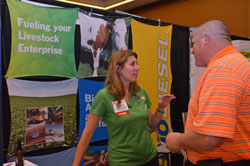
ams15-nbbThe National Biodiesel Board (NBB) was proud to once again be a part of the Ag Media Summit last week and share their positive message about the biodiesel industry.

“AMS is really a great gathering of a wide variety of publications across the ag industry,” said Jessica Robinson of NBB. “It’s a good opportunity to talk with people and let them know that biodiesel is growing and as we grow we’re playing a larger role in these spaces.”

NBB exhibited in the InfoExpo and also sponsored some of the professional improvement workshops at the event. They had a special focus this year on the livestock industry and how biodiesel is helping to make producers more profitable. “We know people are always looking for new and interesting stories and this is definitely a good one and one we’re happy to share,” said Jessica.

Interview with Jessica Robinson, National Biodiesel Board

2015 Ag Media Summit Photo Album

Audio, Biodiesel, NBB

How Are You Connecting Equipment & Data?

Jamie Johansen

New Holland ZimmPollOur latest ZimmPoll asked the question, “Do you consider yourself social media savvy?”

It’s exciting to see so many people out there that have grasped social media as way to communicate online and also use it as a marketing tool. Yet will had a few pollers who don’t see it as beneficial. It is hard to look into the future and not see social media. Changing and developing yes, but not leaving for good.

Here are the poll results:

  • Yes – I’ve got it – 55%
  • Yes – Still need training – 23%
  • No – Want to learn more – 6%
  • No – Not worth my time – 16%

Our new ZimmPoll is now live and asks the question, How are you connecting your precision equipment and data?

Drones, big data, new standards are all precision ag buzz words but connectivity was a common theme this year at the InfoAg Conference. More and more companies are developing stable wireless options to communicate back and forth from the cab. Let us know what method you are using and feel free to leave a comment.

ZimmPoll

Wind Energy Zoning Needs Improvement

Joanna Schroeder

Tthe Center for Rural Affairs has released a report, “Zoned Out: An Analysis of Wind Energy Zoning in Four Midwest States,” that finds zoning need improvement. According to Alissa Doerr, Center for Rural Affairs legal extern and author of the report, Zoned Out analyses different approaches to zoning commercial wind energy systems in four different Midwest states – Iowa, Minnesota, Nebraska, and Wisconsin. The report also broke down the advantages and disadvantages of these approaches, and what makes for effective zoning standards.

Center for Rural Affairs Logo“Wind energy zoning remains generally uncoordinated and subject to state and local regulations, resulting in a piecemeal approach where zoning standards vary between states and within states,” Doerr said. “In order for wind energy development to continue increasing, there must be an effective approach to wind energy zoning implemented that reduces inconsistency and unpredictability caused by the patchwork approach that is currently in place.  The key is finding the right balance between local and state control.”

Doerr noted that as more wind energy projects are developed, members of local communities continue to have questions including how it will affect the community and what role the community plays in the development process. She added that zoning authorities must aim for efficient and effective standards, incorporating considerations from the local areas where wind development would take place.

Doerr further explained that the key to effective wind siting and zoning regulation is to strike the right balance between local and state control, avoiding some of the pitfalls for either approach, while trying to capture the benefits. Authorities at the state and local level must consider the pros and cons that can result from difference ordinances. The ideal balance should be focused on consistent standards that still allow for local autonomy.

“As wind power continues to play a bigger role in meeting our energy demands, it’s important that we craft regulations that incorporate local preferences and address local concerns, while also providing clear and consistent standards for developers,” Doerr concluded.

Clean Energy, Electricity, Wind

BioEnergy Bytes

Joanna Schroeder

  • BioEnergyBytesDF1Novozymes has become a member of the the Minnesota Bio-Fuels Association. “We are pleased to welcome Novozymes to our portfolio of members. Novozymes provides its customers with advanced bioinnovation solutions that set new standards for performance and viability,” said Tim Rudnicki, executive director of the Minnesota Bio-Fuels Association.
  • In the first six months of 2015, the European offshore wind industry installed more new capacity than in any other year on record as several projects reached completion and deployment of larger turbines increased. Installations in the first half of 2015 touched 2,342.9MW – tripling the grid-connected capacity for the same period last year. As a result, total installed offshore wind capacity in Europe hit 10,393.6MW in 82 wind farms across 11 countries.
  • Senate President Kevin de León and California Air Resources Board Chair and Governor Edmund G. Brown, Jr. appointee Mary Nichols have announced the award of $1.6 million to the City of Los Angeles for an electric vehicle pilot program in disadvantaged neighborhoods. Pasquale Romano, president and CEO of ChargePoint, said of the announcement, “Today, California leaders are making a clear statement: California’s innovation economy is for everyone, including economically hard hit communities where clean technology investments mean more jobs and healthier communities.”
  • Hydro Ottawa has announced that it has acquired 10 run-of-the-river hydroelectric facilities from Fortis Inc., in Ontario and nearby New York State; representing approximately 30.9MW of installed operating green energy capacity. Hydro Ottawa was already the largest municipally-owned producer of green energy in Ontario with a generation capacity of 48 MW. The acquisition aligns with Hydro Ottawa’s 2012-2016 Strategic Direction to increase the utility’s supply of clean energy to customers, and by pursuing low risk opportunities with stable long-term returns.
Bioenergy Bytes

Voters Want Pro Clean Energy Prez Candidates

Joanna Schroeder

NextGen Climate has released the results of a survey that finds voters in key presidential swing states support transitioning to at least 50 percent clean energy by 2030. Hart Research conducted the poll in eight battleground states including: Colorado, Florida, Iowa, Nevada, New Hampshire, North Carolina, Ohio and Wisconsin. In particular, the survey found that young voters (Millennials) are more likely to vote for a candidate who embraces aggressive climate change goals.

The survey also found:

  • 70% of voters had a favorable reaction to a goal of at least 50% clean energy by 2030 — including 69% of independents and 54% of Republicans.
  • 61% of voters said they would be more likely to vote for a candidate who embraced this goal, while only 14% say they would be less likely.

“Transitioning to a clean energy economy is an ambitious goal, but one that is necessary and achievable — and politically potent, ” said NextGen Climate President and Founder Tom Steyer. “It’s time for presidential candidates in both parties to produce plans to achieve at least 50% clean energy by 2030 and put us on a path to a completely clean energy economy by 2050—creating millions of jobs across the country and protecting our economy from the most devastating impacts of climate change.”

The survey supports that swing state voters believe achieving at least 50 percent clean energy by 2030 is an “important priority” and “necessary” and favor specific policies and initiatives that will build a clean energy economy. Millennial voters are particularly likely to support the goal, and see it as “inspiring.”

The poll is part of an NextGen Climate initiative to call on leaders to embrace policies that accelerate the transition to a clean energy economy.

Clean Energy, Climate Change, Environment, Video