U2’s Bono Helps Celebrate Solar in Africa

Joanna Schroeder

U2's Bono with Gigawatt Global co-founders Yosef Abramowitz and Chaim Motzen, plus Electrify Africa Act co-sponsor US Senator Chris Coons at East Africa's first solar field near Kigali, Rwanda. Bono and Abramowitz are both Nobel Prize candidates for 2015. (PRNewsFoto/Gigawatt Global)

U2’s Bono with Gigawatt Global co-founders Yosef Abramowitz and Chaim Motzen, plus Electrify Africa Act co-sponsor US Senator Chris Coons at East Africa’s first solar field near Kigali, Rwanda. Bono and Abramowitz are both Nobel Prize candidates for 2015. (PRNewsFoto/Gigawatt Global)

Bono of U2 fame joined a delegation of U.S. Government representatives to celebrate the one-year anniversary of the first completed solar field under the White House’s Power Africa program. The 8.5 MW project, developed by Gigawatt Global and built by Scatec Solar, is on the grounds of the Agahozo-Shalom Youth Village near Kigali, Rwanda. Bono’s One.org backs the Electrify Africa Act, which is co-sponsored by Senator Chris Coons (far right) and advances power production as a strategy to combat poverty. Yosef Abramowitz and Chaim Motzen, co-founders of Gigawatt Global, an American-owned Dutch solar and social development enterprise, led the tour of the field.  Bono and Gigawatt Global are both candidates for the 2015 Nobel Peace Prize, which will be announced next month.

Clean Energy, Electricity, International, Solar

BioEnergy Bytes

Joanna Schroeder

  • BioEnergyBytesDF1Innovative Solar Systems, LLC (ISS) has now announced that it will become an Independent Power Producer (IPP) in all 50 States. The company will become one of the largest independent power producers in the nation by selling the majority of the power produced from the company’s 2016 solar farm projects directly to the end user and provide a win/win situation for both ISS and well as the customers of the company’s power.
  • Panasonic has announced it was awarded a competitive grant from the U.S. Department of Energy’s Advanced Research Projects Agency-Energy (ARPA-E). The funding will be used to develop a technology that aims to lower the cost of solar photovoltaic systems, improve their performance and ultimately help to reduce use of fossil fuels.
  • Yingli Green Energy Europe GmbH and Namene Energy International Limited, a leading renewable energy solutions developer focused on West Africa, have formed a new joint venture, Yingli Namene West Africa Limited. The new venture aims to develop a total of MV of utility-scale solar projects and up to 50 MW of commercial rooftop projects in Ghana and neighboring countries over the coming years and Yingli Europe will serve as the JV’s preferred solar panel supplier.
  • UBM India will host the 9th edition of its flagship event, Renewable Energy India Expo (REI) from September 23-25th at the India Expo Center, Greater Noida. REI is a global platform where India’s green economy community including overseas participants will congregate to discuss industry trends, challenges and market insights including the Indian regulatory framework. The event aims to further upscale and mainstream the applications of renewable energy resources, showcase innovations, product launches and enrich the deliberation through international exhibition and conference platform.
Bioenergy Bytes

Algae Biomass Summit to Highlight Comm’l Potential

John Davis

ABOScientists and industry innovators will be talking about the commercial potential of algae at the upcoming 9th Annual Algae Biomass Summit, taking place in Washington, DC. This news release from the Algae Biomass Organization says the summit happens Sept. 30th-Oct. 2nd and features nearly 30 oral presentations on the business strategies, technologies and sustainable production methods that are bringing to market algae-based products, such as fuels.

“The leaders of the algae industry and research community are gathering in Washington, DC for the very first time at this year’s Algae Biomass Summit to highlight the unprecedented progress we have seen in algae’s potential to impact a number of multi-billion dollar markets,” said Al Darzins, Program Chair for the Algae Biomass Summit. “Companies from around the nation, and the world, are unveiling new production and process technologies, new facilities, new purchase agreements and other milestones. The commercial potential of these projects in terms of revenues, jobs and production yields will be hot topics at this year’s summit.”

The summit will have four tracks and more than 100 live presentations.

More information is available here.

algae, biomass

Missouri Biodiesel Plant Coming to Life, Finally

John Davis

lakeviewenergyAfter too many years languishing empty, a Missouri biodiesel plant is finally coming to life. This article from Moberly (MO) Monitor-Index says Chicago-based Lakeview Energy, LLC is re-opening what started as the Producer’s Choice Soy Energy biodiesel facility and will now be known in the northern Missouri town as Lakeview Biodiesel, LLC.

The new project will not come cheap for Lakeview. The company is estimated to devote $5 million to upgrade the facility.

Lakeview Energy, LLC CEO Jim Galvin mentioned that the Moberly Area offers a significant workforce pool to pull from including many people with work experience in the biofuels sector.

Galvin went on to say, “After looking at various locations, we decided to expand in Moberly due in part to the availability of the PCSE facility but also the abundance of quality employees in the area. We are excited about the opportunity to rapidly expand our operations and the necessary work on the Moberly facility has already begun. We have enjoyed working with the City of Moberly and MAEDC and look forward to a long and rewarding relationship in Moberly.”

Last month, Lakeview Energy got some help in the form of a U.S. Department of Agriculture $3.3 million loan guarantee to help acquire this Missouri biodiesel plant and make improvements to bring it online to produce enough biodiesel to run approximately 16,500 vehicles annually.

Biodiesel

Swedish Mill Dumps LPG to Put in Biomass Boiler

John Davis

Waggeryd1A pulp mill in Sweden is ending its use of non-renewable LPG in favor of a biomass boiler. This news release from Waggeryd Cell says it will invest about $7 million to run the flash dryer on biomass, expected to be up and running next March and reducing the mill’s fossil carbon dioxide emissions by 85 percent.

Waggeryd Cell produces bleached CTMP and ever since start-up in 1989 the whole production has been flash dried using LPG as heat source. When the new boiler has started in September 2016, LPG will be totally replaced by bioenergy. It is a grate boiler with an effect of about 12 MW. The supplier is Urbas, an Austrian company specialising in systems designed to extract energy from wet and coarse wood fuels from sawmills, woodworking factories and general forestry thinning. It is a turnkey project and Urbas is responsible for the whole delivery, including projecting, mounting and start-up.

“This is yet another of the environmental investments we have done since we began modernising the mill fifteen years ago,” says Ulf Karlsson, MD Waggeryd Cell. “By replacing LPG for our flash dryer with heat from the new biomass boiler we will reduce our emissions of fossil carbon dioxide by 85 % at the same time as we reduce our costs. The boiler will be fuelled by sawdust, oversized wood chips and fibre residuals from our process as well as bark and fuel wood mainly supplied from our owner ATA Group’s sawmills.”

Urbas has been designing, building and pioneering energy systems for use of biomass fuels for more than 20 years.

biomass, International

RFA Responds to Anti-Ethanol Boat Campaign

Joanna Schroeder

This weekend marks the end of “summer” and boaters are expected to hit the waters for one last hurrah. In an effort to undermine the Renewable Fuel Standard (RFS) and growth of biofuels, the Boat Owners Association of the United States (BoatUS) released a survey of Fueled with Pride - Boat Safe Fuel Rightits members that show half of them say ethanol free gas is not available to them at marinas and gas stations. In addition, the survey found that 91 percent of boaters want ethanol-free gas for their boat and more than half of the respondents claimed to have had to replace or repair their boat engine or fuel system parts due to suspected ethanol damage.

Interestingly, this past weekend, an ethanol-powered speed boat reached speeds of 208 MPH in an annual shootout.

In response, the Renewable Fuels Association (RFA), stated:

“The poll results are, unfortunately, a clear indication that the myths surrounding boating and ethanol continue to exist,” said Bob Dinneen, President and CEO of the Renewable Fuels Association. “The National Marine Manufacturers Association has engaged in a relentless misinformation campaign regarding E15 and, in doing so, has confused the issue. It is simply not true that ethanol and boat engines do not mix. E10 is safe for boat engines. In fact, every boat manufacturer warrants the use of ethanol-blended fuel with up to 10 percent ethanol. So boaters should not have any worries about filling their engines with E10 over the Labor Day holiday.”

RFA has made available information related to ethanol use in boats. Click here to learn more.

biofuels, Ethanol, Ethanol News, RFA

Nebraska Wants Clean Air

Joanna Schroeder

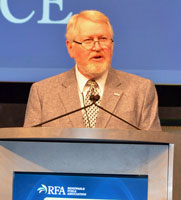
Kim Clark ACE 2015Kim Clark, former director of biofuels development for Nebraska Corn spoke during the recent Ethanol Conference in Omaha, Nebraska hosted by the American Coalition for Ethanol (ACE) about their Clean Air for Nebraska campaign. Her focus is to educate consumers across the state about ways to improve air quality. The goal of the campaign is create awareness around how using ethanol in fuels is a small step to make a big impact in air quality. She noted that there is a good number of organizations supporting the efforts.

The multi-facted campaign includes adding additional biofuels infrastructure throughout the state with Nebraska Corn allocating $500,000 to adding more blender pumps. Next, the campaign is focusing on helping consumers understand what ethanol blends are and what cars can use what blends including E15 and E85. Much of the marketing is taking place at the pump but the campaign also included radio ads. Ultimately the clean air campaign supporters hope their tools can be used by other regions and states as a template for biofuel and air pollution education.

To learn more about the Clean Air for Nebraska campaign, listen to Kim Clark’s presentation: Kim Clark, Clean Air for Nebraska

2015 ACE Annual Meeting Photos

ACE, ACE Ethanol Conference, Audio, biofuels, E15, E85, Education, Ethanol

BioEnergy Bytes

Joanna Schroeder

  • BioEnergyBytesDF1NextEra Energy and Hawaiian Electric Company, Inc., Hawaii Electric Light Company, Inc. and Maui Electric Company Limited (collectively referred to as Hawaiian Electric), subsidiaries of Hawaiian Electric Industries, Inc. have provided additional extensive details on NextEra Energy’s plans for its merger with HEI, including a comprehensive package of 85 commitments, of which more than 50 are new, that would accelerate the achievement of Hawaii’s goal of an affordable, 100 percent renewable energy future by 2045.
  • Hydro-Québec and Eversource Energy have underscored their firm commitment to help solve New England’s energy challenges through their long-standing partnership. The two companies are working together to build the Northern Pass Transmission project, which will export 1,000 MW of hydropower from Québec’s world-class generation fleet to New England, increasing clean energy trade between the Northeast U.S. and Eastern Canadian electricity markets, a primary goal of the New England Governors and the Eastern Canadian Premiers.
  • Canadian Solar has announced that its wholly owned subsidiary, Recurrent Energy, one of North America’s largest solar project developers, signed an agreement with Southern Power, a subsidiary of Southern Company. Southern Power will acquire a controlling interest in the 200-megawatt (MW) Tranquility Solar Power Project in California. The project, developed by Recurrent Energy, is currently under construction.
Bioenergy Bytes

USDA Report Shows Importance of Int’l Biofuel Trade

John Davis

USDA logoA new government report says that while the U.S. is a major exporter of biofuels, it still imports biofuels in order to meet government mandates. The study from the U.S. Department of Agriculture’s Economic Research Service says some other countries are major exporters and domestic users, thanks to laws there that allow greater blending amounts.

The ethanol blend wall in the United States, and an increase in demand for biofuels from other countries, helped the United States emerge as a net exporter of ethanol for the first time in 2010, with net exports positive each year since. Indeed, the United States has become the world’s largest exporter of ethanol. U.S. ethanol production and exports both remained strong in the face of falling gasoline prices in 2014 due to interactions of supply- and demand-side factors; production capacity beyond domestic policy requirements and strong export markets helped make high exports possible. In addition, U.S. imports of ethanol in 2014 fell to their lowest amounts in years.

Along with market forces, policies can affect future U.S. biofuel trade. If the blending rate in Brazil continues to increase (as it has recently), less Brazilian ethanol will be available to compete with the United States on the global market. At the same time, Brazil could continue to import U.S. ethanol to help meet its mandate. In addition, U.S. biofuel policies could affect the future of U.S. biofuel trade. For example, reducing the amount of ethanol that can be derived from corn in the U.S. renewal fuel mandate could potentially lead to reduction in U.S. ethanol production infrastructure in the long run, which could limit the availability of ethanol for exports.

The study also indicates some grave implications for the U.S.’ biofuel producers if the federal government continues to ignore the requirements under the law that created the Renewable Fuel Standard.

If the scheduled future increases in the U.S. mandate for advanced biofuel are not met by increased domestic production of advanced biofuels (and are not waived), the increase in the mandate amounts will need to be met with imports, such as sugarcane-based ethanol from Brazil.

Biodiesel, biofuels, Ethanol, Ethanol News, Government, RFA, USDA

Boise State Wants to Run Baja 1000 on Biodiesel

John Davis

gsr_racing1A Boise State University non-profit wants to run an off-road race in Mexico on biodiesel, which the group believes will give them an edge for the win. This article from KMVT-TV says Greenspeed Research is building a biodiesel trophy truck to compete in the Baja 1000, an off-road race that takes place on Mexico’s Baja California Peninsula in the third week of November.

“Right now, we’re preparing for our next vehicle, which is a biodiesel powered trophy truck. And we’re shooting for racing at the Baja 1000,” said Dave Schenker, co-founder of Greenspeed.

“A biodiesel powered trophy truck is pretty much the top tier of off-road racing that usually has a big gas guzzling V-8 powered engine in it. But we’re bringing a new fuel and a new engine technology to that event,” said Schenker.

What does going green mean, as far as performance is concerned?

“Performance is the same. The gas mileage is different. The regular trophy truck drivers brag about getting 2.5 to 3 miles per gallon. We should be getting 7 to 8, 9. So that means, when they’re pitting twice, and take 5, 10, 8 minutes to pit, we’ve driven by them. So, yes, biodiesel is a game changers in the off road world, for sure,” said Paul Robinson, an off-road racer who is set to drive Greenspeed’s truck in the Baja 1000.

Greenspeed officials say the biggest challenge in building their first biodiesel trophy truck is the price tag. If you’d like to support their efforts, check them out at greenspeedresearch.org.

Biodiesel, Research, University