ACE Conference 2026

#Ethanol Leaders Discuss RFS with OMB

Cindy Zimmerman

rfalogo1Ethanol organization representatives met Wednesday with with the Office of Management and Budget (OMB) to discuss the forthcoming rule from the Environmental Protection Agency regarding volume obligations under the Renewable Fuel Standard (RFS).

Renewable Fuels Association (RFA) president Bob Dinneen and Growth Energy CEO Tom Buis delivered the message that the RFS is working and that there is no reason for EPA to set the Renewable Volume Obligations (RVOs) for undifferentiated renewable fuel (primarily corn ethanol) below the levels specified in the statute.

growth-energy-logo1Dinneen said data show the U.S. ethanol industry would have no problem meeting the 15 billion gallon blending level specified by the statute. “The latest data from the Energy Information Administration show that gasoline consumption projections for 2016 have increased. In fact, EIA expects 2016 gasoline demand to achieve a nine-year high,” said Dinneen. “Our calculations show that because of the uptick in gasoline demand alone, EPA must increase the 2016 RVO by 270 million gallons.”

Dinneen added that the EPA significantly understated the use of E85 and non-ethanol conventional renewable fuels, including non-advanced renewable diesel and biodiesel, in its proposal. “We provided OMB with data showing that EPA has understated the likely market for E85 and non-ethanol conventional biofuels in 2016 by at least 440 million gallons,” said Dinneen. “All of this suggests there will be at least 14.7 billion gallons of undifferentiated renewable fuel blended next year.”

“This meeting was really our closing argument before the administration makes its final decision. We impressed upon OMB that the oil industry’s ‘blend wall’ narrative is simply not true,” Buis added. “The data is there to prove the value of the program and it shows the RFS is doing exactly what it was intended to do. The president needs to uphold the statute.”

EPA is expected to issue the final RFS rule for 2014-2016 on or before November 30.
EPA, Ethanol, Ethanol News, Growth Energy, RFA, RFS

TASC Poll: Public Unhappy with Hawaii Solar Direction

Joanna Schroeder

According to a new poll from the The Alliance for Solar Choice (TASC), in Hawaii, a majority of respondents support political candidates that support solar development as well as rooftop solar. In addition, a majority said they oppose the Public Utilities Commission’s (PUC) recent decision to eliminate solar net metering, the fundamental policy for rooftop solar growth according to TASC.

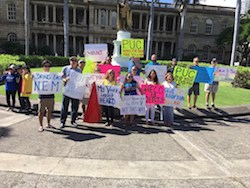
Solar supporters rally in front of the Hawaii Public Utilities Commission (PRNewsFoto/The Alliance for Solar Choice)

Solar supporters rally in front of the Hawaii Public Utilities Commission (PRNewsFoto/The Alliance for Solar Choice)

Three out of four respondents oppose the Commission’s October decision, which was made without holding a hearing or conducting an analysis of the costs and benefits of solar net metering, and without providing notice to customers. In response, dozens of people gathered at a “Rally To Be Heard” in front of the Hawaii Public Utilities Commission.

Solar supporters erected a large megaphone to demonstrate the desire for public participation. “I support greater solar growth,” said Charlie Jeffries who attended the rally. “I’m disturbed that the PUC made a rash decision without giving the public an opportunity to make our voices heard.”

“The Hawaii Public Utility Commission failed to do a study of the costs and benefits of solar,” said Roy Skaggs, also a rally attendee. “How do you make sweeping decisions that impacts thousands of families and jobs without at least knowing the data?”

Those speaking at the rally share the public’s sentiment. A nearly-universal 97% of poll respondents support more rooftop solar in Hawaii.

“The public overwhelmingly supports rooftop solar and believes that Hawaii is moving in the wrong direction on energy policy, but policy makers are not listening,” said Bryan Miller, President of TASC. “This poll shows that Governor Ige and the Commission are ignoring the voices of their constituents.”Read More

Clean Energy, Electricity, Solar

PHG Energy Kicks of Waste-to-Energy Project

Joanna Schroeder

Construction of a new gasification plant at Lebanon, Tennessee’s waste water treatment facility is underway following a groundbreaking ceremony held last week. Tens of thousands of tons of sewer sludge, used tires and industrial wood waste will be processed to produce electricity to help power the plant.  PHG Energy of Nashville is designing and building the new facility, which will include utilization of the world’s largest downdraft gasification unit with a full capacity of 64 tons per day through the system.

Lebanon Groundbreaking 11-12-15 smaller size

From left to Right: Chris Koczaja (vice president of implementation and engineering at PHG Energy); Tom Doherty (environmental specialist with Tennessee Department of Environment and Conservation); Lebanon Mayor Philip Craighead; Lebanon Councilman Fred Burton, Ward 2; Lebanon Councilman Rob Cesternino, Ward 3, and Jeff Baines (public works commissioner for the city of Lebanon)

“This facility is going to be a model for waste-to-energy partnerships,” Lebanon Mayor Philip Craighead said of the project, “as well as the first stage in moving our city completely away from dumping waste into landfills.”

Gasification is a clean thermo-chemical process that breaks down biomass-based material in a high-heat and low-oxygen environment. According to a PHG Energy press release, there is no incineration or burning involved in the process. The only residue after production of synthetic fuel gas is a carbon biochar that has multiple agricultural, industrial and direct fuel uses.

Tom Doherty, Environmental Specialist with the Tennessee, Department of Environment and Conservation (TDEC), said the new facility is an important step forward in efforts Tennessee and his department are fostering across the state. “When we look at the thousands of tons of wood waste and sludge this plant will cleanly process, that is a tremendous step forward. One of the most exciting parts of deploying this technology in Lebanon is that hundreds or tons of scrap tires will be put to beneficial use while saving Wilson County a considerable portion of their previous disposal expense.”

TDEC has awarded the project funding of $250,000 through the Clean Tennessee Energy Grant program, and facilitated a subsidy of 70% of the $3.5 million financing’s interest cost through the Federal Qualified Energy Conservation Bonds program.

biomass, Electricity, Waste-to-Energy

BioEnergy Bytes

Joanna Schroeder

  • BioEnergyBytesDF1The Advanced Biofuels Association (ABFA) has sent a letter to Senate Finance Committee leadership that expressed concern about changes to the biodiesel and renewable diesel blenders tax credit. ABFA President Michael McAdams noted, “At this time common sense dictates that Congress should not be looking to revise an effective, long-term policy with changes to the biodiesel and renewable diesel blenders tax credit as part of legislation to extend various expired tax benefits.”
  • Brazil’s non-hydro renewable power sector is expected to account for more than 25% of Brazil’s total capacity by 2025, with non-hydro renewables’ cumulative installed capacity more than tripling from 17.1 Gigawatts (GW) in 2014 to an estimated 57.8 GW by 2025, according to a new report from GlobalData.
  • The Renault-Nissan Alliance is installing 90 new charge spots for electric vehicles in and around Paris for the COP21 global summit on climate change. The installation is being done in partnership with French energy provider EDF, Schneider Electric, Aéroports de Paris, Paris City Council and SNCF, France’s national railway company. The charging stations, several of which will be donated by Schneider Electric, will refuel 200 EVs serving as VIP shuttles for negotiators, delegates and media attending the conference.
  • Transparency Market Research has released of a new research report titled “Geothermal Power Generation Market – Global Industry Analysis, Size, Share, Growth, Trends and Forecast 2013 – 2019“. According to the report, the global geothermal power generation market is forecast to register a remarkable CAGR of 23.58% from 2013 to 2019, expanding from a value of US$2.5 bn in 2013 to US$8.9 bn by 2019.
Bioenergy Bytes

DOE Releases 2015 Revolution…Now Report

Joanna Schroeder

The U.S. Department of Energy (DOE) recently released the 2015 Revolution…Now report, which details the state of multiple clean energy technologies in the U.S. that have the ability to provide climate change solutions. The report builds upon past versions that demonstrate an increase in deployment and a decrease in cost for transformational technologies including: wind turbines, solar technologies, electric vehicles (EVs) and light-emitting diodes (LEDs).

revolution-now-infographic“We are experiencing a clean energy revolution in the United States, and this report confirms it,” Secretary Moniz said. “Today, clean energy technologies are providing real-world solutions – not only to reduce carbon dioxide emissions that cause global warming, but they also drive a domestic, low-carbon economy with technologies that are increasingly cost-competitive with conventional technologies. We have the tools for a cleaner and more secure energy future.”

The 2015 update finds that dramatic cost reductions are continuing to drive the adoption of clean energy technologies. The report reviews the rapid growth of photovoltaic (PV) solar modules for both large, utility-scale PV plants, and smaller, rooftop and distributed PV systems. DOE continues to invest in research and development for these technologies in addition to reducing market barriers in order to make these clean energy technologies even more cost-effective and widely available across the United States.

Between 2008 and 2014, land-based wind accounted for 31 percent of all new generation capacity installed in the U.S. The DOE says this is in part due to early investments from DOE that helped drive technology innovation.

Clean Energy, Climate Change, Electric Vehicles, Solar, Wind

New Leadership at National Biodiesel Board

John Davis

nBBThe National Biodiesel Board (NBB) has four new members and four returning members on its governing board. This news release from NBB says the group was elected during NBB’s latest annual fall membership meeting in Washington, D.C., this week.

“Biodiesel faces many challenges but we have strong leadership from among all sectors of the industry and we are in a position as an organization to face those challenges head on,” said NBB CEO Joe Jobe. “This industry has reached nearly two billion gallons for a third consecutive year and will continue to grow into the future under the direction of the board.”

NBB members voted to fill eight board member spots:

– Kent Engelbrecht, ADM
– Ron Heck, Iowa Soybean Association
– Ed Hegland, Minnesota Soybean Research and Promotion Council
– Ron Marr, Minnesota Soybean Processors
– Steve Nogel, AGP
– Amy Sigg Davis, Ohio Soybean Council
– Robert Stobaugh, Arkansas Soybean Promotion Board
– Chad Stone, Renewable Energy Group

Steven Levy, Mike Cunningham, Greg Anderson, Jennifer Case, Timothy Keaveney, Robert Morton, and Ben Wootton also continue to serve on the Governing Board. Four long-time board members retired their positions this year including two past chairs Bob Metz, South Dakota Soybean, and Gary Haer, Renewable Energy Group. Also retiring their positions were Ed Ulch, Iowa Soybean Association, and Todd Ellis, Imperium Renewables.

The meeting also saw discussions on the current state of federal policies impacting the industry, held meetings of standing committees, and began the annual program planning process.

Biodiesel, NBB

Vancouver Gets First ‘Green & Go’ Biodiesel Station

John Davis

cowichanMotorists on Vancouver Island in Canada will get more choice in their biodiesel blends. Cowichan Energy Alternatives (CEA), the Cowichan Bio-Diesel Co-op (Co-op) and the Cowichan Valley Regional District (CVRD) are opening the island’s first “Green & Go” biodiesel station, which could pump 5, 20 or 50 percent blends.

The new biodiesel blending pump and Point of Sale (PoS) technology will provide drivers with an easy and secure way to access clean, renewable biodiesel after they create a user account at www.biopay.org. Biodiesel is a proven fossil-fuel-alternative that reduces harmful pollution while increasing a vehicle’s engine life. The pump’s PoS will provide each member with a transaction record that shows greenhouse gas (GHG) reductions with every fill up.

‘Sustainable Solution in Action’ – The Cowichan Biofuel Facility is a homegrown centre for recycling commercial and residential waste cooking oil into environmentally-friendly biodiesel for local use as a petroleum diesel substitute. This demonstration facility is the first of its kind in North America and a model for communities seeking sustainable solutions that support the development of a local, low-carbon economy. It is the result of a unique partnership between the Cowichan Valley Regional District, Cowichan Bio-Diesel Co-op and Cowichan Energy Alternatives, and is part of the growing BC Biofuel Network. Financial support was provided in part by Vancity.

Officials will hold an official ceremony later this afternoon at the Cowichan Biofuel Facility, 3900 Drinkwater Road, North Cowichan, British Columbia. The public and media are invited to the event.

Biodiesel

RFA Updates E85Prices.com

Cindy Zimmerman

e85-pricesThe Renewable Fuels Association has unveiled a redesigned version of its popular fuel market website E85prices.com.

According to RFA Vice President of Industry Relations Robert White, the layout of the site has been updated for easier navigation and redesigned with a modern interface for a cleaner presentation. “The all new E85prices.com website and mobile app make it easier than ever to locate E85 stations, search for the best prices for ethanol blends, and post your personal pricing experiences,” said White. “Both the website and the app are optimized for use on any device and allow easier interaction than ever before. It is our hope that these upgrades will lead to increased usage and reporting.”

nafb15-rfa-whiteDuring an interview at the National Association of Farm Broadcasting last week, White said they have been working on the upgrade since they acquired E85Prices.com earlier this year. “We think this will allow consumers and fleet operators a better ability to find E85 stations to use the fuel and find the best deal they can on E85,” White said, noting that 85 percent ethanol is approved for use only in Flex Fuel vehicles, of which there are now over 19 million on the road in the nation.

E85prices.com is now better integrated with Google for optimal search results that link back to the website. In addition, the E85prices.com mobile app also includes an updated interface that makes it easier for users to share the latest prices for the fuel in their areas.

ethanol-report-adIn this edition of the Ethanol Report, White talks about the update, as well as the increasing number of flex fuel vehicles on the road, the growing number of stations offering E85, and other topics related to higher ethanol blends in the marketplace.

Listen to this edition of the Ethanol Report here: Ethanol Report on Updated E85Prices.com

Audio, E85, Ethanol, Ethanol News, Ethanol Report, RFA

Iowa Biodiesel Makers Take to DC

John Davis

nafb15-nbb-grantIowa Biodiesel Board (IBB) members joined their National Biodiesel Board colleagues in lobbying lawmakers to renew and restructure the federal $1-per-gallon credit for biodiesel and renewable diesel. IBB pointed to Iowa Sen. Chuck Grassley’s proposal that would correct a loophole in the existing program and save U.S. taxpayers $90 million.

“Nowhere is the success of the tax credit more evident than in Iowa. Our state’s 13 plants produced more than a quarter of a billion gallons of biodiesel last year, supporting jobs and economic development while replacing foreign oil and diversifying our fuel supply. The federal tax incentive has played a key role in enabling those plants to stay operating and profitable, benefiting all levels of our economy,” said Grant Kimberley, executive director of the Iowa Biodiesel Board.

But Kimberley isn’t just looking at the benefits for Iowa. During an interview with the recent National Association of Farm Broadcasting meeting in Kansas City, Missouri, he said that Iowa biodiesel can be a real help to California’s Low Carbon Fuel Standard (LCFS).

“California … wants to have all of their transportation fuels fit under the [LCFS], where it reduces greenhouse gas emissions and is better for the environment,” said Kimberley. “Renewable fuels, including biodiesel, can play a key role in that.”

He said biodiesel producers have had to educate California officials just how good biodiesel can be. Initially, California scored biodiesel just above conventional diesel. But education efforts improved that score.

“Now they’ve moved that score higher, so now it’s up to 50-80 percent better than petroleum-based diesel, which means biodiesel can play a really strong role in the [LCFS]. It could be up to 600 million gallons of biodiesel per year that could be utilized in California,” said Kimberley.

He also pointed out that since California doesn’t produce much of the green fuel, it opens up many possibilities for Midwest producers.

Listen to all of Cindy’s conversation with Kimberley here: Grant Kimberley, executive director of the Iowa Biodiesel Board

Audio, Biodiesel, Government, Legislation, Low Carbon Fuel Standard, NBB

HERO BX Purchases Alabama Biodiesel Plant

Joanna Schroeder

Erie, Pennsylvania- based HERO BX has purchased the assets of the former Veros Energy biodiesel refinery located in Moundville, Alabama. The plant will be renamed HERO BX Alabama LLC. The Moundville facility currently employs 17 full-time staff who will remain on as HERO BX Alabama employees. In addition, HERO BX plans to hire and train an additional 10-12 employees as it gears up for recommissioning the facility.

HEROBXHERO BX Chairman and CEO Samuel “Pat” Black III said, “We are excited to be expanding into Alabama. This acquisition allows us to serve a new market outside the reach of our Erie facility and will enable our company to follow through on its growth mission. The preliminary Renewable Fuel Standard volumes are growing and as they do, the Moundville facilities will too.”

According to a press release HERO BX has plans to capitalize on its strong technical and operational expertise to upgrade and expand the 15 MGPY facility, which is slated to come on line in the first quarter of 2016.

HERO BX President Mike Noble, added, “Our technical staff is among the world’s finest. We will take everything that we have learned in almost a decade of producing great biodiesel in Erie and apply it to the Moundville plant. Our quality standards will remain the same. Customers who are familiar with our high quality can again count on biodiesel produced in Moundville to be BQ 9000 certified ASTM D-6751 and Q-RIN approved.”

advanced biofuels, Biodiesel