SolarCity Stops Sales in Nevada

Joanna Schroeder

SolarCity has stopped sales in Nevada due to the decision by the Nevada Public Utilities Commission to “undermine Nevadans’ ability to go solar” according to the company who opened an office in the state in 2013. The company says the decision by the PUC to raise fees for rooftop solar” amounts to a “massive bait and switch” for both the solar industry and more than 12,000 customers including school for what SolarCity CEO Lyndon Rive is calling, “what appears to be an attempt to protect profits of the state’s largest utility”.

solarcity-logo“This is a very difficult decision but Governor Sandoval and his PUC leave us no choice. The people of Nevada have consistently chosen solar, but yesterday their state government decided to end customer choice, damage the state’s economy, and jeopardize thousands of jobs,” said Rive. “The PUC has protected NV Energy’s monopoly, and everyone else will lose. We have no alternative but to cease Nevada sales and installations, but we will fight this flawed decision on behalf of our Nevada customers and employees.” The decision to raise solar fees ways made right before the holidays.

Rive says Governor Sandoval’s Office of Economic Development helped bring SolarCity to Nevada in 2013, and encouraged the company to create local jobs. Accepting the Governor’s invitation, the company expanded to Nevada and has hired more than 2,000 local workers in just over two years. The state also created a rebate program to entice Nevadans to go solar, and many took advantage. The rooftop solar industry helped Nevada become number one in the nation in solar jobs per capita in 2014. With abundant sunshine and a populace eager to adopt solar energy and save on electricity bills, the industry was poised to become a cornerstone of the state’s innovation economy. All three members of the PUC, who voted unanimously to change the rules, were appointed by Governor Sandoval.

“Most disturbing is the PUC’s decision to retroactively sabotage existing solar customers’ investments by changing the rules on them,” continued Rive. “The Nevada government encouraged these people to go solar with financial incentives and pro-solar policies, and now the same government is punishing them for their decision with new costs they couldn’t have foreseen. These actions are certainly unethical, unprecedented, and possibly unlawful. While the rest of the country embraces a clean energy future, Nevada is moving backwards.”


Clean Energy, Electricity, Solar

The Andersons’ Michigan Ethanol Plant to Expand

John Davis

Andersons1Agribusiness The Andersons is expanding its ethanol plant in Michigan. The company says the Albion, Michigan plant’s capacity is being doubled.

“The supply and demand situation in Michigan relative to corn and ethanol is very favorable,” explains CEO Pat Bowe. “Advancements in farm practices and technology continue to increase the size of Michigan’s corn crop and enhance its quality. This added production capacity enables more ethanol to be produced and used in the state.

“This dynamic,” he continues, “combined with the highly efficient operations at the Albion facility, makes it a compelling investment for expansion.”

The facility, built by ICM, Inc. of Colwich, Kansas in 2006, was engineered for future expansion. ICM, Inc. is contracted to build the expansion, which is scheduled to be completed in April 2017. Approximately 10 new full-time production positions will be added when the new capacity becomes operational.

The ethanol plant is co-owned by Marathon Petroleum Corporation.

Ethanol, Ethanol News

China Imports Record Amount of US Ethanol

John Davis

usda-logoU.S. ethanol exports to China hit record numbers this year. And the U.S. Department of Agriculture (USDA) is crediting the rise to its trade mission last year that helped push overall agricultural imports to China to three times what they were just a decade ago.

“Our objective for every trade mission is to create new markets for farm products made in rural America,” said USDA Under Secretary for Farm and Foreign Agricultural Services Michael Scuse, who led the mission. “U.S. ethanol exports to China have jumped from $8 million to more than $86 million since our May 2014 visit. In October, we exported more ethanol to China than in the previous 10 years combined.”

Scuse led the delegation to promote U.S. agriculture, and explore the role that renewable fuels might play in China’s long-term clean energy strategy. The delegation met with gasoline companies, fuel blenders, oil companies, commodity traders, and government officials to promote the benefits of using higher ethanol blends. During October, the U.S. exported 32.5 million gallons of ethanol to China, valued at $57 million, or 46 percent of total U.S. ethanol exports for the month. Previous U.S. exports of ethanol to China averaged less than $3 million annually from 2005 to 2014.

Earlier this year, USDA partnered with 21 states through the Biofuel Infrastructure Partnership (BIP) to nearly double the number of fueling pumps nationwide, expanding the ethanol refueling infrastructure by nearly 5,000 pumps, a $210 million investment that will give consumers access to clean, American-made biofuels, and provide more choices at the pump.

“These are the kind of initiatives that strengthen our rural communities, and open new doors and help our farmers and ranchers capitalize on the tremendous export potential for American agricultural products,” said Scuse.

Ethanol, Ethanol News, USDA

USDA Highlights 2015 Energy Achievements

Cindy Zimmerman

USDAAgriculture Secretary Tom Vilsack has released a list of USDA’s top achievements in 2015 in the areas of trade, food security, conservation, energy, research, rural development, and more.

“Even with challenges in 2015, including an unprecedented animal disease outbreak and lower commodity prices, America’s rural communities have proven once again that we are a nation of makers, creators and innovators, and our economy and security are stronger because of it,” said Vilsack. “As we look to 2016, USDA will continue to seek out new and innovative ways to expand opportunity for America’s farming families and rural communities.”

Among USDA’s 2015 highlights in the area of energy:

Made available $100 million in grant funds, with matching funds from state and private partners, which will provide $210 million to nearly double the number of fueling pumps nationwide that supply American-made renewable fuels, such as E15 and E85.

Through the Biomass Crop Assistance Program, USDA provided assistance to 890 growers on 49,000 acres for costs associated with harvesting and transporting agriculture or forest residues to facilities that convert biomass crops into energy.

Announced 10 Building Blocks for Climate Smart Agriculture and Forestry, which, by 2025, will reduce net emissions and enhance carbon sequestration by the equivalent of taking 25 million cars off the road.

Read more here.

bioenergy, biofuels, Ethanol, USDA

Carson Supports RFS through 2022

Cindy Zimmerman

carson-nwDuring a recent campaign stop in Iowa Republican presidential candidate Ben Carson said the promise of the Renewable Fuel Standard (RFS) needs to be kept through 2022.

“(A)s far as the Renewable Fuel Standard is concerned, there were certain promises that were made that extend out until 2022. And many people, you know, invested a lot of time, energy and resources based on those promises that were made. Those promises have to be kept,” said Carson during an appearance at Northwestern University in Orange City, Iowa on December 18.

According to America’s Renewable Future (ARF), Carson made similar comments at stops in Council Bluffs and Carroll, Iowa this month.

“Carson’s grasp of the issue of the RFS has tightened and we are glad to see him recognize the importance of keeping the promise made to investors and the 73,000 Iowans whose livelihoods depend on it,” said America’s Renewable Future State Director Eric Branstad.

ARF will be releasing a final report card in early January designating each candidate as either good or bad on the RFS. ARF will let Iowans know where the candidates stand through paid media and grassroots efforts.

Listen to Carson’s comments here: GOP candidate Ben Carson on RFS

Audio, Ethanol, Ethanol News, RFS

Merry Christmas From DomesticFuel!

Joanna Schroeder

The DomesticFuel Team is thankful to all of you for tuning in through a busy 2015 as we worked to provide the latest alternative energy news. We’ll be bringing you some news throughout the end of the year and resume full coverage on January 2, 2016. 

We hope you have a Merry Christmas and a healthy and prosperous New Year.

ZimmComm Christmas Card

Miscellaneous

ACE: Tax Credits Will Increase Cheaper Ethanol Blends

Joanna Schroeder

Last week Congress approved the Omnibus Bill that included tax credit extensions for clean, renewable energy. One of these credits is for retail fuel station owners who buy equipment to offer alternative fuels such as E85. Ron Lamberty, American Coalition for Ethanol (ACE) senior vice president and a fuel retailer, says additional ethanol blends  could further increase profitability for retailers.

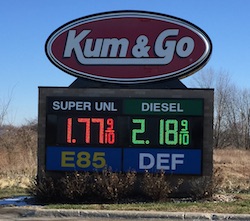
E85 Sign December 2015

Photo Credit: Joanna Schroeder

The Alternative Fuel Vehicle (AFV) Refueling Property Credit until the end of next year, according to Lamberty. The credit, which allows retail gas station owners to claim a 30% tax credit, up to a maximum of $30,000 per location for qualified AFV refueling infrastructure, originally expired on December 31, 2014.

“Marketers who saw the opportunity to gain new customers by offering E85 at the pump, also saw they could increase profits by selling the RIN credits they earned for selling higher ethanol blends. Some added pumps earlier this year, others will, in 2016,” said Lamberty “E85 compatible equipment costs more than standard or E25 compatible fueling equipment, and this credit helps offset some of that additional cost. That means retailers can pass the lower price of E85 through to consumers sooner, increasing volume and RIN profits, which most station owners use to reduce E85 prices even further.”

That means, says Lamberty, retailers can pass the lower price of E85 straight through to consumers, increasing volume and RIN profits, which most station owners use to reduce E85 prices even further.”

Lamberty pointed out that the credit is available for E85 fueling infrastructure only, and is scheduled to expire again at the end of 2016. “Fortunately, the equipment needed to sell ethanol blends up to E25 – including E15, adds only a few hundred dollars per dispenser,” he said.

“Having E15 – a lower cost, higher octane blend that 80 percent of the cars on the road can use – should justify that expense.  And with a growing number of station owners, including innovative retailers like Kum & Go, Sheetz and Protec, adding E15, consumers will quickly become more familiar and be looking for E15,” added Lamberty. “Those retailers were already selling E85 in some locations, and are expanding offerings through USDA’s Biofuel Infrastructure Partnership (BIP) program. We’re hoping the availability of this tax credit inspires those companies and others to make higher ethanol blends available sooner, in even more places.”

ACE, E85, Ethanol, politics, Renewable Energy

Pollers Wonder Climate Accord’s Role for Ag

Jamie Johansen

New Holland ZimmPollOur latest ZimmPoll asked the question, “What do you think climate accord will mean for ag?”

It looks like the majority feel that climate accord will add to the already over-abundant regulations or is simply bad for everyone. Ag Secretary Tom Vilsack said the COP21 deal will support a “better-nourished, stable, secure future” and the benchmarks “build on the ambitious climate smart strategy being implemented by U.S. farmers, ranchers and foresters.” No matter how you feel, the climate discussion isn’t going anywhere as we enter 2016.

Here are the poll results:

  • Meaningless – 10%
  • Good for farmers- 5%
  • More regulations – 35%
  • Good for everyone – 20%
  • Bad for everyone – 30%
  • Other – 0%

Our new ZimmPoll is now live and asks the question, What’s your favorite food/drink gift?

‘Tis the season for yummy gifts of goodies to eat and drink – which is probably why we always end up gaining a few pounds over the holidays! So, what is your favorite food or drink to get or give as a gift during the holidays?

ZimmPoll

Ethanol Report Looks at 2015 in Review

Cindy Zimmerman

ethanol-report-ad2015 was another year of highs and lows for the ethanol industry. Renewable Fuels Association (RFA) president and CEO Bob Dinneen says many of the positives, such as record production and increased exports, were offset by negatives like tighter margins and trade barriers.

In this Ethanol Report, Dinneen takes a look back at some of the good news and bad news for the ethanol industry in 2015 as we prepare to enter another new year.

Ethanol Report on 2015 Year in Review
Audio, Ethanol, Ethanol News, Ethanol Report, RFA

Just in Time for Christmas, Biodiesel Producers Get Extra Jingle

John Davis

uscapitolIt might not be just the jingle of sleigh bells that puts a smile on biodiesel producers faces this Christmas season. With Congress passing the tax extenders legislation and the president signing it into law, many producers will enjoy a little extra figurative jingle in their pockets, as the federal $1-a-gallon biodiesel blenders tax credit is made retroactive for 2015 and covers all of 2016.

Business Record reports biodiesel behemoth Renewable Energy Group will see a windfall of $125 million to $135 million from the measure passing. And Canadian biodiesel maker BIOX, with a 16 million gallon per year biodiesel refinery in Ontario, announced it would see increased profits thanks to the credit.

Alan Rickard, CEO of BIOX Corporation said, “This is a significant piece of legislation that will provide much needed industry stability and support. On the retroactive passage of this legislation, BIOX expects a positive impact of approximately US$7 million to be recorded in our Fiscal Q1 results, related to the entire 2015 calendar year. Even greater is the market stability that the proactive passage of this legislation provides. This, combined with the EPA setting the Renewable Volume Obligations for the Renewable Fuel Standard (RFS2) from 2014 through 2017 and Ontario’s Greener Diesel requirement increasing to 3% in 2016, gives us a positive outlook for the biomass based diesel market in North America.”

Biodiesel