Vilsack Featured Speaker at Nat’l Ethanol Conference

John Davis

vilsackrfaU.S. Secretary of Agriculture Tom Vilsack has been named to the lineup for this year’s National Ethanol Conference. The gathering, going on Feb. 15-17 in New Orleans, is the most widely attended executive level conference for the ethanol industry. Vilsack, a former governor of Iowa, was praised by the Renewable Fuels Association as being a long-time ally of ethanol.

Vilsack is a strong proponent of ethanol, renewable fuels and American agriculture. As leader of the U.S. Department of Agriculture (USDA), Vilsack is working hard to strengthen the American agricultural economy, build vibrant rural communities and create new markets for the tremendous innovation of rural America.

Other topics at the conference include, global marketing and logistics trends, ethanol’s benefits as a high octane fuel source, and much more!

More information and registration are available here.

Ethanol, Ethanol News, National Ethanol Conference, USDA

Canadian Biomass Gets Government Boost

John Davis

canada flagA dozen biomass projects in Manitoba, Canada, are getting a boost from the provincial and federal governments. This article from Canadian Manufacturing says the $500,000 in assistance is designed to help end coal use in the province.

“There are renewable energy resources readily available for use as biomass energy sources,” Manitoba’s Minister of Agriculture, Food and Rural Development, Ron Kostyshyn, said. “By increasing our capacity to make and use green energy we are reducing carbon emissions in Manitoba while promoting the growth of new industry.”

Among the proposals selected to receive funding two projects to convert a coal-fired heating systems to a biomass and funding for new equipment for Southeast Pallet and Wood Products in Blumenort, Man., which will allow the company to double its annual biomass processing capacity.

The program is funded partly through Manitoba’s Coal Tax, and like other bio-fuel programs across the country aims to promote the growing industry as well as reduce emissions.

biomass

Secy Vilsack: Continue to Tout Biofuel Benefits

Joanna Schroeder

U.S. Department of Agriculture (USDA) Secretary Tom Vilsack, spent the morning back in his home state of Iowa (Vilsack is a former Iowa Governor) to kick off the 10th Annual Iowa Renewable Fuels Summit. He began his remarks by saying its great to be back in Iowa and great to be back in front of folks who understand the importance of the renewable fuels industry. He also mentioned he is proud of the work the USDA has done to help expand the industry.

The key focus on his speech was the amount of people, both consumers and legislators, who don’t see the benefits of this industry the way we see them, who are attacking the Renewable Fuel Standard (RFS) in the courts, and attacking the Renewable Fuel Standard in the halls of Congress. “But we continue to point out to those who oppose this industry, the benefits of the country.”USDA Ag Secretary Tom Vilsack during 10th Annual Iowa Summit

For example, the ethanol industry has helped reduce the price of gas at the pump, even as gas prices go down, and given consumers choice at the pump. He also noted biofuels benefit the farm and rural communities, and help to reduce the trade deficit.

Vilsack discussed several of the programs the USDA has implemented to help grow and improve the industry including the Biomass Assistance Program, Biomass Research Centers and Loan Guarantees. But he said he was most excited of the new markets that are being developed. He also highlighted the Farms to Fly program that is looking at producing renewable biofuels for the aviation and shipping industry as well as biofuels for our military.

We need consumers to understand that every time they go to the pump, they are helping the industry. He also stressed the importance of the blender pump program and continuing to bring more mid-level blends to consumers.

In closing, Vilsack said expanding the renewable fuels industry is more than just the benefits (choice at pump, environment, national security, etc.). “It’s really about preserving the value system of rural America. This is an industry that allows us the process of diversifying the opportunities in rural America, to support production agriculture, to expand the biobased economy…so that we have more stable farm income and we give people opportunities to live, work and raise their families in rural areas. That is important to me.”

Listen to USDA Ag Secretary Tom Vilsack’s full remarks: Vilsack Remarks During IRFA Summit

10th Annual Iowa Renewable Fuels Summit Photo Album

advanced biofuels, Audio, aviation biofuels, Biodiesel, biofuels, biomass, Ethanol, IRFA Renewable Fuels Summit, RFS, USDA

IRFA’s Shaw: We Will Not Retreat

Joanna Schroeder

“Today, Iowa’s renewable fuels industry – the entire renewable fuels industry quite frankly – is at a fork in the road. We must decide whether to retreat, or whether to fight for victory. I know we will not retreat. It is simply not in the farmers DNA. So we fight,” said Monte Shaw, executive director of the Iowa Renewable Fuels Association (IRFA) during the opening session of the 10th Annual Iowa Renewable Fuels Summit referring to the Renewable Fuel Standard (RFS). This legislation, said Shaw, is the key to long-term success of renewable fuels.

IRFA Executive Director Monte Shaw“I know the renewable fuels industry will not waiver or retreat or surrender,” said Shaw. “It will continue to battle for market access and to tear down the bogus ‘blend wall.’ I know this because the renewable fuels industry has fought the odds for 35 years – and won.”

He continued, “Keeping the RFS intact is key to near term biodiesel growth, the ability for cellulosic ethanol to have a chance to develop, and to pulling corn ethanol above 15 billion gallons per year. When the RFS finally breaches the artificial blend wall and major markets add the distribution infrastructure necessary for E15, ethanol use won’t increase by just that prescribed amount. Once the hole is in the dam, the octane value of corn ethanol will burst through – pulled by the RFS just as certainly as cellulosic ethanol and biodiesel.”

He also noted there is not a consensus to repeal nor modify the RFS in D.C. Do buy in to the narrative and choose the path of retreat because Big Oil is trying to win, he added.

To view Shaw’s selected prepared remarks, click here.

Biodiesel, biofuels, Ethanol, Iowa RFA, IRFA Renewable Fuels Summit, RFS

Why Chris Soules Supports Ethanol

Joanna Schroeder

Chris Soules at Iowa NASCAR race 2016

Iowa farmer Chris Soules speaks with race fans about ethanol during the Iowa Iowa NASCAR race last summer.

Iowa native and farmer Chris Soules rose to fame as The Bachelor and his participation in Dancing With The Stars. He has since used his status to spread positive messages about biofuels including ethanol. I spoke with Chris recently to learn why biofuels are so important to him and why he has leveraged his notoriety in partnerships with several ag and biofuel organizations to be a national face and voice for agribusiness.

Q: Was one of the reasons you went on The Bachelor to create a platform to talk about agriculture to consumers?

A: I went on the show to hopefully meet someone. However, since then I’ve realized that I have interesting, positive experiences, in particular about being a farmer, that I want to share. I’m thankful that I have been able to work with organizations such as Growth Energy who have given me the opportunity to share my stories about how farmers work every day to provide food and fuel to consumers across the country.

Q: Of all of the issues you can champion, why biofuels?

A: Biofuels are an important way to help America diversify its fuel choices and move away from foreign oil. It’s also a clean burning fuel as compared to gas, so not only is it a good economic choice, but the consumer is also helping the environment at the same time.

Q: Do you use biofuels (biodiesel or ethanol) on your family farm? Do you grow crops for biofuels?

A: Yes, on our farm we use both ethanol and biodiesel. We also grow the crops, corn and soybeans, that are used to produce the biofuels.

Q: How will your farm be affected if the Renewable Fuel Standard (RFS) doesn’t continue to ramp up?

A: My family began to lose demand for our products resulting in lower prices. It would also end up costing jobs in rural areas. When biofuels were identified as a way to diversify our fuel supply and bring jobs back to rural America, demand for our product rose. So if the RFS doesn’t move forward, demand will drop again hurting not only our family’s livelihood and family farms across the country, but millions in the Midwest who rely on ag-based jobs and a thriving ag community.

*Note, while final volumes for renewable fuels under the RFS were increased for 2014, 2015 and 2016 at the end of last year, they are still not at mandated levels leaving the RFS in jeopardy.

Q: Do you plan on continuing your public awareness efforts around biofuels in 2016?

A: Yes. Biofuels are very important to me and my family, and the nation’s energy security. That is why I am proud to help raise awareness of the importance of biofuels and the RFS.


Biodiesel, biofuels, Ethanol, RFS

BioEnergy Bytes

Joanna Schroeder

  • BioEnergyBytesDF1China Sunergy has announced that it has successfully completed a 2.5MW solar module supply agreement with Stobart Group. The modules will be used for the construction of the solar farm located at London Southend Airport to satisfy around 20% of the airport’s annual electricity requirement. The solar array, which consists of over 9,500 individual solar panels and occupies 3.2 hectares of unused grassland at the north of the airport site, makes it the largest at a UK airport.
  • ReNew Power Ventures Private Limited, one of India’s largest clean energy companies, has announced the commissioning of 40 MW wind power project in the Raichur district of Karnataka. This project consists of 20 X 2 MW G97 turbines supplied by Gamesa India. With this, the total wind capacity commissioned by ReNew Power till date is 693 MW.
  • 3 Phases Renewables has announced a new contract with the City of Santa Monica to supply clean, 100% renewable power for all municipal operations, beginning in January 2016. Santa Monica was the first city in the nation to convert its operations to renewable power and in the coming years it has plans to expand its renewable energy purchasing to benefit all electric utility customers in Santa Monica.
  • SPI Energy Co., Ltd. has announced that its application to list the Company’s American depositary shares on the Nasdaq Global Select Market has been approved by Nasdaq. SPI Energy expects its American depositary shares to commence trading on January 19, 2016 under the ticker symbol “SPI”. Upon commencement of trading, the company’s American depositary shares will cease to trade on the OTC Markets.
Bioenergy Bytes

NBB Challenges EPA Rules on Argentinian Biodiesel

John Davis

scalesofjustice1The National Biodiesel Board (NBB) is challenging the federal government’s rules on the import of Argentinian biodiesel. This article from the NBB’s ally, the American Soybean Association (ASA), says NBB filed a legal brief with the U.S. Court of Appeals for the District of Columbia Circuit that says the way the Environmental Protection Agency (EPA) is handling Argentinian biodiesel violates the Renewable Fuel Standard (RFS).

In January of 2015 the U.S. EPA approved an application to streamline the process for Argentinian biodiesel imports to demonstrate compliance with the eligible renewable biomass and sustainability verification requirements of the RFS. The application was submitted to EPA by CARBIO, the trade association representing Argentinian biodiesel producers. The EPA approval allows a more streamlined survey approach for demonstrating feedstock sustainability instead of the more rigorous map and track requirements.

The NBB filed the initial petition in December 2015 seeking court review of the EPA decision, citing the lack of a public comment period, the adequacy of the Argentinian plan, and the inability of EPA to verify that the plan meets RFS requirements.

In the brief filed this week, the NBB responded to EPA’s claims that the U.S. biodiesel industry is not a proper party to challenge EPA’s decision and that EPA can act outside of the public eye and without the court’s oversight in this case. The reply brief reminds the Court that EPA never disputed that Argentina continues to expand its agricultural base or that the CARBIO proposal was the first of its kind and differed from what EPA previously noticed to the public.

The NBB also previously filed an administrative petition for reconsideration with the EPA regarding this decision. However, EPA has not responded to that administrative petition, choosing instead to argue in Court. Final briefs in the case are due next month, after which oral arguments will be scheduled.

ASA points out that imports of biodiesel from Argentina to the U.S. increased sharply toward the end of 2015 and are expected to rise again this year.

Biodiesel, NBB

Oregon Starts Push for Renewable Diesel

John Davis

oregongovThe state government in Oregon is using a combination of incentives and technical expertise to support adoption of renewable diesel. This news release from the Oregon Department of Energy (ODOE) says some of the results of the initiatives include reduced emissions and a decrease in fleet maintenance for the Eugene Water & Electric Board, which began testing this innovation in alternative fuel in September 2015.

“Public agencies and companies across Oregon are working on ways to reduce their greenhouse gas emissions and reach their climate goals,” said ODOE Director Michael Kaplan. “ODOE helps them get there by offering expertise on fleet management and innovative products like renewable diesel.”

In 2014, ODOE issued the Eugene Water & Electric Board a tax credit for installing an alternative fuel fueling station to run its fleet of vehicles. The station was designed to pump biodiesel, a well-known alternative fuel also made from natural fats and oils. But ODOE Senior Policy Analyst Rick Wallace thought EWEB could go even “greener” by using renewable diesel rather than biodiesel.

EWEB was enthusiastic about giving the product a try. “Moving our fleet to biodiesel helped us achieve our carbon reduction goals,” said EWEB Fleet Manager Gary Lentsch. “Switching to renewable diesel has taken us to another level.”

EWEB quickly realized the benefits of switching to renewable diesel for its fleet of 85 diesel vehicles. Using a regular gallon of diesel fuel emits more than 30 pounds of greenhouse gases into the air. Using a gallon of renewable diesel emits fewer than 10. EWEB is currently using about 6,100 gallons of renewable diesel a month.

EWEB also discovered that renewable diesel is much easier on vehicle engines and diesel particulate filter systems. After making the switch, Lentsch noticed a significant decrease in maintenance issues. “We have telematics on all of our vehicles and equipment so we know what’s going on with our fleet,” he said. “It wasn’t uncommon to get alert codes on our vehicles, and our shop would have to manually empty the filters (known as regeneration). After we switched to renewable diesel, our trucks don’t require regeneration as often as when they were using regular diesel. As a matter of fact, the shop hasn’t done a manual re-gen since the switch. Now, our trucks are staying in service longer with less down time.”

Renewable diesel is seen as an emerging market in the state.

Biodiesel, renewable diesel

Biofuel Industry’s United Stand

Joanna Schroeder

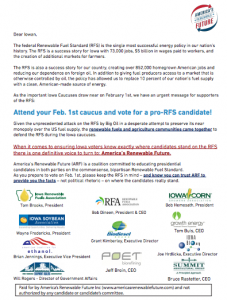
The biofuel industry continues to maintain its united front on encouraging legislative support for the Renewable Fuel Standard (RFS) especially during the presidential campaigns. Leaders from the renewable fuels and agriculture community released a public letter to allies outlining their support for America’s Renewable Future (ARF) to protect the RFS.

Screen Shot 2016-01-18 at 12.11.31 PMThe letter urges Iowa voters to turn to ARF to know where candidates stand on the RFS. It also designates the organization as the definitive voice on the issue. This letter comes as Sen. Ted Cruz has been under fire for his confusing stance on ethanol and the RFS. In a statement from ARF, they said they are committed to continuing let Iowans know that despite his change in tone, Cruz is still anti-RFS and he will destroy Iowa’s agriculture economy and Iowa farmers.

The letter was signed by the following leaders: Tom Buis, CEO – Growth Energy; Bob Hemesath, President – Iowa Corn Growers Association; Tom Brooks, President – Iowa Renewable Fuels Association; Jeff Broin, CEO – POET Biorefining; Bob Dineen, President & CEO – Renewable Fuels Association; Wayne Fredricks, President – Iowa Soybean Association; Joe Hrdlicka, Executive Director – Iowa Biotech Association; Grant Kimberly, Executive Director – Iowa Biodiesel Board; Will Rogers, Director of Government Affairs – Iowa-Nebraska Equipment Dealers; Bruce Rastetter, CEO – Summit Agricultural Group; and Brian Jennings, Executive Vice President – American Coalition for Ethanol.

Biodiesel, biofuels, Ethanol, RFS

More Renewable Energy = Higher GDP

Joanna Schroeder

According to a new report, achieving a 36 percent global share of renewable energy by 2030 would increase global domestic product (GDP) by up to 1.1 percent or nearly U.S. $1.3 trillion. “Renewable Energy Benefits: Measuring the Economics,” conducted by the International Renewable Energy Agency (IRENA), provides a global estimate of the macroeconomic impacts of renewable energy deployment. Specifically, it outlines the benefits that would be achieved under the scenario of doubling the global share of renewable energy by 2030 from 2010 levels.

“The recent Paris Agreement sent a strong signal for countries to move from negotiation to action and rapidly decarbonise the energy sector,” explained  Adnan Z. Amin, IRENA Screen Shot 2016-01-18 at 10.08.14 AMDirector-General. “This analysis provides compelling evidence that achieving the needed energy transition would not only mitigate climate change, but also stimulate the economy, improve human welfare and boost employment worldwide.”

The report also looks at country-specific impacts. Japan would see the largest positive GDP impact (2.3 percent) but Australia, Brazil, Germany, Mexico, South Africa and South Korea would also see growth of more than 1 percent each. In addition, the impact of renewable energy deployment on welfare is estimated to be three to four times larger than its impact on GDP, with global welfare increasing as much as 3.7 percent. Employment in the renewable energy sector would also increase from 9.2 million global jobs today, to more than 24 million by 2030.

The report also found that a transition towards greater shares of renewables in the global energy mix would also cause a shift in trade patterns. It would more than halve global imports of coal and reduce oil and gas imports, benefiting large importers like Japan, India, Korea and the European Union. Fossil fuel exporting countries would also benefit from a diversified economy.

“Mitigating climate change through the deployment of renewable energy and achieving other socio-economic targets is no longer an either or equation,” added Amin. “Thanks to the growing business case for renewable energy, an investment in one is an investment in both. That is the definition of a win-win scenario.”

Climate Change, Renewable Energy