ICM to Expand Albion Ethanol

Joanna Schroeder

ICM has been hired by The Andersons Albion Ethanol for an expansion project. The company will be designing and building the expansion that will double ethanol production.

ICM_2-color_logoVRTThe dry-mill corn ethanol plant was designed and built by ICM, Inc. in 2006 and engineered for future expansion. As part of the project, the plant will add a combined heat and power system that will generate approximately 7.5MW of electricity and produce steam for the existing and expanded ethanol plant. The ethanol plant expansion and installation of the combined heat and power system is expected to be completed in April 2017.

ICM President Chris Mitchell said, “We’re thrilled to announce the expansion project at the Albion, Michigan facility, and we look forward to continued collaboration with The Andersons to support the economic growth of the region by providing our process technologies and services to advance renewable energy.”

biofuels, Ethanol

Alliance BioEnergy Touts CoProMax

Joanna Schroeder

Alliance BioEnergy Plus is touting the benefits of Harvesting Technology CoProMax for an ethanol plant. When combined with the ALLM CTS process, the company reports a 55 million gallon per year (mmgy) biorefinery can add more than $17 million to the bottom line to a corn ethanol plant without bringing in outside feedstock.

alliance-bioAccording to Alliance BioEnergy, the CoProMax system eliminates the production of thin stillage and utilizes a unique method to extract nearly three times the high value Distillers Corn Oil (DCO) other than what is typical with average production practices. In addition the process provides both a high protein, high fiber distillers grain (with protein levels in excess of 45 percent and containing three quarters of the available corn kernel fiber). The DDGs with high levels of corn kernel fiber can be converted through the CTS unit, extracting even more DCO and adding millions of gallons of cellulosic ethanol output says the company.

The company also says this technology eliminates the need to transport 1,000s of tons of feedstock per day saving costs. In addition, without the feedstock there is no need to add expensive material handling or pretreatment processes.

Alliance BioEnergy says the combined CTS/CoProMax system allows an existing corn ethanol plant the ability to produce cellulosic ethanol by offering both low capital and operating expenses while retaining the ability to expand and add outside feedstocks for additional cellulosic ethanol output.

advanced biofuels, biomass, Cellulosic, Distillers Grains, Ethanol

China Leads in U.S. Ethanol Exports

Joanna Schroeder

According to Ann Lewis, research analyst with the Renewable Fuels Association (RFA), U.S. ethanol exports increased by 7 percent over December 2015 kicking off 2016 with a strong start. Using U.S. data, the increase marked a 14-month high with the industry shipping 87.1 million gallons (mg), with China taking the lead with a third of the market at 29.4 mg—rivaling the record of 32.6 mg to China last October.

During the same time frame, Canada received just 13.7 mg—the lowest volume of exports north of the border since October 2010. The United Arab Emirates (10.9 mg) and South Korea (10.4 mg) were other top markets in January. Brazil brought in a fairly sizable volume (6.6 mg) considering its recent absenteeism from the U.S. export picture. January’s robust exports equate to 1.05 billion gallons on an annualized basis.
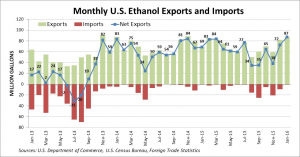
Monthly US Exports Jan 2016Denatured fuel ethanol exports saw a 29 percent month-on-month increase to 65.0 mg in January. China grabbed 29.4 mg (45%) of that market, with Canada (12.2 mg, or 19%), the UAE (8.1 mg, or 12%) and South Korea (5.9 mg, or 9%). Lewis reports that January exports of undenatured ethanol for fuel use fell 29 percent from December to 20.2 mg. Brazil (6.6 mg) and South Korea (4.5 mg) received 55% of undenatured fuel exports, while the Philippines (2.9 mg), the UAE (2.8 mg), Mexico (2.2 mg) and Peru (1.1 mg) rounded out the list. Sales of undenatured ethanol for non-fuel, non-beverage use crashed to the lowest level since February 2013, dipping 64 percent to 212,369 gallons. Similarly, denatured non-fuel use ethanol exports slumped 21 percent to 1.7 mg—the lowest volume in over a year. The U.S. kept exports of non-fuel product close to home with 78 percent of total shipping to Canada and 9 percent to Mexico.

The U.S. imported just a splash of ethanol for fuel use in January. Inbound shipments came from Canada (500 gallons) and the Netherlands (165 gallons). Given the paltry import figure, January U.S. net exports of 87.1 mg were the highest since the record month of December 2011.

January exports of U.S. distillers dried grains with solubles (DDGs) fell 19 percent from January to 800,580 metric tons (mt). DDGS exports to China tallied at 218,961 mt, representing a 3 percent decrease over December volumes but an increase in market share (27% of total U.S. exports vs. 23% in December). On a side note, these volumes were recorded despite the country opening an anti-dumping case against the U.S. for DDGs. Other export markets included Mexico at 195,669 mt, Ireland at 48,456 mt, Canada at 47,617 mt, Thailand at 46,838, Vietnam at 45,744 mt and South Korea at 45,046 mt.


Distillers Grains, Ethanol, Ethanol News, Exports, RFA

Comet Biorefining Awarded CA $10.9M

Joanna Schroeder

Comet Biorefining has been awarded CA $10.9 million dollars from the Sustainable Development Technology Canada (SDIC) to assist with the construction of its biobased chemicals plant located in Sarnia, Ontario. The biorefinery will convert corn stover into high-purity dextrose sugar. SDTC supports the development of technologies which address the challenges of clean air, soil, water and climate change.

Comet Biorefining logoAndrew Richard, founder of Comet, said, “This funding will support the commercialization of our feedstock-flexible technology and produce a much-needed raw material for the growing bioeconomy. By supporting Comet Biorefining, SDTC is investing in Canada’s environmental goals and economic future.”

Comet’s technology enables sugars to be produced cost- competitively with corn or sugarcane-derived dextrose, the conventional raw materials for today’s biochemical production. Comet’s facilities may be built on a small scale that enables flexibility to locate production close to biomass supplies, reducing transportation costs.

“Sustainable Development Technology Canada (SDTC) is incredibly proud to support Comet Biorefining,” added Leah Lawrence, president and CEO. “Our mission is to help Canadian cleantech entrepreneurs move their ground-breaking technologies to commercialization by bridging the funding gap between research and market entry. This dextrose sugar plant is the kind of technology that has the potential to generate jobs, growth and export opportunities, and to bring lasting economic, environmental and health benefits to Canadians and the world.”

biochemicals, biomass, biomaterials

Iowa Biofuel Impact Takes Small Step Back

Joanna Schroeder

A new study conducted by John Urbanchuk of ABF Economics and commissioned by the Iowa Renewable Fuels Association (IRFA) found that while the renewable fuels industry continues to be a strong driver of Iowa’s economy, its impacts have taken a small step back from last year. The report cited reductions to the Renewable Fuel Standard (RFS) as the cause.

Iowa RFA logo-new“Iowa is the leading producer of ethanol in the United States,” said Iowa Gov. Terry Branstad during a press conference at the Capitol to release the study results. “We have been disappointed by the EPA’s unwillingness to restore a robust Renewable Fuel Standard. This study shows how important renewable fuels are for the future of our Iowa economy.”

The study found that in 2015 the renewable fuels industry in Iowa:

  • Supported nearly 43,000 jobs throughout the entire Iowa economy;
  • Generated almost $2.3 billion in household income for Iowans; and,
  • Accounted for about $4.6 billion, or 3.5 percent, of Iowa GDP.

“While Iowa’s ethanol and biodiesel industries continue to power the state’s economy, it’s disappointing that those impacts took a small step backwards last year,” added IRFA Executive Director Monte Shaw. “What may be as equally frustrating is the missed opportunity to really grow Iowa’s economy. When the EPA reduced the statutory RFS levels, it reduced our ability to grow ethanol and biodiesel production, to grow forward-looking investments into new technologies, to grow farm income and to grow Iowa jobs.”

Ethanol, Iowa RFA, RFA

UT & Genera Harvest Poplar Trees for Biofuels

Joanna Schroeder

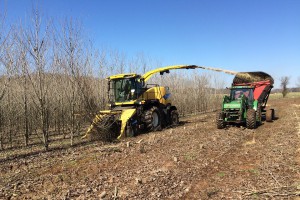
Harvester works the field web

A self-propelled forage harvester with a specialized woody harvesting head harvests a 10-acre stand of hybrid poplars being studied to advance lignocellulosic biomass as part of a USDA-funded project coordinated by the University of Tennessee Center for Renewable Carbon. Photo courtesy Genera Energy Inc

University of Tennessee AgResearch Center is harvesting its first batch of popular trees to be used as biomass to create biofuels. The 10-acre plot of hybrid poplars was planted about four years ago and now the 30-foot trees are expected to produce between 60-100 tons of woody biomass. The harvest is part of a five-year $15 million multi-disciplinary research and development effort (IBSS) funded by the U.S. Department of Agriculture (USDA) to reduce barriers to the development of the Southeastern bioeconomy.

Tim Rials, director of the UT’s Center for Renewable Carbon said, “The goal of the IBSS partnership is to demonstrate the production of advanced biofuels from sustainable sources of lignocellulosic biomass, that is, biomass made from designed herbaceous and woody crops.” IBSS has focused on perennial switchgrass and short-rotation woody crops like eucalyptus, pine and hybrid poplar, trees that can be grown in the Southeast.

“It’s important for the industry and producers to have a portfolio of crops that can supply the cellulosic biomass for the biorefineries,” Rials continued. “Very little information is available on the performance of hybrid poplar in the Southeast. This project is designed to identify the effect of both genetic differences and management practices on the growth and yield of this potentially important energy crop. The data should provide the basis for future productivity improvements.”

The harvest included plots of several hybrid poplar varieties, called clones. Although genetic differences clearly impacted the overall yield, research has shown little difference in the chemical composition of the different hybrid poplar clones. “This information provides valuable guidance for continued enhancement of this new energy crop,” Rials said. Similar field trials, some with the same varieties, are also underway in Alabama, Mississippi and North Carolina to evaluate environmental impacts on biomass yield.Read More

advanced biofuels, biomass, Cellulosic, Ethanol

Biodico Seeking Summer Interns

Joanna Schroeder

Biodico is looking for 10 interns this summer for its facilities in Fresno and Ventura Counties, California. Four interns will be based at the company’s laboratory at Naval Base Ventura County at Port Hueneme, Calif., and six interns will be based at the company’s “Westside” facility in the San Joaquin Valley located at Red Rock Ranch in Five Points, Calif. Biodico Westside recently went online and produces advanced biofuels while being powered by renewable heat and power generated on-site.

biodico logo“This program represents our commitment to create green energy jobs in economically depressed areas, as well as provide opportunities for the next-generation of bioenergy professionals to gain experience,” said Biodico President and Founder, Russ Teall. “Students who share our passion for the environment and finding economically viable solutions to power the future are encouraged to apply.”

Interns will be exposed to an array of biofuel and bioenergy technologies, including biodiesel production, anaerobic digestion, gasification, solar cogeneration and wind, as well as cultivation of biofuel crops and laboratory work. Students will be placed based upon their field of study and interests.

Several of the jobs at Westside were created in partnership with West Hills Community College in Fresno County, a region with historically high employment rates. Biodico developed an internship program specifically for West Hills’ students, and hires graduates of the school’s two-year Industrial Technology Program. Biodico has also partnered with University of California Santa Barbara to provide internships for environmental studies majors.

For more information about applying for the internship program, please email internships@biodico.com. Applications for the summer of 2016 are due March 31.

advanced biofuels, bioenergy, Education

Admin Takes Swift Action on China Antidumping Case

Joanna Schroeder

The U.S. ethanol industry recently called on the Obama administration to take quick action against China who has opened an antidumping case on U.S. exports of dried distillers grains (DDGs). In the letter, the groups asked for swift action to “mount an aggressive defense of our access to the Chinese livestock feed market.”

This week the office of the United States Trade Representative (USTR) as well as the Department of Commerce contacted the appropriate Chinese officials, expressing their concern over the process and sampling methodology utilized in selecting U.S. companies for participation in the antidumping and countervailing duty cases.

Following the decisive response, Growth Energy and RFA praised the administration for action to defend the U.S. DDG industry.

growth-energy-logo1Tom Buis, co-chair of Growth Energy noted, “I would like to commend President Obama and his administration for taking immediate action to protect the U.S distiller’s grains industry. The simple fact is that there is no reason the People’s Republic of China should file a case like this – it is counterproductive, disrupts trade and produces uncertainty throughout the domestic ethanol industry. Growth Energy and its members are grateful for the position this administration has taken to ensure that unnecessary trade restrictions such as this anti-dumping and countervailing duty case are resolved as quickly as possible.”

rfalogo1“I congratulate and appreciate the administration for getting involved in this crucial issue,” said RFA President and CEO Bob Dinneen. “I am glad both the United States Trade Representative and the Department of Commerce are recognizing the urgent need to address our concerns. I look forward to a quick resolution of these cases and returning to fair trade of the U.S. distillers dried grains industry.”

Distillers Grains, Ethanol, Exports, Growth Energy, RFA

PERC Promotes Farm Incentive Program

Joanna Schroeder

Several years ago, the Propane Research and Education Council (PERC) launched the Propane FEED Program for farmers. Today the program has evolved as is now called the Propane Farm Incentive Program and it’s taking off. To learn more about the program and how farmers can get involved, Chuck Zimmerman spoke with PERC’s Director of Agriculture Business Development Cinch Munson during Commodity Classic 2016 in New Orleans.

classic16-percThe results for 2015 are in, said Munson, and they follow the trends for the past five years. “Folks who switched to a propane irrigation engine from a diesel engine saw their energy costs go down 58 percent in 2015. So by making that switch they’re ending up with a lot of money in their pocket. Grain dryers a similar story. By upgrading their equipment from an old generation propane grain dryer to a new propane grain dryer people saved 42 percent on energy.”

Technology is changing; technology is getting better and equipment is so much more efficient, said Munson. He noted that when you combine that with the fact that propane supplies are up and propane prices are down, people who make the switch are seeing more money in their pockets.

To learn more about the Propane Farm Incentive Program, listen to Chuck’s interview with Cinch Munson: Interview with Cinch Munson, PERC

2016 Commodity Classic Photo Album

Agribusiness, Alternative energy, Audio, Commodity Classic, Propane

Spring is in the Air – What are you looking forward to?

Jamie Johansen

New Holland ZimmPollOur latest ZimmPoll asked the question, “How important are farm shows to farmers’ buying decisions?”

Farm equipment and technology are big investments for farmers and ranchers. Buying on the fly isn’t an option. Our latest poll confirms the need for farms shows that display the latest opportunities in the agriculture world.

Here are the poll results:

  • Very – 25%
  • Somewhat – 54%
  • Not at all – 13%
  • Depends – 8%

Our new ZimmPoll is now live and asks the question, What do you look forward to most in spring?

Spring is knocking at our door and I will assume we are all beginning to get Spring Fever. What are you looking forward to most this spring? Is it simply warmer weather or are you dying to dive into spring cleaning?

ZimmPoll