2017 Fuel Ethanol Workshop Coming Up Fast

Cindy Zimmerman

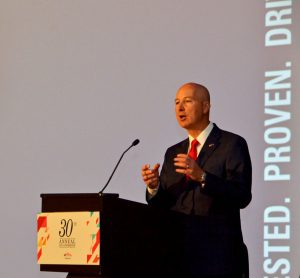
The 33rd annual International Fuel Ethanol Workshop & Expo (FEW) is coming right up, June 19-21 in Minneapolis, Minnesota.

The event, produced by BBI International and Ethanol Producer Magazine, includes more than 140 speakers and four track sessions. “This year’s agenda covers the latest innovations and efficiencies currently being developed for ethanol production,” said Tim Portz, vice president of content at BBI International. “The agenda committee did an outstanding job of rating presentation abstracts and bringing the brightest biofuels minds together under one roof for this event.”

Once again, the National Advanced Biofuels Conference is co-located with the FEW, and will feature the world of advanced biofuels—cellulosic ethanol from corn fiber, biodiesel, carbon reduction strategies, bolt-on technologies, RIN markets and more.

Details here.

Ethanol, Ethanol News, FEW

Ethanol Exports Dive in April but Still on Record Pace

Cindy Zimmerman

U.S. ethanol exports are still on a record pace for 2017 despite a 32% drop in April exports compared to March at 87.2 million gallons, the lowest volume in eight months, according to the latest government data analyzed by the Renewable Fuels Association (RFA). Year-to-date ethanol exports totaled a record 474.8 mg in the first four months of 2017.

Brazil was again the top customer for U.S. exports, receiving 44.5 mg (slightly more than half of the total volume) in April. Canada was the other major destination for U.S. product in April, taking in 19.0 mg. Peru (3.9 mg), United Arab Emirates (3.3 mg), and South Korea (2.5 mg) rounded out the top five markets. Noticeably absent from the April roster were India and the Philippines. Together, the two counties imported more than 50 mg of U.S. ethanol in March, and India had been the third-leading market for U.S. export in the first quarter.

No imports of fuel ethanol were recorded in April, leaving year-to-date import total at well below 1 mg.

Ethanol, Ethanol News, Exports, RFA

Forced Summer Hiatus Begins for E15

Cindy Zimmerman

It’s June 1st, which means the kids are out of school, the pools are open, and E15 pumps in two-thirds of the nation are shutting down.

Today marks the official beginning of the Environmental Protection Agency’s (EPA) “summer ozone control season,” and according to the Renewable Fuels Association (RFA), is the result of “an arbitrary, decades-old EPA regulation that protects the status quo and denies consumers year-round access to a fuel that is cheaper, cleaner, and offers higher octane than today’s gasoline.”

“EPA’s nonsensical and disparate RVP regulation offers no consumer or environmental benefit whatsoever,” said RFA President and CEO Bob Dinneen. “In the end, EPA’s actions are punishing consumers who are being denied access to the cleanest, lowest cost and highest source of octane fuel on the planet. We again call on EPA or Congress to resolve this arcane barrier. ”

In 2011, EPA approved the use of E15 in 2001 and newer vehicles, but the agency did not allow E15 to benefit from the 1-pound per square inch (psi) Reid Vapor Pressure (RVP) waiver that is available to E10 blends. As a result of this disparity, retailers in conventional gasoline areas would have to secure special “sub-RVP” gasoline blendstock in order to continue selling E15 during the EPA summer ozone control season, which lasts from June 1 to September 15. Such gasoline blendstock is generally unavailable in conventional gasoline areas and would be uneconomical to ship.

Sen. Deb Fischer (R-Neb.) introduced legislation earlier this year to extend the RVP waiver to E15 and RFA highlighted the need for E15 RVP relief in its comments recently submitted to EPA on regulatory reform.

E15, Ethanol, Ethanol News, RFA

Iowa Gov and Ag Groups to Make China Trip

Iowa’s new governor and the state’s agricultural organizations miss Terry Branstad so much that they are already planning a trip to see him in China.

Iowa Governor Kim Reynolds will lead an all-Iowa agriculture trade mission to China July 19-28 with representatives from the state’s corn, pork, soy, beef, egg, poultry, dairy and turkey industries. The trip marks the first time all of Iowa’s farm groups have come together for a trade mission which will be jointly funded by the participating organizations.

“There is no better time than now to market and pitch our products in China,” said Reynolds. “Our relationship with the country is strong, and their growing middle class means increasing purchasing power and Iowa stands to gain significantly as a result.”

The goal of the mission is to build relationships, understanding and trust with the hope of opening new possibilities for Iowa’s agricultural products. The groups will be meeting with government officials and industry partners. Reynolds says they will be visiting Ambassador Terry Branstad in Beijing, whose insight will be important as the groups navigate solutions to some of the current issues.

China currently accounts for 60 percent of global soybean imports – and growing. “It’s a vital market and an historic trip,” said Iowa Soybean Association CEO Kirk Leeds. “Relationships matter for the Chinese. Rarely do they do business with people they don’t know.”

China was the second-largest purchaser of U.S. ethanol last marketing year and a major buyer of U.S. distiller’s dried grains (DDGS), but because of Chinese antidumping and countervailing duties investigations, U.S. DDGS entering China now face duties of over 90 percent, and China has not approved any corn products derived from biotechnology since December 2014. “This has created market access challenges for corn exporters and restricted farmers’ access to new technologies,” said Iowa Corn CEO Craig Floss.

China is the second largest export market for U.S. pork producers but imports of U.S. beef have been banned for 13 years, so cattle producers are optimistic about the opportunities with the recent announcement to lift the ban.

Reynolds made the announcement Tuesday during her first weekly press conference as governor, joined by Lt. Gov. Adam Gregg, Iowa Corn CEO Craig Floss, ISA CEO Kirk Leeds, and Iowa Cattlemen’s CEO Matt Deppe. Listen to the announcement here: IA Gov China Trip Press Conference

Ag group, AgWired Animal, AgWired Energy, AgWired Precision, Audio, corn, Ethanol, Soybean

GRFA Charts Global Food Prices vs Ethanol Production

Cindy Zimmerman

The Global Renewable Fuels Alliance (GRFA) has released a new chart that shows the opposite trends in the UN FAO’s Food Price Index (FPI) and world fuel ethanol production since 2008 from F.O. Licht’s 2017 forecasts.

GRFA president Bliss Baker says the graph clearly demonstrates that “ethanol production is not a main driver of global food prices.” The chart shows a steady decline in the FPI from a peak of 229.9 points in 2011 to 161.5 points in 2016 which parallels the drop in annual oil prices over the same period from $94.88 to $43.15.

By contrast, this decline in food prices has coincided with a period of record ethanol production expansion, rising from 87 billion litres in 2011 to 98.5 billion litres in 2016, a 16% increase over this period. This disparity clearly demonstrates that increased ethanol production does not drive food prices.

“Real world data has long contradicted speculation about ethanol production driving up food prices,” Baker said. “These latest figures should finally put to rest any “food vs. fuel” concerns with ethanol production and are consistent with findings by the World Bank which concluded that almost two thirds of food price increases are caused by rising oil prices,” he added.

Ethanol, Ethanol News, food and fuel, Food prices, International

Growing Up Lyons

Dr. Mark Lyons and Dr. Pearse Lyons at Alltech ONE 17

Dr. Mark Lyons was a young boy in 1980 when his father, Dr. Pearse Lyons, started Alltech with an investment of $10,000. Today, the global animal health company employs more than 4700 people with a presence in 128 countries, including the rapidly growing Chinese market where Mark is based as global vice president for the company.

The youngest Dr. Lyons says he definitely thought about pursuing a career outside his father’s company, but it was the beer that changed his mind. “We started in the ethanol industry and got into agriculture,” but Mark says the beer came about because after graduating from the University of Chicago his father bought the local 200-year-old Lexington Brewing Company that was closing and urged Mark to go study brewing in Scotland. “And that’s how we actually started with Kentucky Ale, so I headed off to Scotland with a beer to brew,” he said.

That was 1999 and Alltech Lexington Brewing & Distilling Co. has since become a producer of the Kentucky Ale family of award-wining beers and spirits and is one of the few joint brewing and distilling operations in the world. In 2012, the company became part of the famous Kentucky Bourbon Trail® when it opened its Town Branch Distillery, which produces Town Branch® Bourbon, Pearse Lyons Reserve® and Bluegrass Sundown®.

This was my first year to attend the Alltech ONE symposium, even though AgWired has been there since 2008, and it was the first time I had met any of the Dr. Lyons’s so in the short five minutes I had to chat with Mark I really wanted to know what it was like growing up with a disruptor like his father: Interview with Dr. Mark Lyons, Alltech

Mark’s topic at the Alltech symposium was Meeting the Demands of the “Rising Billion” – Dr. Mark Lyons, Alltech 2017 presentation

Alltech ONE17 Photo Album

AgWired Energy, Alltech, Audio

American Ethanol Driver Wins

Cindy Zimmerman

The No. 3 Chevrolet owned by Austin Dillon’s grandfather, Richard Childress, returned to Victory Lane during the Coca-Cola 600 for the first time since the late Dale Earnhardt won his last race on Oct. 15, 2000 at Talladega.

It was the first career Monster Energy Series win for Dillon, who races the No. 3 Dow/American Ethanol/AAA Chevrolet SS team car, and the seventh year the NASCAR series has been powered by Sunoco Green E15. Dillon thanked “those partners that were here from the very beginning – Dow, American Ethanol – it feels so good to deliver. They had to believe in me no matter what.”

The American Ethanol partnership, which includes Growth Energy and the National Corn Growers Association (NCGA), sponsored the 2014 return of the No. 3 car owned by Richard Childress Racing (RCR). “This is an incredible victory for the No. 3 team, and the entire American Ethanol family is filled with pride – we knew this day would come,” said Growth Energy CEO Emily Skor.

“NCGA is obviously thrilled by the win because it further validates the abilities of ethanol fuel on the road and on the track. Specifically, it provides great positive exposure for E15 at a time when the fuel is beginning to make significant gains in consumer retail space, said Paul Jeschke of Illinois who serves as chairman of NCGA’s Ethanol Action Team.

The No. 3 was not wearing the American Ethanol paint out for the Charlotte race but it is featured at six races during the year with the next one being the Coke Zero 400 at Daytona International Speedway in Daytona Beach on July 1.

American Ethanol, NASCAR

POET Founder to Receive BIO Award

Cindy Zimmerman

POET founder, chairman and CEO Jeff Broin will receive the 10th annual George Washington Carver Award for Innovation in Industrial Biotechnology at the 2017 BIO World Congress on Industrial Biotechnology July 23-26, 2017 at the Palais des congrès de Montréal in Montréal, Québec, Canada.

“Jeff Broin is one of the great innovators and entrepreneurs in the industrial biotechnology sector,” said Brent Erickson, executive vice president of BIO’s Industrial & Environmental Section. “He ranks among the most influential leaders in agriculture as well.”

The George Washington Carver Award is also sponsored by the Iowa Biotechnology Association. Joe Hrdlicka, executive director of the Iowa Biotechnology Association, said, “Jeff Broin has created an environment at POET where new ideas thrive throughout the value chain of new economic opportunities for American agricultural producers and rural communities. His business model truly reflects the ideas and passion spawned by George Washington Carver a century ago.”

Jeff Broin led the growth of POET from a small 1-million-gallon facility 30 years ago to the current POET network of 28 biorefineries in 7 states with 1,800 team members. The annual Carver award recognizes an individual who has made a significant contribution to building the biobased economy by applying industrial biotechnology to create environmentally sustainable products and Broin becomes the 10th recipient honored with the award.

BIO, Ethanol, Ethanol News, POET

Video Explains Impact of Changing RFS Obligation Point

Cindy Zimmerman

The Main Street Energy Alliance (MSEA) has released a video about the negative impact of shifting the Renewable Fuel Standard’s (RFS) point of obligation.

“It’s important for Americans to understand that shifting the point of obligation in the Renewable Fuel Standard will disadvantage small business owners and decrease the overall consumption of renewable fuels in the country,” said Michael Steel, a spokesman for MSEA. “The issue is quite complex, but this new video effectively walks viewers through the facts and should serve as an educational tool for those who wish to inform themselves about the issue.”

Representing more than 30 energy companies and trade associations, including fuel retailers and biofuel producers, MSEA is urging the administration to resist the calls of a few special interests to alter the point of obligation requirement under the Renewable Fuel Standard.

Watch the video here:


Ethanol, Ethanol News, RFS, Video

Ethanol Production Picks Up Again in May

Cindy Zimmerman

U.S. ethanol production has been over a million gallons again for the last three weeks, according to Energy Information Administration (EIA) data.

After five weeks of below a million gallons, production picked up again at the beginning of May. As a result, the four-week average for ethanol production as of May 19 was just over a million gallons, for an annualized rate of 15.44 billion gallons.

The first week of May also saw the first ethanol imports in 37 weeks. Imports of ethanol totaled 28,000 b/d the week of May 5 but dropped to zero again the past two weeks.

Average weekly gasoline demand surged to 407.6 million gallons (9.704 million barrels) daily last week, the highest level since mid-August 2016. However, refiner/blender input of ethanol dipped slightly from last week’s 40-week high, falling 0.2% to 949,000 b/d.

Ethanol, Ethanol News, RFA