

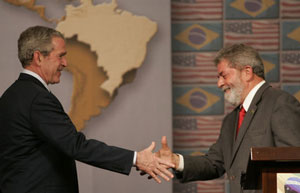
 Lawmakers and special interests have been chiming in with reaction to the US-Brazil biofuels agreement announced last week.
In a press statement, Senator Richard Lugar of Indiana praised the agreement. “Working with Brazil will help turn ethanol into a global commodity and reduce our dependence on oil. It also demonstrates to our friends in the Hemisphere that we are ready partners in advancing our common interest for energy security. If implemented vigorously and funded generously, a policy of partnerships in biofuels production could rehabilitate the U.S. in the eyes of everyday Latin Americans,” Lugar said.
The Illinois Corn Growers Association issued a release calling the memorandum of understanding “a natural and positive step forward for the development of a international ethanol industry,” but officials say they “will watch these developments closely to assure any future agreements are formulated in the context of fair trade.”
However, the National Farmers Union says the agreement could have “negative impact on family farmers, ranchers and American taxpayers.” In a statement, NFU President Tom Buis expressed concerns that the partnership could allow foreign ethanol investors to receive U.S. tax subsidies and compete with U.S. producers. “Decreasing our reliance on foreign oil while increasing our reliance on foreign biofuels is the wrong move when attempting to become energy independent. Ethanol production is the only sector in agriculture that has seen a decrease of consolidation, a direct result of farmer-owned biofuels production facilities. We should not jeopardize this achievement by having U.S. taxpayers foot the bill for foreign-owned biofuel production.”
 During a press conference Friday with Brazilian President Luiz Inacio Lula da Silva, President Bush said, “I hope the citizens of Brazil, like the citizens of the United States, are as optimistic about the future as these two Presidents are. And one reason we’re optimistic is because we see the bright and real potential for our citizens being able to use alternative sources of energy that will promote the common good.”
  Leaders from a broad alliance of agricultural, energy, environmental, business and labor groups recently rolled out a set of specific recommendations for reaching an ambitious renewable energy goal: 25 percent of the nation’s energy supply from renewable sources by 2025. Members of the
  The Action Plan, which was presented to Congressional leaders, contains 35 specific recommendations that “would cost just five percent of what America spent on imported oil in 2006 and would result in a dramatic increase in new jobs and economic activity, along with significant reductions in oil consumption and global warming emissions.”
 Virtually every livestock representative testifying had a statement similar to Joy Philippi of Nebraska, immediate past president of the
  However, in separate press conferences Thursday, the chairmen of the House and Senate Agriculture Committees disagreed.
 House Ag Committee Chairman Collin Peterson of Minnesota pointed out that grain producers are finally getting a fair price for their crop. “What people fail to recognize is that over the last number of years, corn prices have been substantially below the cost of production and the livestock industry has benefited from this,” said Peterson.
 The City of Coral Gables, Florida will be the first city in South Florida to use biodiesel in the city’s vehicle fleet.
 When it opens this summer, the Imperium Renewables plant is expected to produce 100 million gallons of biodiesel a year and will become the largest in the country. And all that biodiesel means increased shipping for the area. In fact, the
  Two Republican senators voiced concerns Wednesday about a potential U.S.-Brazil ethanol accord.
 South Dakota Republican John Thune argues that elimination of the tariff is counter-productive to the intention of developing a strong domestic ethanol industry. “This is something that is very good for American agricultural producers,” he said. “So it doesn’t make sense for us to be trying to develop that industry elsewhere around the world nor to make us dependent on a foreign source of energy when the whole purpose is to become less dependent on foreign sources of energy.”
 Ethanol industry leader
  RFA President Bob Dinneen issued the following