

Right after POET™ opens it’s 20th ethanol production facility this Friday in Iowa, the company will be preparing to break ground on yet another plant, this one in Ohio.
 On May 16, POET will hold a groundbreaking ceremony for POET Biorefining – Marion, located in north central Ohio about 50 miles north of Columbus. When complete, the plant will produce 65 million gallons of ethanol a year from 21 million bushels of corn.
POET has built 25 ethanol production facilities since it was founded 20 years ago and has eight more under construction or in development. POET currently manages 19 ethanol production facilities and is holding a grand opening celebration for its twentieth in Corning, Iowa May 4. With Corning, the total annual production capacity for those 20 facilities is more than 1 billion gallons of ethanol.

 The U.S. Department of Energy (DOE) will provide up to $200 million, over five years to support the development of small-scale cellulosic biorefineries in the United States.
  According to
  Some student designs are proposing that windmills, such as the one shown on the left, would be built above the nation’s highways. As cars whooshed by, the wind would turn the turbines and produce electricity. Proponents say its a way to produce green energy, even when the original source is not so green.
 The 48th Annual Corn Dry Milling Conference is coming up May 31 – June 1 at the National Center for Agricultural Utilization Research in Peoria, Illinois. The conference is jointly sponsored by the North American Millers’ Association and the National Center for Agricultural Utilization Research Agricultural Research Service, USDA.
 There are 115 biodiesel plants in the United States with a combined production capacity of 865 million gallons a year — about five days of total U.S. distillate consumption, according to industry group, the National Biodiesel Board (NBB).
 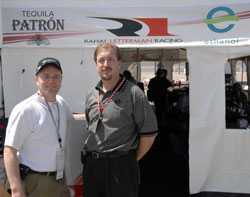 One of the people I met at the Kansas Speedway this weekend was Troy Hobbs, Monsanto Corn Biofuels Strategy Lead (left). He’s pictured here with
 Seattle-based Imperium Renewables is making an investment in its own future by loaning money to Propel Biofuels to build its first biodiesel filling stations in Washington state.
 Rob Elam, president of Propel Biofuels, said that the company is looking to have its biodiesel equipment installed at about 20 fueling stations in Washington, Oregon and California by the end of this year.