

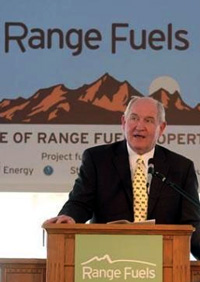
 Georgia Governor Sonny Perdue welcomed a new phase in ethanol production to his state with Range Fuels’ groundbreaking of the nation’s first commercial-scale cellulosic ethanol plant this week.
“Georgia is proud to partner with Range Fuels to lead the nation in delivering cellulosic ethanol as a solution to America’s dependence on foreign and fossil fuels,” said Governor Perdue. “Our abundance of natural resources, as well as our growing bioenergy research and development community and access to global markets firmly establish Georgia at the forefront of the national movement to a higher level of renewable energy.”
U.S. Secretary of Energy Samuel Bodman also attended the ceremony Tuesday at the site of the plant in Soperton, Georgia.
“Together, the Department of Energy and Range Fuels are blending science and technology in order to reduce America’s dependence on foreign oil. The biorefinery soon to stand on this site is the result of President Bush’s initiatives to expand the use of homegrown alternative fuels, protect the environment, and enhance the nation’s energy security,” Bodman said.
The first two phases of the Range Fuels project, in which the Department of Energy is playing a cost-sharing role, is projected to process 1000 tons per day of wastewood to produce about 30 million gallons of biofuels and chemicals.
 5. Micro Wind Turbine
 Presidential candidates Sens. Hillary Clinton (D-New York) and John McCain (R-Arizona) made separate stops at two Renewable Energy Group biodiesel facilities during their campaigns in Iowa today.
 Clinton toured the 30-million gallon REG network biodiesel production facility in Newton, while McCain attended the ribbon-cutting of the new REG headquarters in Ames. The fact that two national candidates are pushing biodiesel is a welcome sight to the National Biodiesel Board:
 DuPont and BP are working to bring a next generation biofuel to market on a commercial scale and officials are optimistic that it might get there before cellulosic ethanol.
 In an
In an  The 20th annual
  Massachusetts lawmakers will consider a proposal designed to increase that state’s use of biofuels. State Senate President Therese Murray and House Speaker Sal DiMasi, working with Governor Deval Patrick, filed a bill today that sets usage standards and creates a state Biofuels Task Force, responsible for addressing issues, such as energy crop incentives, tax credits for advanced biofuels research and development, fuel performance standards, and requirements to produce flex-fuel vehicles.
 What started as a project to brew biodiesel in some old pots from the school cafeteria has turned into a 100,000-gallon-a-year production line that saves the school an estimated $125,000 a year in fuel costs.
 A cellulosic ethanol company funded by California-based Khosla Ventures is holding a groundbreaking this week for its first planned facility in Georgia.