

The three major ethanol producer groups are working together to combat negative publicity and keep ethanol moving forward.
 Ethanol Promotion and Information Council Executive Director Toni Nuernberg says the three groups – EPIC, the Renewable Fuels Association, and the American Coalition for Ethanol – complement each other.
 “All three of us have a roll to play in this industry,” Nuernberg says. “We are looking at all the initiatives under way by the different organizations, how we can work together, and make sure we’re not duplicating effort.”
 EPIC’s main focus is to drive demand with consumers, while RFA’s role is to protect and promote policy in Washington DC, and ACE is the grassroots organization dedicated to expansion of ethanol production.
Because of the three different roles, Nuernberg says all three groups should be supported by the industry. “It’s all equally important and will benefit plants long-term,” she says.
EPIC has just started a major national advertising campaign, which also includes three syndicated radio programs – The Wall Street Journal, NPR Car Talk and Bill O’Reilly. Nuernberg says they are very pleased to have the support of O’Reilly in the effort.
Listen to an interview with Toni Nuernberg from the 2008 FEW here about the ethanol industry’s promotional efforts:
[audio:http://www.zimmcomm.biz/few08/few08-toni.mp3]
 A group of students in West Virginia are learning how to brew up biodiesel, while helping run the buses to get them to those classes.
 “It opens the door to a whole new world,” Lincoln County FFA president Katelyn Brogan, 17, said. “You learn so much more from it: How to recycle properly, how to renew your fuels, how to save money and time.”
 The National Biodiesel Board has two new members on its Governing Board.
 Hopkins, CEO of US Biofuels, has 35 years of combined experience in the biodiesel and chemical engineering fields, and is involved in several chemical production associations. US Biofuels, a multi-feedstock biodiesel producer, is based in Rome, Ga.
 Johnson, president & CEO of GEN-X, has had extensive experience in the food processing industry in capacities ranging from operations to quality assurance. GEN-X is a multi-feedstock producer based in Burbank, Wash.
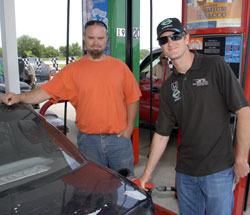 Consumers in Ankeny, IA were treated to a little relief at the gas pump today when the Ethanol Promotion and Information Council teamed up with Kum & Go for a pre-race ethanol promotion.
 General Electric has released a study that says the taxes paid back to the U.S. government are more than the tax incentives given to wind energy companies by the government.
 Sen. Charles Grassley (R-Iowa) renewed his commitment to Congress renewing the biodiesel tax incentive… while he took a shot at the Grocery Manufacturers Association for what he says is a smear campaign by the group against biofuels. Grassley’s comments come on the heels of Tuesday’s vote, when the U.S. Senate came up just eight votes short of cloture to end debate on extending the $1-a-gallon biodiesel tax credit.

 Buttons of many colors can be seen on hundreds of name badges walking around the 2008 Fuel Ethanol Workshop creating a positive mantra for the ethanol industry.
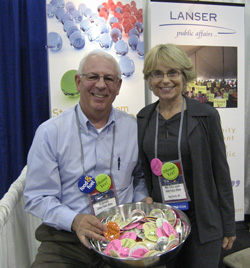 The “Yes Ethanol” buttons are the creation of
 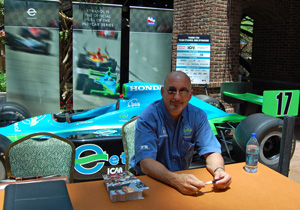 With a model of the Number 17 Team Ethanol car behind him, Rahal chatted with ethanol industry representatives about the season so far and the talent of driver Ryan Hunter-Reay.