

 A recent announcement was made by Michigan Governor Jennifer M. Granholm and Michigan Department of Labor & Economic Growth Director Keith W. Cooley that will allow funding for E85 infrastructure at fourteen retail facilities throughout Michigan. This endeavor is part of an initiative that will bring more renewable fuels to the state.
“Investing in alternative energy infrastructure and promoting the use of ethanol is an important element of our effort to diversity Michigan’s economy,” Granholm said. “This program will help deliver the 267 million gallons of ethanol per year Michigan already produces and will deliver advanced cellulosic ethanol as it comes online.”
Stations will receive up to $70,000 to install their E85 infrastrucure. All have agreed to begin selling the alternative fuel by November 15 of this year. The awardees and cities they will be selling the fuel are:
Corrigan Oil Corp., (Brighton)
Coyne Oil Corp., (Mount Pleasant)
Downtown Wixom Development, (Wixom)
Haggerty Joy Mobil, (Canton)
Jawad Marathon, (Southfield)
Ten & Greenfield Sunoco, (Oak Park)
274 Gratiot Corp., (New Haven)
Speedway SuperAmerica LLC, (Cheboygan)
Speedway SuperAmerica LLC, (Davison)
Speedway SuperAmerica LLC, (Jackson)
Speedway SuperAmerica LLC, (Lansing)
Speedway SuperAmerica LLC, (Lansing)
Speedway SuperAmerica LLC, (Livonia)
Speedway SuperAmerica LLC, (Ypsilanti)
Stations can also use the Federal income tax credit that will allow 30 percent of the cost of their project up to $30,000.
There are currently 70 E85 fueling facilties across the state of Michigan.

 The
The  Putting the acreage report in context with respect to America’s ethanol industry,
 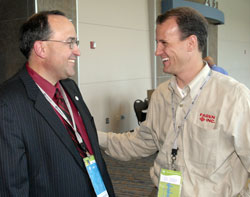 Another representative of Fagen Incorporated has joined the ranks in the
  Sixty days after it left port in Sagunto, Spain… and 14 days ahead of the previous world record… the 100 percent biodiesel-powered boat, Earthrace, has finished circling the globe faster than any other boat ever has before.
 While big wind farms are part of the U.S. Department of Energy’s plan to have wind power make up 20 percent of the nation’s energy supply by 2030. But at least one small wind power generator is saying, “Don’t forget about the little guys.”

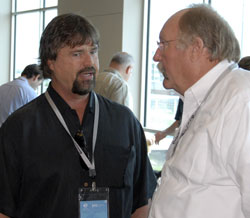 Gary Pestorious (pictured speaking with EPIC founder Ron Fagen) isn’t new to ethanol nor to the
  One of the nation’s largest power companies has added to its wind energy holdings. Charlotte, North Carolina-based Duke Energy has spent $240 million to acquire Vermont-based wind energy company Catamount Energy Corp.