

 Just moments ago, Pres. Barack Obama, in his first State of the Union Address, laid out his plan he believes will lead to the recovery of the U.S. economy. And alternative energy could wind up being a big winner as part of the plan.
Obama said that while “we have known for decades that our survival depends on finding new sources of energy,” we’re continuing to import more foreign oil than ever before. Part of the solution to that ever-growing dependence on foreign oil are alternatives, such as biodiesel, ethanol, solar and wind energy, as well as hybrid vehicles. Obama wants $15 billion to invest in those green energy sources From his speech posted on the White House Web site:
“We know the country that harnesses the power of clean, renewable energy will lead the 21st century. And yet, it is China that has launched the largest effort in history to make their economy energy efficient. We invented solar technology, but we’ve fallen behind countries like Germany and Japan in producing it. New plug-in hybrids roll off our assembly lines, but they will run on batteries made in Korea.
Well I do not accept a future where the jobs and industries of tomorrow take root beyond our borders – and I know you don’t either. It is time for America to lead again.
Thanks to our recovery plan, we will double this nation’s supply of renewable energy in the next three years. We have also made the largest investment in basic research funding in American history – an investment that will spur not only new discoveries in energy, but breakthroughs in medicine, science, and technology.
We will soon lay down thousands of miles of power lines that can carry new energy to cities and towns across this country. And we will put Americans to work making our homes and buildings more efficient so that we can save billions of dollars on our energy bills.
But to truly transform our economy, protect our security, and save our planet from the ravages of climate change, we need to ultimately make clean, renewable energy the profitable kind of energy. So I ask this Congress to send me legislation that places a market-based cap on carbon pollution and drives the production of more renewable energy in America. And to support that innovation, we will invest fifteen billion dollars a year to develop technologies like wind power and solar power; advanced biofuels, clean coal, and more fuel-efficient cars and trucks built right here in America.
Obama also pointed to Greensburg, Kansas as an example of how the entire country can rebuild in a green energy way. Maybe, then, our economy can as well.
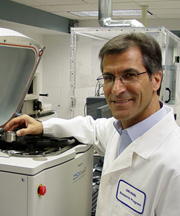 Lou Honary, a professor and director of the National Ag-Based Lubricants Center at UNI, says while biodiesel and ethanol produced from traditional crops of soybeans and corn are the obvious choice for the Midwest… despite the criticisms from some city cousins… a diversity of feedstocks and energy sources needs to be the country’s goal:
 Novozymes has been vocal about its commitment to bringing process improvements and lower enzyme costs to market by 2010. They estimate that with the lower enzymes costs a gallon of cellulosic ethanol can be produced for $2.25 per gallon by 2010, which cuts costs by more than half from only 2 years ago while making it competitive with corn-ethanol.
 Indirect land-use affects of corn-based ethanol would be “small” reported Thomas Darlington, with Air Improvement Resource, Inc., today during a special press conference as part of the National Ethanol Conference. Darlington has been working with RFA to help legislators, in particular the California Air Resources Board (CARB) and Environmental Protection Agency (EPA) better understand Land-Use Change. Indirect land use research is still in its infancy in terms of the scientific research behind the issue.
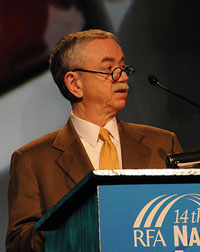 Introducing Jim Ford with API, Renewable Fuels Association president Bob Dinneen stressed the importance of working with the petroleum industry. “They’re our customers, they’re the ones bringing our product to the consumer, so we have to work constructively with them,” said Dinneen.
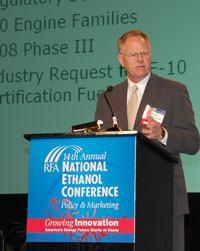 Kris Kiser, Executive Vice President of the Outdoor Power Equipment Institute, spoke to the National Ethanol Conference on a Marketing Higher Level Blends panel.
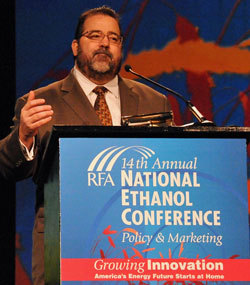 “Some look at what we’re up against and see “an industry in crisis.” I look at what we’re up against and see an industry with the perseverance and determination to succeed,” said Dinneen in his annual address this morning at the National Ethanol Conference in San Antonio.
 With the economy in the toilet, I thought I’d get a little inspiration from T. Boone Pickens’ book,