

We should not put all of our energy eggs in one basket… that’s the view of a professor from the University of Northern Iowa, who also dismisses some of the food-versus-fuel myths in this fascinating guest column in the Des Moines (IA) Register.
 Lou Honary, a professor and director of the National Ag-Based Lubricants Center at UNI, says while biodiesel and ethanol produced from traditional crops of soybeans and corn are the obvious choice for the Midwest… despite the criticisms from some city cousins… a diversity of feedstocks and energy sources needs to be the country’s goal:
The economic downturn has exposed many fallacies regarding biofuels. Most important, the recent drop in farm commodity prices has shown that the increase in the cost of food was not all because of the increased production of biofuels, but rather it was due to the absurd increases in the price of petroleum, $146 per barrel just a few months ago.
It also exposed the fact that the best intentions could be attacked for the wrong reasons. Just a few months ago, U.S. farm producers and the biofuels industry were being blamed as the root cause of food riots, starvation and deforestation of the Amazons, not the $5-per-gallon diesel fuel required to transport the foodstuffs…
During the past three years, when petroleum prices began to increase, most politicians forgot about biobased products and biopower sources and collectively jumped on the biofuels-only band wagon. Of course, with an annual U.S. consumption of nearly 165 billion gallons of gasoline and 45 billion gallons of diesel fuel, or more than one-half of all of our total petroleum use, it would be difficult not to get caught up in the excitement. However, conventional wisdom requires diversifying and suggests not putting all the eggs in one basket. By making biofuels the primary focus of U.S. efforts to reduce imported oil, an easy target was provided to detractors, with devastating results.
The country will be better served by promoting an array of alternative energy sources and biomass-based fuels, chemicals and bioproducts. Biofuels may get more support due to their sales volumes, but the message should be balanced and emphasize reduction of imported petroleum through promotion of all three priorities: bioproducts, biopower and biofuels.
 Novozymes has been vocal about its commitment to bringing process improvements and lower enzyme costs to market by 2010. They estimate that with the lower enzymes costs a gallon of cellulosic ethanol can be produced for $2.25 per gallon by 2010, which cuts costs by more than half from only 2 years ago while making it competitive with corn-ethanol.
 Indirect land-use affects of corn-based ethanol would be “small” reported Thomas Darlington, with Air Improvement Resource, Inc., today during a special press conference as part of the National Ethanol Conference. Darlington has been working with RFA to help legislators, in particular the California Air Resources Board (CARB) and Environmental Protection Agency (EPA) better understand Land-Use Change. Indirect land use research is still in its infancy in terms of the scientific research behind the issue.
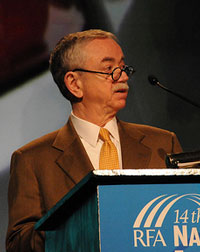 Introducing Jim Ford with API, Renewable Fuels Association president Bob Dinneen stressed the importance of working with the petroleum industry. “They’re our customers, they’re the ones bringing our product to the consumer, so we have to work constructively with them,” said Dinneen.
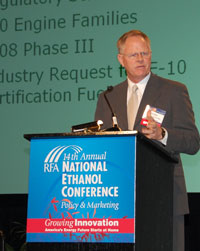 Kris Kiser, Executive Vice President of the Outdoor Power Equipment Institute, spoke to the National Ethanol Conference on a Marketing Higher Level Blends panel.
 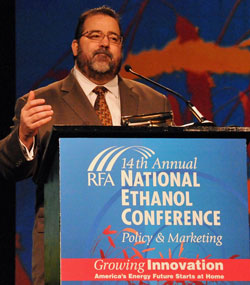 “Some look at what we’re up against and see “an industry in crisis.” I look at what we’re up against and see an industry with the perseverance and determination to succeed,” said Dinneen in his annual address this morning at the National Ethanol Conference in San Antonio.
 With the economy in the toilet, I thought I’d get a little inspiration from T. Boone Pickens’ book,