ACE Conference 2026

Farm Foundation to Host Food-vs-Fuel Analysis Update

John Davis

farmfoundationforum2Last summer, crude oil prices were skyrocketing to around $150 a barrel, and we were all sweating the $4-$5 a gallon fuel prices every time we pulled up to those gas pumps. It was during this time of anxiety that the debate around the role biodiesel and ethanol were playing in food price spikes that were also hitting everyone hard in the pocketbooks. Our friends at Farm Foundation took on this debate when they released in July 2008 the report, What’s Driving Food Prices?

What a difference eight months make, as oil prices have fallen back below $40 a barrel, and gas is a lot closer to a buck-and-a-half per gallon than the summer’s highs. Funny… food prices seem to have remained high… hmmmmm.

Well, in their never-ending quest to continue the conversation, the Farm Foundation folks have asked the report’s authors, Purdue University Economists Phil Abbott, Chris Hurt and Wally Tyner, to update their analysis of the drivers of food prices. Their findings will be the subject of a March 11th Forum at the National Press Club, 529 14th Street NW, in Washington D.C. The forum runs from 9 to 11 am, and they’ll even serve up a cup of joe starting at 8:30 am.

Contact my friend, Mary Thompson, Farm Foundation Director of Communications at mary@farmfoundation.org to RSVP by noon CST, Monday, March 9th. The forum is free.

Farm Foundation

America’s Destiny: An Eco-Sustainable City

John Davis

df-logoThis edition of the DomesticFuel Cast… and yes, we have returned on a regular basis… we look at Destiny, Florida… a community striving to be the nation’s first eco-sustainable city.

We talked to Roz Gatewood, the Vice President of Business Development for the 41,000-acre community founded in 2005 in South Central Florida… less than an hour from the attractions of Orlando and Disney World and less than a day’s drive from anywhere in the Southeastern United States.

destinyShe explains Destiny was founded by South Florida land developer Anthony V. Pugliese, III and Fred DeLuca, co-founder of Subway restaurants based on the principles of being sustainable on an agricultural, environmental and economical basis. When it is fully operational, the city will operate an energy park that produces power from biodiesel, ethanol, solar and wind sources for companies that contribute to sustainable industries, such as building solar panels. In fact, she says they hope there will be 16,000 green tech jobs in the city one day.

It’s a fascinating concept, and I think you’ll be interested in what she has to say. You can check it out here: [audio:http://www.zimmcomm.biz/domesticfuel/DFCast-2-26-09.mp3]

You can also subscribe to the DomesticFuel Cast by http://www.zimmcomm.biz/domesticfuel/domestic-fuel-cast.xml”>clicking here.

Biodiesel, Domestic Fuel Cast, Ethanol, News, Solar

National AF&V Conference Keynote Speakers Announced

2009afviThe Alternative Fuel Vehicle Institute (AFVi) have announced that General Wesley Clark, T. Boone Pickens, and Jeff Schuster will be their keynote speakers for their 2009 conference. Their fifteenth annual conference will be held in Orlando, Florida on April 19-22, 2009.

Keynote speakers will be joined by 200 experts presenting topics in thirty-five concurrent sessions. Information will focus on evolving transportation policy and funding changes during created an opportunity for alternative fuels. Session topics will include legislation, air quality, plug-inhybrids, fuel cells, heavy-duty hybrids, biofuels updates, electric driveadvances, and in-depth workshops on federal funding, biofuels, vehicle conversions, and natural gas trucking.

An estimated 2,000 people are scheduled to attend the conference. For more information on the conference, go to http://www.afv2009.com.

News

“2008 an Anomaly Year”

Joanna Schroeder

john-urbanchuk

“When the  history books are written, 2008 most likely will go down as an anomaly year, ” began John Urbanchuk, Director of LEGC, LLC. Housing market crash. Financial market crash. Global recession. Commodity boom and bust. Wave of bankruptcies. “We slipped into a recession in December 2007, ending a seven year run of economic growth.” But, he continued, President Obama, in his address last night, brought back his primary message: hope. 

There are several economic factors that affect the ethanol industry, says Urbanchuk. They include: corn supply and price; economic growth; consumer spending and gas demand; credit availability; oil and gas prices; and inflation. With the recent passing of several economic stimulus packages, along with the consumers driving more and oil prices back on the rise, the economy should see a turn-around by the end of 2009, early 2010.

Ultimately, Urbanchuk says, “The worst is behind us.” That’s great news for the ethanol industry.

 You can listen to Urbanchuk’s comments at the conference here: [audio:http://www.zimmcomm.biz/rfa/nec-09-urbanchuk.mp3]

RFA recently released Urbanchuk’s latest economic report, “Contribution of the Ethanol Industry to the Economy of the United States.” Click here to download the full report.

Audio, Ethanol, National Ethanol Conference, RFA

NRDC’s Take on Indirect Land Use

Joanna Schroeder

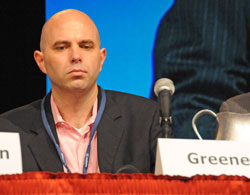
Nathaneal GreeneIndirect land use has been a hot topic at this year’s 14th annual National Ethanol Conference.

The ethanol industry has been working closely with many organizations on this issue including the National Resources Defense Council (NRDC). I caught up with Nathanael Greene, Senior Policy Analyst–Air and Energy, after he participated in the panel: The Impact of Lifecycle Greenhouse Gas Emissions on Ethanol Use. He spoke with me about why indirect land use is so important to the ethanol industry.

You can listen to my interview with Nathaneal here: [audio:http://www.zimmcomm.biz/rfa/nec-09-greene-joanna.mp3]


See photos from the National Ethanol Conference here.

Audio, Ethanol, National Ethanol Conference, RFA

Dell’s Oklahoma Facility to Run on Windpower

John Davis

dellDell Computer officials have announced their 240,000 square-foot campus in Oklahoma City will be powered entirely by wind energy.

This story from PC Magazine says the move boosts Dell’s renewable energy use by 35 percent nationwide and is part of the company’s overall goal of becoming the greenest technology company on Earth:

The Oklahoma City facility is gearing up to its part in a partnership with Oklahoma Gas and Electric company that aims to prevent 5,100 tons of CO2 from entering the atmosphere each year. By 2015 Dell expects to cut its worldwide operations’ emissions by 40 percent. This will be achieved via on-site renewable-energy generation, purchasing renewable energy certificates, and further collaboration with local utilities.

“Integrating green power into our operations wherever and whenever possible is a key environmental and business strategy,” said Dane Parker, director of environment, health and safety at Dell. “It’s critical that our industry take a leadership role in the transition to a green economy. Aggressive energy efficiency and renewable-power targets are essential.”

Wind

Biodiesel Making Fast, Clean VWs Faster, Greener

John Davis

vwtdi2Volkswagen will be running B5 biodiesel in all its race cars, transport vehicles and generators during the 2009 Jetta TDI Cup season.

This press release says they’ll be using the green fuel provided by Houston-based HYPERFUELS:

“We are extremely pleased to have HYPERFUELS as a partner for the 2009 Jetta TDI Cup series. SynDiesel(R) B5 biodiesel has been fully approved for use in all Volkswagen TDI powered vehicles that are available at local Volkswagen dealerships today,” said Clark Campbell, Motorsport Manager, Volkswagen of America, Inc. “The addition of SynDiesel B5 biodiesel in the Jetta TDI Cup race cars further demonstrates the feasibility of biodiesel as an alternative fuel source for American consumers and supports the clean and green racing of the Jetta TDI Cup series,” added Campbell.

Performance testing has proven that diesel powered vehicles offer more low-end torque than traditional gasoline engines, providing quicker off-the-line acceleration that’s well suited for the race track. In addition, the Jetta TDI engine’s use of a “common rail” direct injection system improves fuel economy over gasoline engines and reduces sooty emissions by 95 percent, even under demanding race conditions. During the 2009 season, the Jetta TDI Cup cars will consume approximately two tanks of B5 biodiesel during race conditions and overall carbon emissions produced by the series will be reduced by 2,583 pounds as a result of the new fuel. These environmentally-friendly characteristics classify all Volkswagen TDI models as Advanced Lean Technology Vehicles, qualifying consumers for a $1,300 Federal Income Tax Credit.

“HYPERFUELS is excited that the 2009 Volkswagen Jetta TDI Cup and SCCA Pro Racing acknowledge that the addition of biodiesel creates a clean performance racing fuel,” said Jess Hewitt, President, Gulf Hydrocarbon, the parent company of HYPERFUELS. “If we can help take biodiesel awareness and performance to the next level, then everyone wins. It’s cleaner burning, yields a faster burn, produces less emissions and is easily accessible. I can’t imagine a better fuel or better cars to showcase the performance and benefits of biodiesel,” added Hewitt.

Officials say this brand of biodiesel has 20 percent more BTUs than petroleum diesel. No wonder they’re using it in racing cars.

Biodiesel

Biofuels Industries Form Global Renewable Fuels Alliance

Joanna Schroeder

global-renewable-fuelsalliance1

From left to right, Bliss Baker, Executive Director, Global Renewable Fuels Alliance; Gordon Quaiattini, President, Canadian Renewable Fuels Association; Robert Veirhout, Secretary General, European Bioethanol Industry Organization; Bob Dinneen, President and CEO, Renewable Fuels Association

The Renewable Fuels Association, the Canadian Renewable Fuels Association and the European Bioethanol Industry Organization have joined together to form the Global Renewable FuelsAlliance. Their first initiative is to reach out to the World Bank, along with other organizations, to encourage them to make investments in developing countries’ biofuels infrastructure a top priority.

While Brazil is not yet a part of this organization, Bliss Baker, Executive Director, of the Global Renewable FuelsAlliance, said that they have spoken and invited them, along with dozens of other worldwide organizations, to join the alliance. Bob Dinneen, President and CEO of the Renewable Fuels Association followed up by saying, “Quite frankly, we expect them to join.”

The announcement of this global alliance comes on the heals of President Obama’s commitment to continued biofuels development in the States and the cooling of the “food versus fuel debate” which was proven to be a hoax this summer as commodity prices plummeted and food prices skyrocketed. There was a consensus among the group that the time was right to begin working together to help build the global energy infrastructure.

Gordon Guaiattini, President of the Canadian Renewable Fuels Association, stressed the importance of helping developing countries develop their agricultural productivity. “Agriculture productivity and poverty are directly linked.” He wants this new organization to take a similar approach that leading agricultural groups have, who have for years, helped developing countries adopt more sustainable practices while increasing output. He said that they will ensure that biofuels are developed in a sustainable manner that will allow poverty stricken areas to significantly increase their economic condition. 

As energy is a global issue, this new alliance, which represents 60 percent of the global biofuels production and 29 countries, will focus on ensuring that international biofuels policies are sustainable, and developed in a way that each countries’ best interest as the center of all decisions. To learn more, visit the Global Renewable FuelsAlliance’s website at www.globalrfa.org. 

Click here to listen to the full press conference: [audio:http://www.ethanolrfa.org/ethanolreport/audio/nec-09-grfa-conference.mp3]

Ethanol, International

Tom Buis is New Growth Energy CEO

Chuck Zimmerman

Growth EnergyGrowth Energy will be holding a press conference this morning.

Growth Energy Co-Chairman General Wesley Clark will announce two new members of the leadership team at Growth Energy on Wednesday, February 25, 2009 at 10:30 a.m. EST. Clark will name a CEO and a Senior Advisor, both known for their leadership and service, who will help Growth Energy achieve its goals of creating American jobs at home, reducing greenhouse gas emissions, and decreasing our dependence on foreign oil through the expanded use of ethanol in our gasoline supply.

Several sources here at the National Ethanol Conference have told us that Tom Buis, President, National Farmers Union, will be announced as the new CEO for Growth Energy. I’ll be on the conference call to confirm this later this morning.

Post Update: This is confirmed now and I’ve recorded this morning’s press conference call that includes remarks from Wesley Clark, Tom Buis and Jim Nussle. You can listen to the press conference here: Growth Energy press conference

Ethanol, Growth Energy

Obama Calls for $15 Billion for Alternative Energy Development

John Davis

obamaportraitJust moments ago, Pres. Barack Obama, in his first State of the Union Address, laid out his plan he believes will lead to the recovery of the U.S. economy. And alternative energy could wind up being a big winner as part of the plan.

Obama said that while “we have known for decades that our survival depends on finding new sources of energy,” we’re continuing to import more foreign oil than ever before. Part of the solution to that ever-growing dependence on foreign oil are alternatives, such as biodiesel, ethanol, solar and wind energy, as well as hybrid vehicles. Obama wants $15 billion to invest in those green energy sources From his speech posted on the White House Web site:

“We know the country that harnesses the power of clean, renewable energy will lead the 21st century. And yet, it is China that has launched the largest effort in history to make their economy energy efficient. We invented solar technology, but we’ve fallen behind countries like Germany and Japan in producing it. New plug-in hybrids roll off our assembly lines, but they will run on batteries made in Korea.

Well I do not accept a future where the jobs and industries of tomorrow take root beyond our borders – and I know you don’t either. It is time for America to lead again.

Thanks to our recovery plan, we will double this nation’s supply of renewable energy in the next three years. We have also made the largest investment in basic research funding in American history – an investment that will spur not only new discoveries in energy, but breakthroughs in medicine, science, and technology.

We will soon lay down thousands of miles of power lines that can carry new energy to cities and towns across this country. And we will put Americans to work making our homes and buildings more efficient so that we can save billions of dollars on our energy bills.

But to truly transform our economy, protect our security, and save our planet from the ravages of climate change, we need to ultimately make clean, renewable energy the profitable kind of energy. So I ask this Congress to send me legislation that places a market-based cap on carbon pollution and drives the production of more renewable energy in America. And to support that innovation, we will invest fifteen billion dollars a year to develop technologies like wind power and solar power; advanced biofuels, clean coal, and more fuel-efficient cars and trucks built right here in America.

Obama also pointed to Greensburg, Kansas as an example of how the entire country can rebuild in a green energy way. Maybe, then, our economy can as well.

Biodiesel, Ethanol, Government, News, Solar, Wind