

A major federal investment in the entire value chain of advanced biofuels and biobased products commercialization is needed to move advanced biofuels and emerging biobased materials to market, according to the executives of companies who are working to make that happen.
 During a teleconference today hosted by the Biotechnology Industry Organization (BIO), representatives from cellulosic ethanol and other advanced biofuels companies gave updates on progress being made toward commercializing advanced biofuels and some of the challenges still to be overcome.
BIO Executive Vice President Brent Erickson says they are recommending the implementation of specific policies to provide funding in a number iof areas, including feedstock development, enzymes and fermentation organisms, algal oil production, alternative fuel distribution networks and vehicles, and biorefinery construction.
“We need a new systems approach to advance biofuels throughout the whole value chain,” said Erickson. “We’re actually talking about creating a new energy infrastructure, which this country hasn’t done for over 100 years.”
They are requesting an immediate injection of capitol for biorefinery construction, feedstock development and fuel delivery infrastructure, which can be accomplished through existing programs within the Departments of Energy and Agriculture. They are also recommending an increase in the availability of E85 fuel pumps and flex fuel vehicles, as well as the certification of higher ethanol blends and the extension of the cellulosic producer tax credit.
BIO is holding its annual legislative fly-in this week and members of the organization will be meeting with administration officials and members of Congress over the next two days to communicate their ideas.
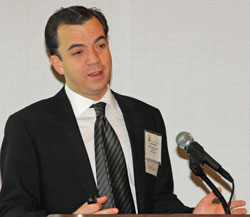 I think Joel Velasco, Brazilian Sugarcane Industry Association, had the quote of the day here at the Farm Foundation Transition To A Bio Economy Conference.
 Seth Meyer is with the Food and Agricultural Policy Research Institute (FAPRI). He’s also a speaker here at the Farm Foundation’s Transition To A Bio Economy Conference.
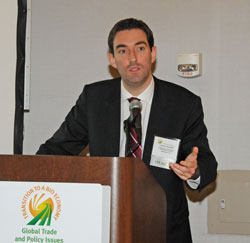 Speaking on behalf of the European Commission To The United States here at the Transition To A Bio Economy Conference was Laurent Javaudin.
 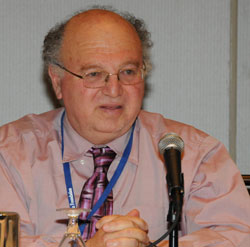 We know that OPEC has had a monopoly control over the price of oil on the world market and we hope that the increase of more environmentally friendly biofuels will force that to change. However, David Zilberman, University of California, Berkeley, has created a model to measure how much impact we’re having.
 A Colorado company is getting ready to debut a biodiesel hybrid officials claim will get 100 miles per gallon… if they can get it finished for an upcoming auto show.
 A high school science project has turned into a way for a North Carolina school to save money, save the environment and comply with a state law requiring biodiesel use.
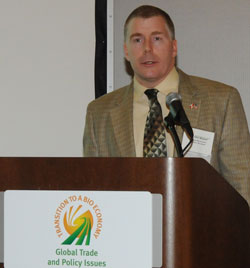 Biofuels production in Canada will impact meat trading patterns according to research by Al Mussell, George Morris Centre, University of Guelph. He says that the increase in biofuels production will turn the country into an importer of grains instead of an exporter. Al was one of the speakers at the Transition To A Bio Economy Conference.