

 A lawsuit filed by Tesoro Refining and Marketing Company against the California Air Resources Board (CARB) seeking to prevent use of up to 10% ethanol in each gallon of gasoline sold in California will be dismissed with prejudice following the California Superior Court for the County of Sacramento’s rejection of the company’s bid for an injunction against CARB. California passed a mandate that increased the ethanol blend from 5.7 percent to 10 percent. Oil refiners and blenders have until the end of 2009 to comply with the mandate, and CARB is overseeing its compliance.
The Court had determined that The Renewable Fuels Association (RFA) would represent the ethanol industry regarding the case. “The injunction decision by the Court that Tesoro’s lawsuit lacked merit and the settlement to dismiss the case with prejudice clears the way for refiners in California to increase ethanol blending to 10 percent per gallon,” said RFA President Bob Dinneen.
The mandate was put in place to provide flexilibily for refiners to include up to E10 in reformulated gasoline as California continues forward with its legislation to improve air quality standards and reduce toxic emissions from gasoline. The state has also passed a low carbon fuels standard and the ethanol industry has been very active in working with CARB as they develop the standard.
“Tesoro’s claims were without merit and designed to impede open competition from a renewable alternative. The dismissal of this case is critical to a constrained ethanol market that is looking for increased demand. By moving from 5.7 percent to 10 percent ethanol in California gasoline, hundreds of millions of gallons of new demand will be created helping refiners meet federal and state requirements for renewable fuel use and air quality standards,” said Dinneen.
 The Environmental Protection Agency
 Bob Stallman, President of the
  It was the scene of the “day that would live in infamy.” Now, visitors to the USS Arizona Memorial in Pearl Harbor, Hawaii will be able to pay homage to the more than 1,000 heroes honored with a renewable energy source: biodiesel.
 A 25-member panel of researchers that advises the President and Congress on science and engineering issues is calling for more development of sustainable and clean energy sources to transition the country away from fossil fuels.
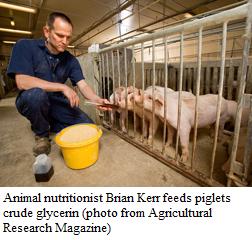 Kerr led studies that examined how crude glycerin feed supplements affected swine energy use. In five different experiments, he supplemented the diets of starter pigs and finisher pigs with different levels of crude glycerin…
 According to a POET press release, POET Biorefining in Bingham Lake, Minnesota, has used a new technology wich will eliminate water discharge providing a more efficient way to produce ethanol.
 The 35 million gallon per year facility currently uses less water than average plants. Bingham Lake facility used 3.42 gallons of water to produce one gallon of ethanol. With zero-liquid discharge, that is cut by 23 percent, to an estimated 2.64 gallons of water per gallon of ethanol.
 A landfill in Dallas, Texas will soon be the source of renewable biomethane that will be burned to create electricity.
 “This gas sale agreement validates selling renewable biomethane as a valuable, low-carbon fuel. It provides Clean Energy with a sound, long-term revenue stream and also supports expansion of the plant’s production capacity for additional gas sales, including potential use as vehicle fuel,” said Andrew J. Littlefair, Clean Energy president and chief executive officer “Many of our largest customers are showing interest in biomethane for their fleet vehicles as it is one of the best alternative fuels to meet new Low Carbon Fuel Standards coming in California and other states.”
 The nation’s leader in biodiesel making and making biodiesel plants has a new leader of its own.
 Mr. Oh takes the reins from Nile Ramsbottom, who has served as Renewable Energy Group’s president since the company’s incorporation in 2006. Mr. Ramsbottom’s leadership helped launch REG as a premier producer and marketer of high quality biodiesel. In the nine years Mr. Ramsbottom has served at REG and its predecessor West Central Cooperative, the company’s biodiesel business has grown from a 1 million gallon-per-year batch plant to a network with the more than 300 million gallons of annual production capacity. Mr. Ramsbottom has agreed to forgo full retirement to help strengthen REG’s global presence. The new global sales position will be based in St. Louis.
 The 25th anniversary of the Fuel Ethanol Workshop (FEW) is fast approaching – June 15-18, 2009 in Denver, Colorado. Two awards will be presented this year to outstanding industry professionals: The High Octane Award and the Award of Excellence.