

 The latest edition of Domestic Fuel Cast listens in on some of the conversation at this week’s Farm Foundation “Transition to a Bioeconomy: Global Trade and Policy Issues” conference.
 This is the fourth in a series of conferences looking at the transition to a bioeconomy the Farm Foundation has sponsored. This week’s event brought people from around the world to Washington, DC, where they were able to combine their divergent viewpoints to come up with workable solutions that everyone can live with. Unlike some other conferences where everyone already agrees before they meet, these Farm Foundation meetings put together people with vastly different perspectives. The conversations are lively, they’re maybe a bit pointed, but they work… and they are something we need to have more of in this country: frank, honest discussions where everyone doesn’t have to agree.
Folks like Purdue’s Wally Tyner or the European Commission’s Laurent Javaudin come with ideas that each might believe is best but walk away with more ideas than what they would have had with just yes-men around them. We picked up on part of the conversation regarding how the U.S. and Europe have different approaches to renewable energy mandates: the U.S. choosing to set a number of gallons of biodiesel and ethanol produced, while Europe wants to base its renewable energy goals on a percentage of all energy produced… regardless of the source. And while the Americans and Europeans had plenty to talk about with the recent tariffs being slapped on U.S. biodiesel coming to Europe, our friends like Joel Velasco with the Brazilian Sugarcane Industry Association reminds us that there are some pretty steep protectionist tariffs America has put on the import of his country’s ethanol. Finally, David Zilberman with the University of California-Berkeley reminds us to keep our eyes on the prize: becoming free from the yoke of OPEC oil.
It’s a unique conversation, and you can hear some of it on this week’s Domestic Fuel Cast here: [audio:http://www.zimmcomm.biz/domesticfuel/DFCast-4-03-09.mp3]
 College students work best under pressure – so here’s your deadline to enter and win a MacBook Air laptop in the
 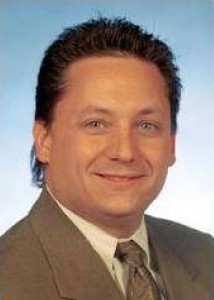 Robert Friedland, President and CEO of
 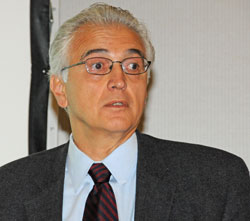 Commercializing Gasification/Fermentation Technology was the topic of comments made by Mark Dietzen,
 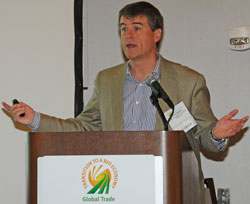 I spoke with Paul Willems, BP Energy Biosciences Institute, one of our speakers at the Farm Foundation Transition To A Bio Economy Conference. I had met him previously at an earlier conference in the series.
 The legislation calls for the production of 4.3 billion gallons by 2015, but during a House Agriculture Subcommittee hearing this week, Dr. Howard Gruenspecht with the Energy Information Administration said, “It seems unlikely to us that you would get to those kind of levels by 2015, 2016.”
 In March, the European Commission imposed tariffs of 26 euros ($34.51) to 41 euros ($54.42) per 100 kg (220 lbs) on American biodiesel, virtually shutting the Yankee green fuel out of the European market.
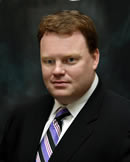 “The comments we have filed highlight that arbitrary procedural conclusions and inaccurate market assumptions were used by the EC as the basis for imposing provisional duties on U.S. biodiesel,” stated Manning Feraci, NBB’s Vice President for Federal Affairs. “The rationale used to impose AD and CVD duties – which clearly benefit the interests of European biodiesel producers – runs afoul of the EU’s WTO commitments.”
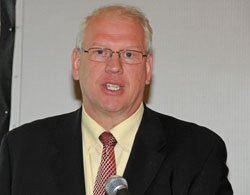 Biofuels like ethanol and biodiesel weren’t the only energy alternatives on the program at the Farm Foundation Transition To A Bio Economy Conference. We also had a presentation on wind energy from Mark Willers, Minwind Energy.
 The
The