

 An American biodiesel maker has headed north of the border, but its product will come back to the U.S.
This story from the Winnipeg Free Press says North Carolina-based Greenway Biodiesel is opening a approximately 5 million-gallon-a-year refinery in St. Boniface, Manitoba… the first for the Canadian province. While the green fuel will be headed for sale in Minnesota, it will actually trigger a biodiesel mandate in Manitoba:
Its owner, Royce Rostecki, says that as things stand now, he won’t produce a single litre for the local market — he will sell all his production from the new St. Boniface plant to Minnesota, where his U.S. customers receive a $1-per-gallon blending subsidy.
“If we were on a level playing field, we would be winning the race (to produce for the local market), but because everyone else is getting subsidized, it has put Manitoba producers at an insurmountable disadvantage,” Rostecki said in an interview.
Greenway Bio-diesel is capable of producing 20 million litres of product a year — fulfilling a legislative prerequisite for the implementation of a biodiesel mandate in Manitoba.
During the last provincial election, Premier Gary Doer promised a five per cent biodiesel mandate for 2010 that would create demand for 40 million litres of the biofuel, which would be blended with petroleum diesel. But government officials have since indicated that the province intends to introduce some level of mandated use before the end of 2009.
Canadian officials say they are working on legislation that will make Canadian biodiesel more competitive.
 Massachusetts-based Verenium Corporation, a developer of next-generation cellulosic ethanol, has signed a deal with Swedish provider of heat transfer, separation and fluid handling technologies Alfa Laval to market processes that degums vegetable oils, making them better for biodiesel production.
 The American Coalition for Ethanol (ACE) will be awarding $5,000 worth of scholarships to employees and dependents of employees of ACE Voting and Associate member companies and organizations in good standing. The application is now available but 2009 membership dues must be paid for applicants to be eligible.
 It looks as though the state of Maine could have no ethanol blended with their gasoline. Assistant Senate Majority Leader Lisa Marrache has submitted a bill requiring oil companies to make ethanol-free fuel an option at the pump in Maine.
 “Man’s most carnal tendencies are inflamed by the most modern of elements, uranium.”
 Many thought the debate over nuclear energy was cooled but in fact its as heated as ever. There is a vocal worldwide debate about the fate of nuclear energy and its role as a green alternative to coal. Uranium is one of the most abundant elements in the world and ours for the taking. The United States is working on bringing several new nuclear facilities online, the first in more than two decades, and while France is adding more nuclear plants Germany is shutting all their nuclear facilities down citing environmental issues. Yet a handful of countries trying to build nuclear facilities are being denied access to the technology citing “terrorism” concerns.
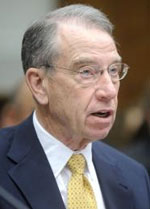 Senator Charles Grassley (R-IA)
  Progress toward next generation biofuels will be a focus of the
  The Biotechnology Industry Organization (BIO) has
  The companies – Edenspace Systems Corporation, ICM, LanzaTech Inc., POET, Qteros, Inc., Range Fuels, Red Shield Acquisition LLC, and ZeaChem – assert that removing the regulatory cap of 10 percent “will ensure the product market necessary to encourage continued investment in the commercialization of advanced biofuels.”
 Dr. Hans Blaschek, director of the CABER explains the degree will provide a professional science master’s degree program.
 The award is named for a true pioneer in the biotechnology field, and it will be handed out by a group touted to be the “champion of biotechnology” to someone who makes the most significant contribution in the field of biotechnology.