

 National Wind, LLC, based in Minneapolis, Minnesota, has received the 2009 Minnesota Environmental Initiative (MEI) Green Business and Environmental Management Award. The award recognizes National Wind’s for partnering with communities to build utility-scale wind farms. MEI is a nonprofit organization whose mission is to build partnerships that create solutions to environmental problems throughout Minnesota.
MEI’s Executive Director, Mike Harley congratulated National Wind. “National Wind’s partnerships with communities are excellent examples of green business developments that help preserve the environment for future generations. Their grassroots wind energy projects start with local communities. By creating opportunities for community members to influence the development process and own a stake in the project, National Wind engenders broad support for clean energy and environmental stewardship.”
National Wind is currently developing twelve families of wind projects across the Midwest and Plains States. The company has more than 1000 landowner partners and over 1300 megawatts (MW) of locally-owned wind projects in development or operation in Minnesota alone. The key component to their success is that they offer joint ownership with local landowners to develop utility-scale wind farms. This enables local communities to have a positive financial stake in their investment in renewable energy.
Leon Steinberg, the CEO of National Wind was on had to recieve the award along with sevearl members of his team. “We have accepted this award on behalf of our 50 employees, our 450 rural farmer-partners and the thousands of landowners that will participate in our projects. Without all of their involvement, this award would not be possible. We want to acknowledge MEI’s success in building consensus to tackle important environmental issues. We also want to thank the utility sponsors of the 2009 awards, namely Great River Energy, Xcel Energy and Minnesota Power.”
 A six-foot tall box behind a restaurant in Massachusetts is a solution to two problems: what to do with leftover cooking oil and how to power the fryers that produce all that grease in the first place.
 Last December, after a year of 80-hour weeks on the development, Peret, 33, installed the first Vegawatt at Finz, a joint that offers loads of fried seafood. With patents still pending, he’s reluctant to give specifics on its inner workings, but it begins with staff members pouring in 10 to 12 gallons of used deep-fryer oil each day. Before going into the Vegawatt’s generator, the bread-crumb-filled muck is deposited into a reservoir and undergoes a multi-stage cleaning, treatment and filtration process. At this stage, the oil is prepared for combustion with a method Peret devised that draws heat from the exhaust system. After that, the processed grease moves into a tank that feeds the modified 15-horsepower diesel generator. Heat from the Vegawatt’s engine coolant is used to warm the water in the building’s pipes, further reducing the restaurant’s energy needs.
 Instead of bringing an apple for teacher, students in Montgomery, Alabama schools will be encouraged to bring in used cooking oil that the city’s public schools will turn into biodiesel to run their school buses.
 New York City is going to get a little cleaner thanks to a clean-running garbage truck.
 Gov. Chris Gregoire said her staff has meetings scheduled with department heads in June to talk about how to incorporate more biofuel usage. “I don’t want to lose the momentum that we’ve built up,” said Gregoire in The Herald of Everett. “We’re going to get there but it’s going to take more time than what was originally projected.”
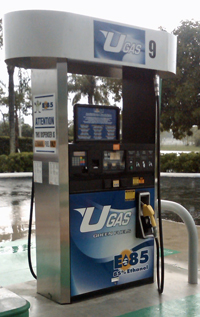 RFA Director of Market Development Robert White says this is a milestone in E85 history. “Being in the Miami metro area promoting E85 shows that this is not a Midwest niche fuel any longer,” White said. “This is a product that can be distributed and sold anywhere in the country and we are able to take E85 where the people and the flex-fuel vehicles are.”
 President Barack Obama
 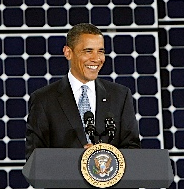 Meanwhile, during his visit to Nellis Air Force Base in Nevada yesterday, Obama talked up the promise of clean energy for creating green jobs in America.
 President Obama was talking about the power of the sun today at the nation’s largest solar array.
 Our friends at the National Algae Association’s Mid-South Chapter has snagged some impressive speakers for their upcoming workshop, “Algae: The Race for New Oil,” on June 12, in Orlando, Florida. Among those speaking will be Ronald Pate of Sandia National Laboratories, who will talk about the U.S. Department of Energy’s take on the OBP’s Recovery Act Funding Opportunities:
 Filling up with 85 percent ethanol paid off in a big way for an Indiana couple who hit the Hoosier Lotto jackpot this month.