

The leftovers from an ethanol co-product could be used as a fertilizer, according to research being done at South Dakota State University.
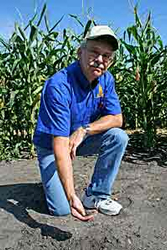 When the ethanol by-product known as dried distillers grains with solubles (DDGS) is heated at high temperatures under limited oxygen to make synthesis gas, or syngas, the remains are a fine, dust-like ash. SDSU Soil Testing Laboratory manager Ron Gelderman set out to learn whether that residue could be applied to fields as a soil nutrient, since the ash likely would be discarded in a landfill otherwise.
An SDSU greenhouse study found that dried distillers grain ash resulted in about the same increase in corn growth as fertilizer phosphorus. Use of dried distillers grain ash as a source of potassium in that study was inconclusive, since the selected soil supplied adequate plant potassium.
However, a separate field study at SDSU showed that DDGS ash was just as effective as fertilizer phosphorus and potassium in providing both nutrients for corn production, Gelderman said.
“After ashing or burning, the inorganic minerals are generally left in the ash and usually are plant-available. But we have to test that to be sure. We found that it worked quite well,” Gelderman said.
However, Gelderman says the problem is that the material is too fine to be used as a fertilizer spreader-type application, which means that further processing of the material — for example, into pellets, or as a liquid slurry, or mixed with manure or lime — might be necessary to get it back onto the land.
 Culver
  A
A The depot will use a gasifier from Packer Engineering to convert grass, leaves, branches and other biomass into syngas, a gas mixture that contains carbon monoxide and hydrogen. The syngas can then be used to create cellulosic ethanol, bio-electricity or hydrogen. Although the proposal calls for trying all three fuel types, Keller said it would be more practical to concentrate on producing just one fuel when the depot is built.
 The Colorado Corn Growers Association, the Governor’s Biofuels Coalition, Western Convenience Stores and Southern Colorado Clean Cities in Colorado Springs are partnering to celebrate the opening of a new E85 pump location at 227 West Fillmore Street in Colorado Springs, Colorado, on August 26. This will be the ninth station selling E85 in Colorado Springs.
  The Obama administration’s
  Agriculture Secretary Tom Vilsack says the biomass facility is taking wood, corn stalks and other crop residue and converting it into pellets that can be used to produce energy or a substitute for propane on the farm.
  A one-million-gallon-a-year algae-biodiesel plant could soon become a reality for Massachusetts with some help from the state and federal governments.
 The bad news is: According to
 A pair of three-year National Science Foundation grants will help the St. Louis-based Donald Danforth Plant Science Center continue its biofuel research.