

 New North, Inc. has recently released Phase 2 of a study on the feasibility of cellulosic ethanol plant in Niagara, an area in Northeast Wisconsin. Phase 2 demonstrates the availability of feedstocks to the plant, primarily wood resources, should the plant be able to produce ethanol using a diversity of feedstocks. The news is positive as many local community members and companies have expressed interest in providing feedstocks to the plant.
Phase 1, which was released this past July, studied the surrounding biomass resources in order to determine if a cellulosic plant could be sited in the region. Both parts of the report were conducted by Resource Analytics. The study also notes the possibility of creating switchgrass supplier cooperatives in conjunction with the establishment of an ethanol plant over the coming years.
“As second generation biofuels emerge as a fuel source, the New North is well positioned to take advantage with the resources and infrastructure necessary to create them,” said Jerry Murphy, Executive Director of the New North, Inc. “This study has demonstrated that a cellulosic ethanol facility at the former Niagara paper mill site has a great deal of promise for potential investors.”

 There’s an old saying that goes, “If you think education is expensive, try ignorance.” While it might be true that college does cost, there are some cheaper options out there. And more of those options are including solar and wind degrees from the less expensive community college route.
 GE has donated a small wind turbine to Mesalands Community College in Tucumcari, N.M., and has plans to hire graduates of the school’s new wind energy technician program. And at Milwaukee Area Technical College, local industrial giant Johnson Controls (JCI, Fortune 500) is building a 2,500-panel solar education farm where students can learn to become photovoltaic installers and designers.
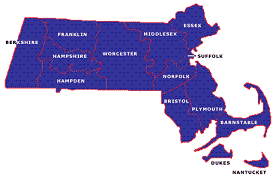 A 2 percent biodiesel mandate beginning next year and increasing to 5 percent in 2013 in Massachusetts has hit some glitches … thanks to confusion over what the next Renewable Fuels Standard (RFS2) might bring …. but it could now be moving forward.
 Members of the National Biodiesel have chosen who will represent the trade association on its governing board and leadership committee.

 The front-end fermentation unit scales up production of the naturally occurring bacteria, called an acetogen, which ZeaChem uses in its fermentation process. Acetogens are highly robust and, unlike yeast, produce no carbon dioxide (CO2) during the fermentation process, allowing ZeaChem to realize a significant efficiency and yield advantage. ZeaChem has successfully produced acetogens at the lab scale for over 1,000 fermentation trials of sugars as well as hydrolyzate derived from cellulosic biomass. The facility will have capacity to produce 250,000 gallons of biofuel per year.
 An important tax incentive on biodiesel is about to expire, and the National Biodiesel Board is scrambling to get it renewed.