

Want to know where you can buy E85? There’s an app for that now.
 The Renewable Fuels Association (RFA) today launched a new application for Garmin GPS units that that maps out the location of E85 (85% ethanol/15% gasoline) for users with flex-fuel vehicles (FFVs).
“The most frustrating thing for many FFV owners is not knowing where they can fill up with higher level ethanol blends, like E85,” said RFA Director of Market Development Robert White. “With this new feature, drivers going to the grocery store or to Grandma’s for Thanksgiving will know the exact location of the nearest E85 pump.”
Using the Garmin navigation system, FFV owners can download station locations and program their device to guide them to upcoming E85 stations. The Garmin application is available for download on ChooseEthanol.com. There, consumers can download individual state data, a combination of states, or national data directly to their computer and then to their Garmin devices. Directions for installing this point of interest (POI) data are now available.
While the program is currently only available for Garmin GPS units, RFA is working to bring this data to other navigation systems and will update station location data quarterly.
 The next great by-product that could help biodiesel plants stay profitable could be put right on the tip of your shiny nose.
 Spokeswoman Alicia Clancy of Renewable Energy Group of Ames said Friday that REG and Elevance “are in discussions” about working together at the Central Iowa Energy biodiesel plant in Newton that REG manages.
 In California, Growth Energy is calling on the Air Resources Board (ARB) to reopen comments on the low-carbon fuel standard (LCFS) in light of undisclosed documents recently uncovered related to the rulemaking process.
 Iowa-based biodiesel producer Renewable Energy Group has released a report that looks at a wide variety of biodiesel feedstocks and the characteristics of both that feedstock and the fuel produced from it.
 A big issue in the current Renewable Fuels Standard … as well as the new RFS2 under consideration by the EPA … is the Renewable Identification Numbers (RINs).

 There’s an old saying that goes, “If you think education is expensive, try ignorance.” While it might be true that college does cost, there are some cheaper options out there. And more of those options are including solar and wind degrees from the less expensive community college route.
 GE has donated a small wind turbine to Mesalands Community College in Tucumcari, N.M., and has plans to hire graduates of the school’s new wind energy technician program. And at Milwaukee Area Technical College, local industrial giant Johnson Controls (JCI, Fortune 500) is building a 2,500-panel solar education farm where students can learn to become photovoltaic installers and designers.
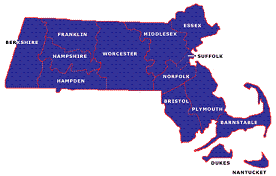 A 2 percent biodiesel mandate beginning next year and increasing to 5 percent in 2013 in Massachusetts has hit some glitches … thanks to confusion over what the next Renewable Fuels Standard (RFS2) might bring …. but it could now be moving forward.