

The ability of termites to digest wood may hold a key to advancing the production of cellulosic ethanol from woody biomass.
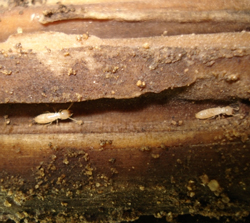 Researchers at the University of Florida have been working on genetic sequencing to harness the insects’ ability to churn wood into fuel. That ability involves a mixture of enzymes from symbiotic bacteria and other single-celled organisms living in termites’ guts, as well as enzymes from the termites themselves, which could ultimately improve the production of cellulosic ethanol.
“Termites are very unique creatures, and this research helps give the most complete picture of how their systems collaborate to, very efficiently, break down really tough biological compounds to release fermentable sugars,” said UF entomologist Mike Scharf, who leads the research.
The team has identified nearly 200 associated enzymes that help break down the problematic plant compound lignocellulose. This compound is the most costly barrier to wide-scale production of cellulosic ethanol because it must be broken down by intense heat or caustic chemicals. Termites, however, are able to almost completely break down lignocellulose through simple digestion.
Once the genetic sequence that produces the enzymes can be isolated, it could be transferred into genetically modified fungi or bacteria, or possibly into other insects, such as caterpillars, to produce the enzymes on an industrial scale.
 Paper companies that have been cashing in on an alternative fuels tax credit could soon see that loophole close.
 The
The  As first reported in the Tennessean.com, state lawmakers say they may remove funding from a project dedicated to the University of Tennessee that will produce ethanol from switchgrass. This news came about after legislators were informed that the school will be doing business with DuPont (a corn based ethanol producer) and scaling down ethanol production. Cost for the government for these changes would increase the project an additional $11 million through June 30, 2013.
 F.O. Licht managing director Christoph Berg told attendees at the conference that they are forecasting that global ethanol consumption next year will total 76.4 billion litres, compared to an estimated supply of 77.1 billion. “This would result in a surplus of around 700 million litres which is urgently needed to maintain the supply chain,” he said. However, Berg says global ethanol manufacturing capacity will only increase four percent this year, compared to last year’s increase over 2007 of 33 percent.
 There were 16 different equipment manufacturers involved with POET’s Project LIBERTY Field Day. One of them was
  Mark your calendar for Tuesday, November 17th, for what’s being billed as the Midwest’s premier energy, economic and environmental conference.
  A green fuel will be used to haul the nation’s foremost evergreen cross-country.
 “We are honored to be the first state to deliver the tree in a clean, green manner,” said Richard Davalos, coordinator of the Capitol Christmas Tree. “We are also honored to help promote reducing America’s dependence on foreign oil.”