

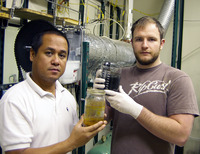
CE-CERT development engineers Junior Castillo (left) and Eddie O’Neil (right) display the results of the steam hydrogasification process that converts urban waste feedstock (rear container) into clean synthetic diesel fuel (foreground container). The fuel was produced in the lab-scale reactor behind them.
University of California, Riverside’s College of Engineering-Center for Environmental Research and Technology (CE-CERT) has been awarded a $1 million grant from the California Energy Commission to build a demonstration plant to convert biosolids to clean synthetic diesel fuel. As evaluated by the National Energy Technology Laboratory of the U.S. Department of Energy, this process is 12 percent more efficient and 18 percent lower in capital costs than all other mainstream gasification technologies.
The plant will use a steam hydrogasification process coined the “CE-CERT Process,” to convert biosolids from the the city of Riverside’s wastewater treatment facility, along with other ‘waste’ feedstocks, to produce energy. The state of California has committed to reducing its petroleum use by 2.4 billion gallons per year, and the intent for the fuel produced using this process is to be integrated into the transportation mix as a clean alternative to fossil fuels.
According to a UC Riverside news statement, California produces an estimated 83 million dry tons of biomass wastes per year, including agricultural and forestry wastes and wastewater treatment biomass that must be disposed of. Virtually 32 million dry tons of this biowaste are estimated available for fuel production.
According to researchers, the advantages of this process are many including access to a diversity of feedstocks that typically go to landfills, lower capital investment required to build a plant, and smaller plants can be located near the feedstock sources for an economic and environmental advantage.
Proof of technology of the pilot plant is the last step before full scale commercial production.
 On Twitter, many agriculture advocates are taking part in tweeting the hashtag #thankafarmer today from 10 am to 12 pm CST. Twitter users are also expressing their gratitude with a
  A Massachusetts company is working on developing a cheap catalyst that will separate water molecules to harvest the hydrogen for home use.
 South Carolina’s Clemson University is getting $98 million in federal funds for wind energy research that is expected to create hundreds of wind energy jobs and make the area a center for wind research.
 Biodiesel producers are worried the wait for the renewal … or even worse, the failure of renewal … of a crucial tax credit, set to expire in just more than a month, could be a death knell for the industry.
 Iowa Senator Chuck Grassley, who has always been an ethanol supporter, will push Congress to act if the EPA turns down a waiver request that will increase the amount of ethanol in fuel from 10 to 15 percent. The EPA is expected to grant or deny the request by December 1.
 The
The 
 According to a survey by the