NEC 2027

EPA Official Explains RFS2 at Ethanol Conference

Cindy Zimmerman

2010 National Ethanol Conference Photo Album
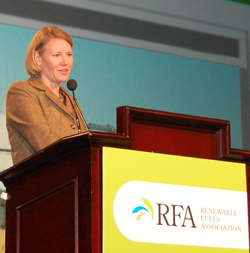
The new rule for the expanded Renewable Fuel Standard, fresh out of the box just two weeks ago, was the main topic of discussion at the Renewable Fuels Association’s 15th National Ethanol Conference in Orlando. Sarah Dunham, Transportation and Regional Programs Division Director with the U.S. Environmental Protection Agency, boiled down the guts of the new RFS2 in a 45 minute presentation that highlighted changes made in lifecycle analysis determinations from the rule as originally proposed.

“I can safely say that this is the area we got more comment than any other area in the rule,” Dunham said, calling it very constructive and helpful to get real data and science to apply to the rule. This led to “significant” decreases in estimates of international indirect land use change related to biofuels production, “more than 50-60-70 percent in some cases,” she added. Using corn ethanol as an example, she noted that the final rule factored in both increasing yields and the value of co-products, which had not been in the original model

Dunham also talked about how EPA addressed “uncertainty” in their analysis. “There is inherent uncertainty in these assessments,” she said. “And we thought it was important to try to formally recognize that uncertainty” and incorporate it into the analysis. The assessments will be updated over the next two years as more information becomes known.

The regulations for RFS2 are scheduled to go into effect on July 1 and between now and then EPA will be working with the Renewable Fuels Association and the biofuels industry in general to conduct workshops to help inform producers about the new rule and what it means to them.

If you are in the industry, it is worth listening to Sarah’s presentation, including answers to questions at the end asked by moderator Charles Knauss with Bingham McCutchen LLP. Listen to the audio in the player below and you can see screen shots of some of the slides she references in the NEC conference photo album.

Audio, Ethanol, Ethanol News, Government, National Ethanol Conference, RFA

US-China Group Announces $1.5 Bil Texas Wind Project

John Davis

Two American companies have teamed with a Chinese company for a $1.5 billion West Texas wind farm project.

The Austin (TX) Business Journal says Texas-based Cielo Wind Power and U.S. Renewable Energy Group out of Washington, DC have teamed with Shenyang, China-based A-Power Energy Generation Systems Ltd. subsidiary Shenyang Power Group for a 36,000 acre wind farm:

A-Power will begin shipping wind turbines in March and deliver all units by the same month of 2011. Its subsidiary, Shenyang Power, is contributing $36.6 million to the project, which is expected to produce about 600 megawatts of energy.

Shenyang and U.S. Renewable Energy formed a separate Delaware LLC to own, design, develop, construct, manage and operate the wind turbines, according to the release. A Cielo affiliate will also assist in development.

This is one of the world’s first Chinese-American utility-scale wind power projects, able to produce enough electricity to power 180,000 homes while creating hundreds of U.S. jobs.

Wind

Report: Global Biodiesel Market Worth $12.6 Bil by 2014

John Davis

A new market research report says that the biodiesel market will be worth $12.6 billion by the year 2014.

This press release says the MarketsandMakets report, entitled ‘Global Biodiesel Market (2009 – 2014)’, says the markets in Europe and the Americas will make up nearly 85 percent of that total, with 55.6 percent and 28.6 percent respectively:

Increasing environmental concerns and the need for energy independence have led to the biodiesel market. Despite the economic recession, global biodiesel production totaled 5.1 billion gallons in 2009, representing a 17.9% increase over 2008 levels. The biodiesel market is expected to grow from $8.6 billion in 2009 to $12.6 billion in 2014. Market growth is primarily dependent on the availability, quality, and yield of feedstock, as it accounts for 65% to 70% of the cost of biodiesel production.

Biodiesel derived from rapeseed oil forms the largest segment of the overall market. Germany is the single largest producer of biodiesel with 2.8 million tons produced in 2008. The biodiesel market also offers immense opportunities countries such as U.K., India, and China, as these regions have high diesel fuel prices and a large number of diesel fueled vehicles.

While growth may be affected by feedstock availability issues and the food v/s fuel debate, the market is expected to witness a paradigm shift with the increasing conversion efficiency of existing feedstock, and the development of newer feedstock sources such as algae.

You can read more of the report here.

Biodiesel, International

US Military: Just Months Until Affordable Algae-Biodiesel

John Davis

One of the biggest knocks on algae-based biodiesel is the high cost for the truly green fuel. But the U.S. military says it is just months away from making biodiesel from algae for the same cost as its petroleum-based counterpart.

The UK’s Guardian reports that the Defense Advanced Research Projects Agency … better known as DARPA …. which helped develop the internet and satellite navigation systems, has surprised the industry with the announcement:

Darpa’s research projects have already extracted oil from algal ponds at a cost of $2 per gallon. It is now on track to begin large-scale refining of that oil into jet fuel, at a cost of less than $3 a gallon, according to Barbara McQuiston, special assistant for energy at Darpa. That could turn a promising technology into a ­market-ready one. Researchers have cracked the problem of turning pond scum and seaweed into fuel, but finding a cost-effective method of mass production could be a game-changer. “Everyone is well aware that a lot of things were started in the military,” McQuiston said.

The work is part of a broader Pentagon effort to reduce the military’s thirst for oil, which runs at between 60 and 75 million barrels of oil a year. Much of that is used to keep the US Air Force in flight. Commercial airlines – such as Continental and Virgin Atlantic – have also been looking at the viability of an algae-based jet fuel, as has the Chinese government.

“Darpa has achieved the base goal to date,” she said. “Oil from algae is projected at $2 per gallon, headed towards $1 per gallon.”

DARPA officials expect to have a 50 million-gallon-a-year algae-biodiesel refinery up and running sometime next year, making it possible that cost for the fuel will drop even further.

The effort is part of the Pentagon’s plans to get half of its fuel from renewable sources by 2016.

algae, Biodiesel

Cellulosic Breakthrough Announced at Ethanol Conference

Cindy Zimmerman

2010 National Ethanol Conference Photo Album

A major breakthrough in the development of cellulosic ethanol was announced at the National Ethanol Conference in Orlando Tuesday.

Novozymes launched the first commercially viable enzymes for production of biofuel from agricultural waste – Cellic® CTec2.

“We have been working on this for the past 10 years and promised our customers and the market to be ready by 2010,” says Novozymes’ CEO, Steen Riisgaard, who first started work on the project 30 years ago as a young researcher.

He says they are really focusing on using this new development on making ethanol from agricultural waste, such as wheat straw or corn cobs, to avoid the current controversy of indirect land use change. “Personally, I think energy crop are wonderful and should be part of our future, but I don’t want to see this beautiful development be blocked by people speculating about things,” he said.

Riisgaard gives lots of credit to the United States for moving toward renewable energy sources. “Other than Brazil, the US is certainly in the lead,” he said. “Corn based ethanol has paved the way in terms of establishing the infrastructure and it appears to us on the other side of the Atlantic to be a carefully orchestrated and well-executed plan.” But he stresses the importance of continued investment by both the public and private sectors to make cellulosic ethanol commercially viable.

Novozymes is in the process of contracting a plant in Blair, Nebraska to produce the enzymes. “It will be ready for production by the end of 2011 and will produce enzymes for both corn based and cellulosic ethanol,” he said.

Listen to or download my interview with Steen Riisgaard here:

Audio, Cellulosic, Ethanol, Ethanol News, National Ethanol Conference, RFA

Ethanol’s Economic Impact

Cindy Zimmerman

2010 National Ethanol Conference Photo Album

Despite the bad economy and continued attacks by detractors, ethanol provided a significant economic impact for the nation in 2009.

According to “The Economic Contribution of the Ethanol Industry to the Economy of the United States” by economist John Urbanchuk, the economic activities of the ethanol industry put an additional $16 billion into the pockets of American consumers in 2009, added $53.3 billion to the nation’s Gross Domestic Product and displaced crude oil imports amounting to a value of $21.3 billion.

“While 2009 was a really rough year for the overall economy, the ethanol industry grew and expanded,” Urbanchuk said during the 15th annual National Ethanol Conference in Orlando on Tuesday, where he presented his findings. “I think it’s one of the shining stars in the manufacturing sector.”

Listen to or download an interview with John Urbanchuk from the 2010 NEC in the player below:

Audio, Ethanol, Ethanol News, National Ethanol Conference, RFA

General Motors Executive Calls for More Ethanol Pumps

Cindy Zimmerman

2010 National Ethanol Conference Photo Album

The vice chairman of Global Product Operations for General Motors told attendees of the 15th Annual National Ethanol Conference that his company will keep putting more flexible fuel vehicles on the road, but more ethanol pumps are needed to fuel them.

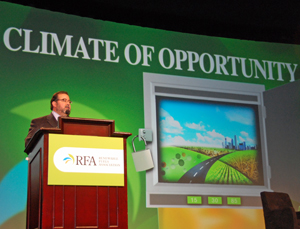
Tom Stephens said GM is committed to making more than half of their vehicle production flex fuel capable by 2012. “GM is spending about $100 million a year adding flex fuel capability to our vehicles,” he said. “We can’t afford to leave this capital stranded.”

He noted that the majority of flex fuel vehicles are in highly populous areas, especially the east and west coasts, while the majority of E-85 fueling stations are located in the Midwest. He advocates the use of blender pumps to allow retailers to put both mid and high level blends in the pumps so consumers can choose the right fuel for their vehicles.

However, when it comes to increasing the blend level to 15 percent ethanol, he added a note of caution. “We believe it’s critical to complete the planned testing of mid level blends to understand the impact on light duty fleet, off-road vehicles, boats and other equipment,” he said. “Until the results of these comprehensive durability tests are fully understood, we remain concerned about customers using fuels containing more than 10 percent ethanol. If ethanol gets a bad name, it will be bad for everyone.”

You can listen to or download Stephen’s speech in the player below and watch part of his talk here:

Audio, Car Makers, Ethanol, Ethanol News, Flex Fuel Vehicles, National Ethanol Conference, RFA, Uncategorized, Video

Fagens Receive First RFA Membership Award

Cindy Zimmerman

2010 National Ethanol Conference Photo Album

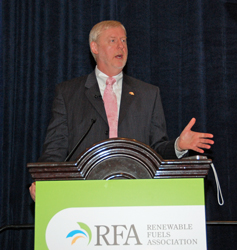
Renewable Fuels Association (RFA) chairman Chris Standlee introduced a new award at the opening session of the 15th annual National Ethanol Conference to recognize individuals who have dedicated their time, energy, resources and ideas to making the ethanol industry and RFA what it is today. The first recipients of the award were Ron and Diane Fagen of Fagen, Inc.

“Member involvement fuels the engine of success,” said Standlee. “Given RFA’s nearly three decades of history there are many people to recognize who helped to build the industry.”

Standlee noted the Fagens’ commitment and leadership to the industry that has helped the industry become “the most energy efficient ethanol industry in the world.”

Fagen is the largest, most respected green energy design-builder in the nation. As President & CEO of the family-owned business, Ron Fagen has been involved in industrial construction since 1974.

I did a brief interview with Ron after he received the award about what Fagen Inc. is up to these days and his outlook on the industry, as well as his feelings about being the first recipient of the RFA Membership Award.

Ethanol, Ethanol News, RFA

State of Ethanol Industry is Strong

Cindy Zimmerman

Compared to last year, Renewable Fuels Association president and CEO Bob Dinneen faced a much happier crowd for the opening session of the 15th Annual National Ethanol Conference.

“A year ago, at this event, we met amidst the worst economic climate since the Depression. Commodity markets were in upheaval, investment dollars had evaporated, gasoline demand was falling, production costs were rising, plants were closing and the very foundation of our industry and our economy was shaking,” said Dinneen. “At that time, I summoned Winston Churchill to admonish you, ‘When you‟re going through hell, keep on going!'”

Dinneen was happy to report that the industry did persevere and survive, “And now, I can say, with confidence and conviction, that the state of the U.S. ethanol industry is strong,” he said.

Among the accomplishments for the industry, Dinneen noted 15% growth, reopening 14 plants that had been previously idled, starting up 8 new plants, and adding1.5 billion gallons of capacity. The ethanol industry contributed $53.3 billion to the economy, along with 400,000 jobs and reducing oil imports by 364 million barrels.

There is an online photo album started from the event for your viewing pleasure: 2010 National Ethanol Conference Photo Album

Read the text of Dinneen’s speech here – listen to or download it in the player below – see the video in the previous post:

Audio, Ethanol, Ethanol News, RFA, Uncategorized

Live Speech from NEC

Melissa Sandfort

We’re broadcasting the opening general session live from National Ethanol Conference. Afterward we’ll be posting a recording of it your you to view at your leisure.

*Post update*

Below is the recorded video of the opening general session which includes comments from Renewable Fuels Association chairman Chris Standlee, President and CEO Bob Dinneen and part of the first session on the RFS2.

Watch live streaming video from zimmcomm at livestream.com

2010 National Ethanol Conference Photo Album

Ethanol, Ethanol News, National Ethanol Conference