RFA E-15 Ad

DF Cast: RFS2 Talk at Biodiesel and Ethanol Conferences

John Davis

Earlier this month, the EPA finally released its new Renewable Fuels Standard, better known as RFS2. It was just in time as both the biodiesel and ethanol industries held their national conferences just days after the announcement, prompting multiple sessions at each gathering to discuss the implications of the new rules.

In this edition of the Domestic Fuel Cast, we hear from National Biodiesel Board Vice Chairman Gary Haer with Renewable Energy Group, who spoke at the National Biodiesel Conference and Expo, and President and CEO of the Renewable Fuels Association, Bob Dinneen, talking from the National Ethanol Conference in Orlando, Florida, and get their thoughts on RFS2.

It’s an interesting conversation, and you can hear more of it below.

You can also subscribe to the DomesticFuel Cast here.

Audio, Biodiesel, Biodiesel Conference, Domestic Fuel Cast, Ethanol, Ethanol News, Indirect Land Use, News

Exciting Enzymes at Ethanol Conference

Cindy Zimmerman

Three different companies announced the introduction of new enzymes for cellulosic ethanol production at this week’s National Ethanol Conference in Orlando.

Novozymes made the biggest splash with its Cellic® CTec2 for the production of biofuel from agricultural waste, but the other two are no less significant in the race towards commercialization of advanced biofuels.

VereniumVerenium Corporation‘s new introduction into the enzyme mix is called Xylathin, which is specifically designed to improve the economics of fuel ethanol production from cereal grains. According to the company, “Xylathin rapidly breaks down xylan, a compound found in cereal grains such as wheat, rye and barley and significantly reduces mash viscosity. This faster acting enzyme allows producers to shorten retention times and reduce enzyme dose. Xylathin also reduces grain water retention lowering grain drying energy requirements.”

GenencorAt the same time, Danisco’s Genencor introduced Accellerase® DUET, a step up from Accellerase® 1500. “Accellerase® DUET employs a whole broth formulation, which provides nutrients for fermentative organisms and lowers the chemical load introduced into our customers’ processes. Higher performance at lower dose will lead to significant improvements in enzyme cost in use for producers, which is critical to enable the cellulosic biofuels industry.”

Representatives from all three companies, as well as others in the field, made presentations at two different sessions during the National Ethanol Conference to talk about advanced biofuels technology and the path to commercialization. If you attended the conference, those presentations are now available on-line.

Cellulosic, Ethanol, Ethanol News, National Ethanol Conference, RFA

CME Announces Ethanol Co-Product Futures Contracts

Cindy Zimmerman

The futures hold a new climate of opportunity for corn, ethanol and livestock producers.

CME Group this week announced the launch of Distillers’ Dried Grain agricultural commodity futures contracts, scheduled to begin trading April 26. Information about the new contract was released during the Renewable Fuels Association’s National Ethanol Conference in Orlando where CME Group was a sponsor.


Distillers’ Dried Grains, a byproduct of corn-produced ethanol, is used for animal feed, including livestock and dairy cows. The electronically traded and physically delivered futures contracts can be used by livestock and ethanol producers, commercial corn interests and others to lock in the price of feed or to hedge their ethanol refining margin in combination with corn, natural gas and ethanol futures.

The contracts will be listed with the Chicago Board of Trade and more information is available on the CME Group commodities website.

corn, Distillers Grains, Ethanol, Ethanol News, National Ethanol Conference, RFA

First Station in NW Alabama Offers E85

The newly reopened Shell Quik Mart at 532 East Second Street in Muscle Shoals, Alabama now offers E85. For the first time, flexible-fuel vehicle owners and operators looking to refill their tanks in Muscle Shoals will have a choice to refuel with traditional gasoline grades or E85.

“We are pleased to be the first and only station, not only in Muscle Shoals, but all of Northwest Alabama, to offer a renewable fuel alternative for conscientious consumers,” said Edwards Oil Company’s President, Jonathan Edwards. “Our customers who own flexible-fuel vehicles have been asking for it, and now they have a choice to refuel their vehicles with a product that reduces air pollution, lowers our dependence on foreign oil, and helps support American farmers.”

Officials with the Alabama Clean Fuels Coalition, which is the principal coordinating point for alternative fuels in the state, say they have seen a dramatic increase in the development of ethanol infrastructure and use in Alabama.

“In 2006, we had zero stations in Alabama offering E85 ethanol, very few entities that had flex-fuel vehicles, and only a handful of people looking for creative ways to implement ethanol,” said Mark Bentley, Executive Director of the Alabama Clean Fuels Coalition. “Today, we have the first station in the Shoals to offer ethanol, our state government and many local communities utilize flex-fuel vehicles, we were part of the nation’s first biofuels clean corridor along Interstate 65, and the City of Hoover, Alabama, was the first in the country to turn yard clippings and wood debris into ethanol to fuel their municipal vehicles. What a difference a few years makes!”

Edwards Oil Company owns and operates forty-one Shell Quik Mart Convenience Stores, fourteen of which are located in Northwest Alabama (Colbert, Lauderdale, Lawrence and Limestone Counties) with the other 27 located in the south-central portion of middle Tennessee.


Ethanol, Ethanol News, News

WPMA Show Concludes in Vegas

The Western Petroleum Marketers Association (WPMA) “Back in the Black” show concluded in Las Vegas today. The regional trade association held their annual show this week which included retailers in the states of Hawaii, Washington, Nevada, Idaho, Utah, Montana and New Mexico.

Condoleezza Rice was the keynote speaker at the show. Following speakers included Petroleum Equipment Institute who spoke on dealing with difficult people, Petroleum Marketers Association who spoke on Petroleum and Public Policy, and Exxon Mobil who spoke on the energy outlook of 2010.

Dresser Wayne representatives supplied a display blender pump for Growth Energy's booth.

The exhibition hall was populated by over 200 exhibitors ranging from fueling product manufacturers such as Gilbarco Veeder Root, Bennett Pumps and Dresser Wayne and ethanol industry groups such as Growth Energy, the Renewable Fuels Association and the American Coalition for Ethanol.

WPMA began in 1982. Each state association is organized with a President, Vice President, PMAA Director and area directors. Most of the state associations are members of the Petroleum Marketers Association of America (PMAA) which represents petroleum marketers on national issues in Washington D.C. Each state is able to have one marketer seated on the PMAA Board.

Ethanol, News

Tucson to Open Area’s First Large-Scale Biodiesel Plant

John Davis

Tucson, Arizona will soon get the area’s first large-scale biodiesel plant.

Inside Tucson Business reports EDG Fuels, a division of Environmental Development Group, will open the refinery next month using used cooking oil as the feedstock:

EDG Fuels anticipates production to be about 3 million gallons of biodiesel the first year, with a potential of doubling to 6 million gallons per year.

EDG Fuels is collecting used cooking oil from Tucson-area restaurants through a program called Enjoy Dining Green. The company also is collecting used cooking oil from elsewhere in the country through contracts it has with chain restaurants.

The company then has contracts to sell the refined biodiesel to companies for their commercial fleet vehicles.

EDG Fuels is also looking at developing biodiesel retail locations in the same area.

Biodiesel

Car Parts Makers Want Biodiesel Tested for Metals

John Davis

The makers of automobile parts, also known as the original equipment manufacturing (OEM) community, as well as emission controls firms want to know how much metal is in biodiesel.

This article from Biodiesel Magazine says the National Renewable Energy Laboratory has been able to improve detection of sodium and potassium … two elements that can compromise catalysts and diesel particulate filters (DPF) by causing ash buildup … to into the parts per billion range, even recognizing sodium leached from glass storage devices:

Another NREL study, “Impact of biodiesel ash loading on DPF performance,” collected 100 samples of ASTM biodiesel. The study, led by NREL engineer Aaron Williams, concluded that with the metal content found in biodiesel, it is highly unlikely that ash build-up would result. “No biodiesel produced right now has these levels of metals.” Williams said at the 2010 National Biodiesel Conference & Expo in Grapevine, Texas, last week. Nevertheless, NREL asks, does the ASTM spec for alkali metals need to be lowered to satisfy catalyst and diesel particulate filter manufacturers?

The original equipment manufacturing (OEM) community and emission controls firms are especially interested in knowing metal limits. “We wanted to see how low we could go,” Alleman said. “If we reported that there was less than 1 ppm in biodiesel, [stakeholders] wanted to know: ‘Well does that mean .9 or .09? Can you qualify that any better?’”

The best news is that biodiesel, even when spiked at 26 times the ASTM limit, still ran amazingly clean.

Biodiesel

Ethanol Report From National Ethanol Conference

Cindy Zimmerman

Ethanol Report PodcastIn this edition of “The Ethanol Report,” we hear from both the chairman and the president and CEO of the Renewable Fuels Association at the 15th Annual National Ethanol Conference held in Orlando, Florida this week.
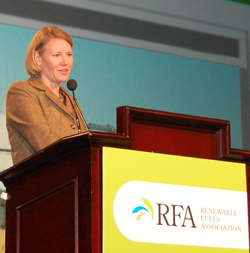
Chairman Chris Standlee of Abengoa Bioenergy talks about the mood at the event, RFA’s new membership award, and developments toward second generation ethanol. President and CEO Bob Dinneen discusses how the industry fared in 2009, the new RFS2 rule from EPA, and the importance of keeping ethanol incentives in place to continue growth.

You can subscribe to this twice monthly podcast by following this link.

Listen to or download the podcast here:

Audio, Ethanol, Ethanol News, Ethanol Report, RFA

EPA Official Explains RFS2 at Ethanol Conference

Cindy Zimmerman

2010 National Ethanol Conference Photo Album

The new rule for the expanded Renewable Fuel Standard, fresh out of the box just two weeks ago, was the main topic of discussion at the Renewable Fuels Association’s 15th National Ethanol Conference in Orlando. Sarah Dunham, Transportation and Regional Programs Division Director with the U.S. Environmental Protection Agency, boiled down the guts of the new RFS2 in a 45 minute presentation that highlighted changes made in lifecycle analysis determinations from the rule as originally proposed.

“I can safely say that this is the area we got more comment than any other area in the rule,” Dunham said, calling it very constructive and helpful to get real data and science to apply to the rule. This led to “significant” decreases in estimates of international indirect land use change related to biofuels production, “more than 50-60-70 percent in some cases,” she added. Using corn ethanol as an example, she noted that the final rule factored in both increasing yields and the value of co-products, which had not been in the original model

Dunham also talked about how EPA addressed “uncertainty” in their analysis. “There is inherent uncertainty in these assessments,” she said. “And we thought it was important to try to formally recognize that uncertainty” and incorporate it into the analysis. The assessments will be updated over the next two years as more information becomes known.

The regulations for RFS2 are scheduled to go into effect on July 1 and between now and then EPA will be working with the Renewable Fuels Association and the biofuels industry in general to conduct workshops to help inform producers about the new rule and what it means to them.

If you are in the industry, it is worth listening to Sarah’s presentation, including answers to questions at the end asked by moderator Charles Knauss with Bingham McCutchen LLP. Listen to the audio in the player below and you can see screen shots of some of the slides she references in the NEC conference photo album.

Audio, Ethanol, Ethanol News, Government, National Ethanol Conference, RFA

US-China Group Announces $1.5 Bil Texas Wind Project

John Davis

Two American companies have teamed with a Chinese company for a $1.5 billion West Texas wind farm project.

The Austin (TX) Business Journal says Texas-based Cielo Wind Power and U.S. Renewable Energy Group out of Washington, DC have teamed with Shenyang, China-based A-Power Energy Generation Systems Ltd. subsidiary Shenyang Power Group for a 36,000 acre wind farm:

A-Power will begin shipping wind turbines in March and deliver all units by the same month of 2011. Its subsidiary, Shenyang Power, is contributing $36.6 million to the project, which is expected to produce about 600 megawatts of energy.

Shenyang and U.S. Renewable Energy formed a separate Delaware LLC to own, design, develop, construct, manage and operate the wind turbines, according to the release. A Cielo affiliate will also assist in development.

This is one of the world’s first Chinese-American utility-scale wind power projects, able to produce enough electricity to power 180,000 homes while creating hundreds of U.S. jobs.

Wind