

A California-based producer of renewable oil from algae production products is getting ready to ship a system that uses a single step to get the oil out of the green pond scum to one of its customers down under.
OriginOil, Inc. has notified Australian MBD Energy Limited that it is ready to ship a Single-Step Extraction™ System (seen in the video below), a cheaper method of algae-oil extraction that eliminates the use of petrochemicals or alcohol solvents and is the second product to be delivered in its multi-phase commercialization agreement:
OriginOil Extracts Oil from Algae Timelapse from OriginOil on Vimeo.
“We believe OriginOil’s concentration and extraction technology holds promise of reducing costs and energy requirements in the algae harvesting process,” said Andrew Lawson, Managing Director at MBD Energy Ltd. “We look forward to now using the equipment we’ve purchased from OriginOil to finalize preparations for our 1 hectare Bio CCS algal synthesizer test facility we’re about to construct at Tarong Power Station in Queensland. If performance tests go to plan we expect to later expand the 1 hectare synthesizer to 80 hectares at which point we hope to produce approximately 10,000 tonnes of oil per year.”
OriginOil’s unit is the second product to be shipped in the test phase of a multi-phase commercialization program under which OriginOil has agreed to supply MBD Energy with progressively larger installations of its algae-to-oil technology as the scale of MBD’s algal synthesizer projects grows. The two products are supplied under a 1 year lease-to-own program. Subject to achieving success in the initial test phase, MBD will purchase significantly larger systems to serve its power station projects in Australia, beginning with the 1 hectare algal synthesizer test plant at Tarong Power Station in South Eastern Queensland, and potentially expanding to full production at all three of MBD’s power station project sites in Australia.
MBD Energy officials say that each of its power station projects can grow 80 hectare commercial pilot plants for algae, each capable of producing about 3 million gallons of oil that can be used for renewable energy and plastics, as well as producing 25,000 tonnes of animal feed each year. Furthermore, the plants could eventually be expanded to 1,500 hectares each, feeding the the algae with the power station’s flue-gas emissions.

 Under the sale, BP acquires the Jennings, LA biofuel pilot plant and the demonstration facility, as well as the San Diego R&D facilities. BP also receives Vereniums cellulosic biofuels and enzyme technologies and related IP. Verenium retains its commercial enzyme business, including its biofuels enzymes products and has the right to develop its own lignocellulosic enzyme program. Verenium will also retain select R&D capabilities, as well as rights to access select biofuels technology developed by BP using the technology it is acquiring from Verenium through this agreement.
 With the stock market continuing to flounder, these speculators are positioning themselves for another bull run on agricultural commodities and crossing their fingers that corn prices go higher. They’ve laid down their bets that the drought in Russia and flood-induced crop failures in Pakistan will leave the world short of grain and spur demand and prices for U.S. grains. As clearly demonstrated by the 2008 commodities bubble, supply-demand fundamentals take a back seat to frenzied speculation when this many trigger-happy gamblers are in the market. Don’t be surprised if even the slightest hints of higher demand for U.S. crops or lower-than-expected U.S. supply touches off speculative hysterics not seen since the spring and summer 2008. If a speculative rally on corn does come to pass this fall, let’s at least hope that the pundits recognize the role of speculators and avoid immediately jumping to the conclusion—as they did in 2008—that biofuels had anything to do with it.


 It was the “Bill and Tom Show” at the 2010 Farm Progress Show on Wednesday as
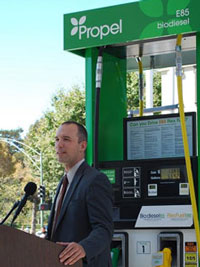 At the grand opening, California Energy Commissioner Anthony Eggert (pictured) said the station development project, known as the Low Carbon Fuel Infrastructure Investment Initiative (LCFI3), will help the state with the development and deployment of low carbon fuels and clean vehicles. “The Energy Commission is proud to team up with Propel Fuels and the partner agencies to bring next generation low carbon biofuels, including cellulosic ethanol, to the nearly half a million flex fuel vehicle customers in California, while creating hundreds of green jobs, and continuing to lead the way in our nation’s battle against climate change,” said Eggert.
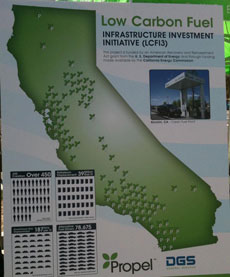 “Presently in California more than one million diesel and Flex Fuel passenger cars are capable of running on renewable fuels, but there hasn’t been a sufficient number of renewable fuel stations,” said John Boesel, President and CEO of CALSTART. “This program takes a major step forward by creating 75 new renewable stations which will give consumers the choice to say ‘no’ to oil dependence, ‘yes’ to the American economy and ‘yes’ to the environment.”

 In the latest