

The Renewable Fuels Association (RFA) recently debuted a new blog on their website that offers commentary from RFA staffers on various topics.
 The E-Xchange Blog debuted earlier this summer and the staff have proven to be quite prolific in their posting. We are going to start featuring posts from the blog as a regular feature here on Domestic Fuel.
Speculators returning to the grain market is the topic of the most recent post by RFA Vice President for Research Geoff Cooper, who notes that “hedge and index fund investors have quietly returned to the agricultural commodities market in droves over the past few weeks.”
 With the stock market continuing to flounder, these speculators are positioning themselves for another bull run on agricultural commodities and crossing their fingers that corn prices go higher. They’ve laid down their bets that the drought in Russia and flood-induced crop failures in Pakistan will leave the world short of grain and spur demand and prices for U.S. grains. As clearly demonstrated by the 2008 commodities bubble, supply-demand fundamentals take a back seat to frenzied speculation when this many trigger-happy gamblers are in the market. Don’t be surprised if even the slightest hints of higher demand for U.S. crops or lower-than-expected U.S. supply touches off speculative hysterics not seen since the spring and summer 2008. If a speculative rally on corn does come to pass this fall, let’s at least hope that the pundits recognize the role of speculators and avoid immediately jumping to the conclusion—as they did in 2008—that biofuels had anything to do with it.
Cooper gives a nice analysis of what happened in 2008 when oil, gas, and corn prices skyrocketed and then the bubble burst and what is happening right now in the market.
Speculators are returning to the agricultural commodities markets in numbers not seen since the weeks leading up to the spectacular bursting of the 2008 bubble. In fact, the Commodity Futures Trading Commission’s (CFTC) latest Commitments of Traders report shows speculative investors hold as many corn futures contracts today as they did at the height of the 2008 bubble. Not since May 2008 have “non-commercial” investors (CFTC’s parlance for “speculators”) held as many net long positions as they do today (long, or “bullish,” positions are contracts that are purchased and held in the hope of profiting from an increase in prices). Speculators held 358,000 net long positions on corn last week, which is the equivalent of 1.8 billion bushels. That compares to a previous high of 360,000 net longs in mid-May 2008, at the height of the bubble.



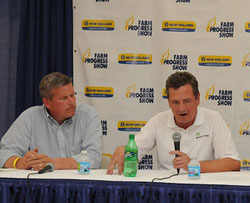 It was the “Bill and Tom Show” at the 2010 Farm Progress Show on Wednesday as
 At the grand opening, California Energy Commissioner Anthony Eggert (pictured) said the station development project, known as the Low Carbon Fuel Infrastructure Investment Initiative (LCFI3), will help the state with the development and deployment of low carbon fuels and clean vehicles. “The Energy Commission is proud to team up with Propel Fuels and the partner agencies to bring next generation low carbon biofuels, including cellulosic ethanol, to the nearly half a million flex fuel vehicle customers in California, while creating hundreds of green jobs, and continuing to lead the way in our nation’s battle against climate change,” said Eggert.
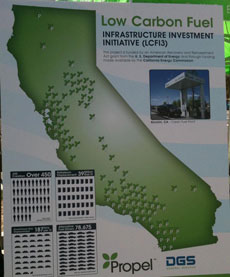 “Presently in California more than one million diesel and Flex Fuel passenger cars are capable of running on renewable fuels, but there hasn’t been a sufficient number of renewable fuel stations,” said John Boesel, President and CEO of CALSTART. “This program takes a major step forward by creating 75 new renewable stations which will give consumers the choice to say ‘no’ to oil dependence, ‘yes’ to the American economy and ‘yes’ to the environment.”

 In the latest
 Mascoma CEO Bill Brady says the two companies share a common vision of converting cellulosic biomass to fuel in a low-cost, sustainable way. “The combined company has extensive commercial experience, with the application of our technologies around the world, and the technology breadth to offer a complete biofuels solution. We believe the combination of Mascoma and SBI significantly advances our capabilities in the cellulosic ethanol field and positions us for a successful future.”