

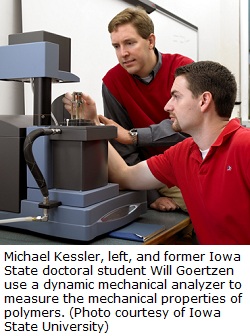
 Researchers at Iowa State University are developing polymers made from vegetable oils that repair themselves.
This press release from the school says Michael Kessler, an Iowa State University professor and an associate of the U.S. Department of Energy’s Ames Laboratory, is working on the technology:
“If successful, the results of this research will provide biorenewable alternatives to petroleum-based resins,” says a summary of Kessler’s research project. Successfully developing the concept “should have a huge impact economically and environmentally.”
Kessler’s research project is supported by a five-year, $400,000 grant from the National Science Foundation’s Faculty Early Career Development Program…
The technology has evolved into a system that embeds catalysts and microcapsules containing a liquid healing agent within a composite. As cracks develop in the composite, they rupture the microcapsules and release the healing agent. The healing agent contacts the catalyst and reacts by forming 3-D polymer chains that fill the cracks. That increases material lifetimes and reduces maintenance.
Kessler has collaborated with fellow Iowa State and Ames Laboratory researcher Richard Larock, who has invented and patented a process for producing various bioplastics from inexpensive natural oils, which make up 40 percent to 80 percent of the plastics.



 “EPA’s decision today is a sound one, but it doesn’t address the issues that still remain regarding a segmented market place and the introduction of a new fuel,” said RFA President Bob Dinneen. “The RFA will continue to work with EPA and other regulatory bodies to expand ethanol use beyond even 15%. Simultaneously, we will continue our dialogue with lawmakers to develop and implement sound, tax-based policies that provide the proper incentives to grow ethanol use across a variety of blending levels.”
 “Today’s decision greenlights the use of E15 for nearly two out of every three cars on the road today and furthers proves ethanol is a safe, effective fuel choice for American drivers,” said Renewable Fuels Association President Bob Dinneen. “EPA continues to move in the right direction with respect to increasing ethanol blends, but challenges still remain. The RFA continues to urge EPA to extend the waiver for E15 use to all cars and pickups.”
 Brian Jennings, Executive Vice President of the American Coalition for Ethanol (ACE), says the move is another important step in making more renewable fuel choices available to consumers. “ACE continues to be confident that the scientific evidence proves E15 is safe and reliable for all cars, and is disappointed that EPA continues to insist of this confusing model-year division, especially when models earlier than 2000 are being excluded without scientific evidence of any issues with using E15 in those vehicles,” said Jennings. “We are pleased with this positive step, but remain concerned about the unnecessary confusion that will unfortunately be caused by EPA’s piecemeal, partial-waiver approach.”
 The U.S. Environmental Protection Agency (EPA) today waived a limitation on selling gasoline that contains more than 10 percent ethanol for model year (MY) 2001 through 2006 passenger vehicles, including cars, SUVs, and light pickup trucks. The waiver applies to fuel that contains up to 15 percent ethanol – known as E15. EPA Administrator Lisa P. Jackson made the decision after a review of the Department of Energy’s thorough testing and other available data on E15’s effect on emissions from MY 2001 through 2006 cars and light trucks.
 A delegation of representing Michigan ethanol producers hit Capitol Hill on Thursday for a series of meetings with members of Congress and their staff. The fly-in, organized by

