ACE Conference 2026

New Study Shows Energy Efficiency of Soy Biodiesel

Cindy Zimmerman

A new study shows that biodiesel offers an amazing 5-to-1 return over fossil energy sources.

The study by the University of Idaho and U.S. Department of Agriculture concludes that for every unit of fossil energy needed to produce biodiesel, the return is 5.54 units of renewable energy. This energy-in, energy-out ratio is called “energy balance” or “fossil energy ratio.”

“This study shows the clear trend that biodiesel production continues to improve when it comes to efficient use of resources,” said Don Scott, director of sustainability for the National Biodiesel Board. “No other fuel available in the U.S. comes close to such a high energy balance.”

Scott noted the most recent data available for this study was from 2006. “Using data from 2009 or 2010 would likely show an even greater gain in energy efficiency,” he said.

Read the study here.

Biodiesel

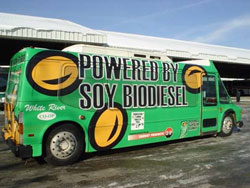
First Biodiesel School Bus Retires

Cindy Zimmerman

What is believed to be the nation’s first school bus to run on a biodiesel blend was put out to pasture at the end of the 2010-11 school year, according to the National Biodiesel Board.

When Medford, New Jersey’s 1998 International school bus retired at the end of June, it reached a milestone in the process. The bus was the first in New Jersey, and possibly the country, to be filled with B20.

Over the course of its life, it consumed over 28,000 gallons of biodiesel and exposed hundred of young people to a cleaner-burning advanced biofuel that not only helped protect their health, but hopefully taught them something about the importance of alternative fuels.

“Similar to the biodiesel industry, the bus certainly bears the marks of a traveling a long and difficult path and weathering a number of storms,” said Joe Biluck, Director of Operations and Technology for the Medford Township Public School district. “The industry has made monumental strides over the past 13 years. Since then, thousands of public and private fleets have made the switch to biodiesel blends in an effort to lessen their environmental impact.”

“Without early support from people like Biluck, the industry wouldn’t be where it is today,” said NBB Chairman Gary Haer. “As America’s only commercially available advanced biofuel, biodiesel stands ready to help meet our energy challenges for years to come.”

The National Biodiesel Board awarded Biluck its annual Inspiration award in 2005.

Biodiesel, NBB

Effort to Block 15% Ethanol Waiver in the House

Cindy Zimmerman

An effort that would prevent the U.S. Environmental Protection Agency from implementing its approved waiver for E15 ethanol blends in America’s fuel supply is being led by Reps. John Sullivan (R-OK) and Gary Peters (D-MI).

Growth Energy CEO Tom Buis says they intend to fight against an amendment to the FY 2012 Department of the Interior and EPA funding bills that would block EPA from moving forward with the regulatory decision made in January approving E15 for all vehicles built in the last decade. “The Sullivan/Peters amendment picks politics over science,” Buis said in a statement. “Voting for this amendment is like voting to keep our nation addicted to foreign oil and all the economic and military consequences of that addiction.”

The amendment is expected to be printed in the record today and could come up for a vote later this week.

Ethanol, Government, Growth Energy

Canadian Waste Oil Biodiesel Facility to Open

Cindy Zimmerman

A commercial-scale biodiesel processing facility is opening this week in the Cowichan Valley of Vancouver Island, Canada

For the past six years, the Cowichan Bio-Diesel Co-operative has been supplying its members with 100% biodiesel processed elsewhere from recycled cooking oil. With the introduction of this new community biodiesel processor, the co-op will now be taking waste cooking oil from area residents and restaurants and processing it into biodiesel themselves. The co-op’s motto is “We eat locally, and so do our cars.”

The grand opening event for the facility will be on Wednesday.

Biodiesel

DOE Biomass Conference This Week

Cindy Zimmerman

Energy Secretary Steven Chu and Agriculture Secretary Tom Vilsack will keynote the Department of Energy 4th annual Biomass Conference on Tuesday.

This year’s conference, Biomass 2011, will focus on topics surrounding the use of biomass as a replacement for petroleum to supply the energy, products, and power markets. The Biomass 2011 theme will explore the new horizons of bioenergy technologies and deployment strategies, business practices, policies, and partnerships that will help sustainably transform the energy landscape.

Among those on the conference agenda is POET’s Project LIBERTY Director Jim Sturdevant who will outline the company’s vision for expanding the reach of its technology to other ethanol producers and new feedstocks. He will also show how the industry will spread to make every state an energy-producing state and what that will mean for America’s economy. Sturdevant will join Richard Wynne, Director of Environment and Aviation Policy for Boeing Company; Henry Bryndza, Director of Biochemical Science and Engineering for DuPont and Mark Maher, General Motors Executive Director for Powertrain and Vehicle Integration in a plenary session “Industry Perspectives on Bioenergy” on Wednesday morning.

biomass, Ethanol, Ethanol News, Government, POET

Elsevier Biofuel Launched to Guide Innovation

Joanna Schroeder

A new tool is now available for biofuel managers and research development professionals to help solve innovation challenges. Elsevier Biofuels is an unique online search and discovery tool that gives companies access to the highest level of scientific, industrial and commercial information that can be utilized by companies to assist them in solving problems or make key decisions.

“BioEnergy RD&D (Research, Development and Demonstration) is a complex interdisciplinary challenge,” said Marcus Gay, biofuels information consultant, Elsevier Biofuels. “As a former BioEnergy R&D manager I am acutely aware of the technical, economic and commercial challenges faced by professionals in the industry. Elsevier’s Biofuel Information Discovery Tool pulls together scientific and commercial information enabling researchers to have this critical binocular vision during every stage of the development process.”

Using keywords, users can drill down to needed data and information. They can also tap into the Elsevier Biofuel Tree Thesaurus where more than 900 journals, 800 books, and 5.8 million patent documents are available. The platform also allows users to compare high-quality data specific to the biofuels industry including: solve problems with existing scientific knowledge; research new, promising advanced technologies; compare applicable approved pathways and methodologies; and minimize waste in resources.

“Having tested the beta version of Elsevier Biofuels discovery tool thoroughly, it became immediately apparent how limiting the information returned from internet only search is, by comparison,” said Dr. Skye Thomas-Hall, Senior Scientist, Cellana LLC. “The combination of high quality journal, book and patent information in one location, is a huge advantage that increased my efficiency by at least 15-20%.”

biofuels, Education

Some Skepticism About USDA Acreage Predictions

Chuck Zimmerman

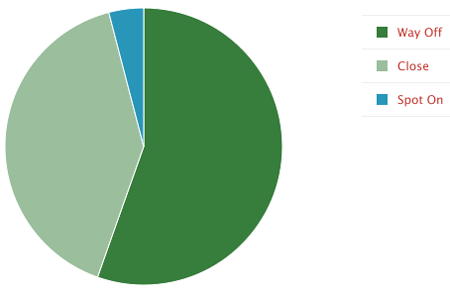
The majority of you who responded to our latest ZimmPoll think USDA’s acreage predictions are way off. We asked the question, “How accurate do you believe the USDA acreage predictions are?” 55% said Way Off while 41% said Close and 4% said Spot On. So there you have it. Take ’em with a grain of salt. Hey, they’re a prediction after all. Does anyone know what the future looks like?

Our new ZimmPoll is now live. We’re asking the question, “Are you worried about how government regulations will hurt your business?” This is a big topic in Washington, DC right now and applies to all businesses. Please chime in and let the world know what you think. Thanks.

ZimmPoll is sponsored by Rhea+Kaiser, a full-service advertising/public relations agency.

ZimmPoll

Buses in São Paulo to Use Sugarcane Diesel

Joanna Schroeder

Sugarcane is not just for ethanol. Amryis Brasil S.A., the Brazilian arm of Amyris, has announced that it will be supplying 160 city buses in São Paulo with its Diesel de Cana, or renewable diesel produced from sugarcane. Beginning this August and expiring at the end of 2012, buses operated by the Viação Santa Brígida will run on a blend of 10 percent Diesel de Cana, with the remaining fuel blend comprised of biodiesel and petroleum diesel supplied by Petrobrás Distribuidora.

“Following the successful launch of our first industrial scale production facility and the positive results of the fleet testing in Brazil, we are thrilled to be a commercial supplier of renewable fuel for buses in Brazil’s largest city. Over the next year, as we expand our fuel supply agreements with bus fleets in São Paulo, we expect to achieve $10-12 million in annual diesel sales,” said John Melo, CEO of Amyris.

São Paulo currently has more than 15,000 buses that burn nearly 450 million liters of diesel per year. The move to Diesel de Cana signals the city’s commitment to reducing its fossil fuel use by 10 percent each year through 2018.

Melo continued, “Brazil’s growing demand for low-sulfur diesel creates a significant opportunity to highlight the superior performance and benefits of our renewable diesel while allowing the country to reduce diesel fuel imports, which comprised nearly 20 percent of Brazil’s diesel needs in 2010.”

The fuel has been tested by SPTrans, Mercedes-Benz, Petrobrás Distribuidora, and Viação Santa Brígida and the results show that when a 10 percent blend of Diesel de Cana is added to a B5 S50 blend, the fuel can lower smoke up to an additional 40 percent. Commercial vehicle manufacturers, including Mercedes-Benz have issued warranties for the B10 Diesel de Cana blend.


Biodiesel, biofuels, Brazil

Algae Meal Performs as Dairy Cattle Feed

Joanna Schroeder

With the demand for meat rising in countries like China and India, there is a shortage of protein in the marketplace. Therefore, one of the hopeful co-products of algal biofuels is algae meal. PetroAlgae has announced that after completion of a third-party feed trial, its micro-crop meal performs as well as alfalfa in dairy cattle diets. The global market for dairy feed from alfalfa alone is estimated at 400 million metric tons by the United Nations Food and Agriculture Organization.

The study encompassed a continuous 6-week feeding trial of a statistically significant sample of 36 dairy cows living in barns housed at the University of Minnesota. It measured the algae meal against a 17.5 percent protein alfalfa diet and measured nutrient intake, milk yield and composition. With the positive results, PetroAlgae anticipates its micro-crop meal will be highly competitive in the feed market.

The University of Minnesota study is the first to validate PetroAlgae micro-crop meal in the dairy diet against the industry standard. Several key findings included algae meal having higher dairy efficiency values, higher energy values than alfalfa, and algae meal matched the alfalfa diet in milk, milk yield, body score, and body weight.

“The results of this study show that PetroAlgae micro-crop meal is a desirable ingredient for high producing dairy cattle and that it performed comparably to high-protein alfalfa meal,” said Dr. Noah Litherland, who performed the study at the University of Minnesota. “We are encouraged to see this product perform so well against one of the more universally understood products in dairy nutrition.”

Litherland added, “There is also an intriguing opportunity to alter the lipid composition of the meat and milk for added human health benefit.”

Agribusiness, algae

Clean Energy Policies Could Boost Midwest Economies

Joanna Schroeder

According to a new report from the Union of Concerned Scientists (UCS), clean energy policies would boost Midwestern economies. Last week, the Brookings Institution released a study that found the private-sector “green” economy in the Midwest already employs nearly 40,000 people. However, “A Bright Future for the Heartland: Powering the Midwest Economy with Clean Energy,” estimates that this number is already higher and will continue to grow.

In particular, the report found that the Midwest has great potential to produce electricity from renewable resources including wind, biomass and solar. Iowa is already the leading state for wind and biofuels and other Midwestern states like Minnesota are following close behind. The UCS report says that renewable energy has the ability to cut home and business energy bills, drive billions of dollars in new business investment and create thousands of jobs. All of this can happen, says the report, while reducing the use of energy created by coal.

“Adopting stronger clean energy standards can help transform the region’s economy,” said Steven Frenkel, director of UCS’s Midwest office. “Generating more renewable energy will put people back to work manufacturing the components needed to power the clean energy economy, such as wind turbines and solar panels. At the same time, reducing energy use can help keep Midwest businesses competitive by cutting their energy costs.”

The study analyzes the possible impact of a clean energy strategy that would help the economy. The duo approach includes policy combined with the adoption of energy efficient technologies. More specifically, the “proposed” policy would require 30 percent of each state’s electricity to come from renewable sources by 2030 coupled with the goal of a 2 percent reduction in annual power consumption by 2015 with an additional 2 percent reduction each following year. The study also found that while individual state policies can have an impact, the greatest achievement would happen if all states acted together.

Claudio Martinez, UCS energy analyst and report author added, “Few places in the world have the combination of a great renewable energy potential, a strong manufacturing base and the skilled workforce needed to realize that potential. And the Midwest is one of those places.”

bioenergy, Electricity, Energy, Research, Solar, Wind